
Comparison MaXpeedingRods MXR3800DF vs MaXpeedingRods MXR3500
Add to comparison |  | 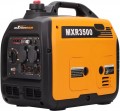 |
|---|---|---|
| MaXpeedingRods MXR3800DF | MaXpeedingRods MXR3500 | |
| Expecting restock | Compare prices 1 | |
| User reviews | ||
| TOP sellers | ||
| Fuel | petrol / gas | petrol |
| Output voltage | 230 B | 230 B |
| Rated power | 3.2 kW | 3 kW |
| Max. power | 3.5 kW | 3.5 kW |
| Alternator | inverter | inverter |
| Alternator winding | copper | |
Engine | ||
| ICE type | 4-stroke | 4-stroke |
| Engine size | 145 cm³ | 145 cm³ |
| Fuel consumption (50% load) | 0.6 l/h | 0.89 l/h |
| Fuel tank volume | 4 L | 4 L |
| Fuel level indicator |  |  |
| Starter type | manual | manual |
| Motor cooling | air | air |
Connection (sockets) | ||
| Total number of sockets | 1 | 2 |
| Sockets 230 V | 16 A x1 | 16 A x2 |
| USB charging port | | |
| Output 12 V | cigarette lighter | |
Features | ||
| Features | display hour metre voltmeter parallel connection | parallel connection |
General | ||
| Sound insulation cover | | |
| Sound level (7 m) | 58 dB | 58 dB |
| Dimensions | 480x305x440 mm | 510x320x475 mm |
| Weight | 25 kg | 21.5 kg |
| Added to E-Catalog | january 2026 | january 2023 |



Compare MaXpeedingRods MXR3800DF and MXR3500
Price comparison
You may be interested in
My comparisons
MaXpeedingRods MXR3500 often compared


Glossary
Fuel
The type of fuel that the generator's engine runs on.
— Gasoline. One of the main types of fuel for internal combustion engines. Gasoline generators are usually cheaper than diesel generators, all other things being equal, but they are more expensive to run due to the higher price of gasoline; in addition, they usually have a shorter resource than diesel ones. Therefore, it is believed that gasoline generators are well suited primarily as a backup power source in case of a power outage.
— Diesel. Diesel generators are usually more expensive than their gasoline counterparts; on the other hand, diesel fuel is cheaper than gasoline, so the increased cost may well pay off with regular use. In addition, diesel generators have a longer resource and a larger power range than gasoline ones. This allows them to be used as both backup and main power sources, including at rather "energy-intensive" objects.
— Gas. The advantages of gas-fired generators are relatively low noise levels and low emissions. On the other hand, the use of gas as a fuel is associated with certain difficulties: it is necessary to connect to a gas pipeline or regularly replace special cylinders, the fuel system is especially sensitive to leaks, etc. Therefore, there are relatively few such models produced, and most of them are stationary high power generators, in which the mentioned disa...dvantages are covered by the advantages.
- Gasoline / gas. Models capable of using both types of fuel indicated. This gives the user the opportunity to choose the option that best suits a particular situation, and also reduces the likelihood of being left without fuel at the most inopportune moment; on the other hand, such models are more expensive than single-fuel ones. The technical features of gasoline and gas are described in detail above.
— Gasoline. One of the main types of fuel for internal combustion engines. Gasoline generators are usually cheaper than diesel generators, all other things being equal, but they are more expensive to run due to the higher price of gasoline; in addition, they usually have a shorter resource than diesel ones. Therefore, it is believed that gasoline generators are well suited primarily as a backup power source in case of a power outage.
— Diesel. Diesel generators are usually more expensive than their gasoline counterparts; on the other hand, diesel fuel is cheaper than gasoline, so the increased cost may well pay off with regular use. In addition, diesel generators have a longer resource and a larger power range than gasoline ones. This allows them to be used as both backup and main power sources, including at rather "energy-intensive" objects.
— Gas. The advantages of gas-fired generators are relatively low noise levels and low emissions. On the other hand, the use of gas as a fuel is associated with certain difficulties: it is necessary to connect to a gas pipeline or regularly replace special cylinders, the fuel system is especially sensitive to leaks, etc. Therefore, there are relatively few such models produced, and most of them are stationary high power generators, in which the mentioned disa...dvantages are covered by the advantages.
- Gasoline / gas. Models capable of using both types of fuel indicated. This gives the user the opportunity to choose the option that best suits a particular situation, and also reduces the likelihood of being left without fuel at the most inopportune moment; on the other hand, such models are more expensive than single-fuel ones. The technical features of gasoline and gas are described in detail above.
Rated power
The nominal power of a generator is the highest power that the unit can supply without problems for an unlimited period of time. In the “weakest” models, this figure is < 1 kW, in the most powerful ones – 50–100 kW and even more ; and generators with welding capabilities (see below) usually have a nominal power from 1–2 kW to 8–10 kW.
The main rule of choice in this case is as follows: the nominal power must not be lower than the total power consumption of the entire connected load. Otherwise, the generator will simply not be able to produce enough energy, or will work with overloads. However, to determine the minimum required generator power, it is not enough to simply add up the number of watts indicated in the characteristics of each connected device - the calculation method is somewhat more complicated. Firstly, it should be taken into account that only the active power of various equipment is usually indicated in watts; in addition, many AC electrical appliances consume reactive power ("useless" power consumed by coils and capacitors when working with such power). And the actual load on the generator depends on the total power (active plus reactive), indicated in volt-amperes. There are special coefficients and formulas for its calculation.
The second nuance is related to the power su...pply of devices in which the starting power (and, accordingly, the power consumption at the moment of switching on) is significantly higher than the nominal one - these are mainly devices with electric motors such as vacuum cleaners, refrigerators, air conditioners, power tools, etc. You can determine the starting power by multiplying the standard power by the so-called starting coefficient. For equipment of the same type, it is more or less the same - for example, 1.2 - 1.3 for most power tools, 2 for a microwave oven, 3.5 for an air conditioner, etc.; more detailed data can be found in special sources. Starting load characteristics are necessary primarily to assess the required maximum generator power (see below) - however, this power is not always given in the characteristics, often the manufacturer indicates only the nominal power of the unit. In such cases, when calculating for equipment with a starting coefficient of more than 1, it is worth using the starting power, not the nominal power.
Also note that if there are several sockets, the specific division of the total power between them may be different. This point should be clarified separately - in particular, for specific types of sockets (for more details, see "230 V sockets", "400 V sockets").
The main rule of choice in this case is as follows: the nominal power must not be lower than the total power consumption of the entire connected load. Otherwise, the generator will simply not be able to produce enough energy, or will work with overloads. However, to determine the minimum required generator power, it is not enough to simply add up the number of watts indicated in the characteristics of each connected device - the calculation method is somewhat more complicated. Firstly, it should be taken into account that only the active power of various equipment is usually indicated in watts; in addition, many AC electrical appliances consume reactive power ("useless" power consumed by coils and capacitors when working with such power). And the actual load on the generator depends on the total power (active plus reactive), indicated in volt-amperes. There are special coefficients and formulas for its calculation.
The second nuance is related to the power su...pply of devices in which the starting power (and, accordingly, the power consumption at the moment of switching on) is significantly higher than the nominal one - these are mainly devices with electric motors such as vacuum cleaners, refrigerators, air conditioners, power tools, etc. You can determine the starting power by multiplying the standard power by the so-called starting coefficient. For equipment of the same type, it is more or less the same - for example, 1.2 - 1.3 for most power tools, 2 for a microwave oven, 3.5 for an air conditioner, etc.; more detailed data can be found in special sources. Starting load characteristics are necessary primarily to assess the required maximum generator power (see below) - however, this power is not always given in the characteristics, often the manufacturer indicates only the nominal power of the unit. In such cases, when calculating for equipment with a starting coefficient of more than 1, it is worth using the starting power, not the nominal power.
Also note that if there are several sockets, the specific division of the total power between them may be different. This point should be clarified separately - in particular, for specific types of sockets (for more details, see "230 V sockets", "400 V sockets").
Alternator winding
— Copper. Copper winding is typical for advanced class generators. The copper alternator is characterized by high conductivity and low resistance. The conductivity of copper is 1.7 times higher than the conductivity of aluminium, such a winding heats up less, and compounds made of this metal endure temperature drops and vibration loads. Among the disadvantages of the copper winding, one can only note the high cost of the alternator. Otherwise, generators with copper winding have high reliability and durability.
— Aluminium. The aluminium winding of the alternator is typical for low-cost-class generators. The main advantages of aluminium are light weight and low price; otherwise, such a winding is usually inferior to copper counterparts. An oxide film is created on the surface of aluminium, it appears everywhere, even in the places of contact soldering. The oxide film undermines the contacts and does not allow the outer protective braid to securely hold the aluminium conductors.
Fuel consumption (50% load)
Fuel consumption of a petrol or diesel generator when operating at half power, and for combined models when using petrol (see “Fuel”).
Fuel consumption usually increases with load. However, generator efficiency is not always linear - fuel consumption may vary disproportionately with different loads. In this case, the approximate amount of fuel consumed by the generator when operating at half power (50% of the rated power) is given. Knowing the fuel consumption and tank capacity, you can at least estimate how long one fill-up will last.
Fuel consumption usually increases with load. However, generator efficiency is not always linear - fuel consumption may vary disproportionately with different loads. In this case, the approximate amount of fuel consumed by the generator when operating at half power (50% of the rated power) is given. Knowing the fuel consumption and tank capacity, you can at least estimate how long one fill-up will last.
Fuel level indicator
A pointer that allows you to monitor the remaining fuel in the generator tank. The simplest such indicators work only with a critical decrease in the level of fuel, warning of the need for refueling; more advanced ones constantly display the remainder. However, anyway, this feature makes it easier to keep track of the fuel supply and reduces the risk of a generator shutdown due to a forgotten refueling.
Total number of sockets
The total number of sockets for 230 and/or 400 V provided in the design of the generator.
This number corresponds to the number of devices that can be simultaneously connected to the generator without using splitters, extension cords, etc. If it is a three-phase model (see "Output voltage") with different types of sockets, it is worth specifying the quantity of each type separately, as different models may have varying configurations. For example, a unit specified as having 3 sockets might have 1 three-phase socket and 2 single-phase ones, or 2 three-phase and 1 single-phase socket. Generally, the most basic modern generators have only 1 socket, though models with 2 sockets are more common; and the most powerful models can have 4 or more sockets.
It is also important to remember that the ability to connect various devices is limited not only by the number of sockets but also by the generator's rated power (see above for more details).
This number corresponds to the number of devices that can be simultaneously connected to the generator without using splitters, extension cords, etc. If it is a three-phase model (see "Output voltage") with different types of sockets, it is worth specifying the quantity of each type separately, as different models may have varying configurations. For example, a unit specified as having 3 sockets might have 1 three-phase socket and 2 single-phase ones, or 2 three-phase and 1 single-phase socket. Generally, the most basic modern generators have only 1 socket, though models with 2 sockets are more common; and the most powerful models can have 4 or more sockets.
It is also important to remember that the ability to connect various devices is limited not only by the number of sockets but also by the generator's rated power (see above for more details).
Sockets 230 V
The number of 230 V sockets provided in the design of the generator, as well as the type of connectors used in such sockets.
The type of connector in this case is indicated by the maximum power that is allowed for the outlet - for example, “2 pieces for 16 A”. The most popular options for 230-volt outlets are 16 A, 32 A, and 63 A. We emphasize that amperes in this designation are not the actual power that the generator can produce, but the outlet’s own limitation; the actual power value is usually noticeably lower. Simply put, if, for example, the generator has a 32 A socket, the output power on it will not reach 32 A; and the specific number of amperes will depend on the rated and maximum power of the unit (see above). So, if for our example we take a rated power of 5 kW and a maximum of 6 kW, then to a 230 V outlet such a generator will be able to produce no more than 5 kW / 230 V = 22.7 A standard and 6 kW / 230 V = 27, 3 A at its peak. And if the power has to be divided between several outlets, then it will accordingly be even less.
As for specific types of connectors, the higher the power permissible for the outlet, the higher the requirements for its reliability and quality of protection. In light of this, as a rule, higher power outlets can be connected to lower power plugs (directly or through an adapter), but not vice versa. And if there are several sockets, by their type it i...s possible to estimate with some certainty the distribution of the entire power of the generator between them: between two identical sockets such power is usually divided equally, and more power is allocated to an socket with a larger number of amperes and power. However, specific details on this matter should be clarified separately in each case; It's also worth considering 400V outlets, if available (see below).
The type of connector in this case is indicated by the maximum power that is allowed for the outlet - for example, “2 pieces for 16 A”. The most popular options for 230-volt outlets are 16 A, 32 A, and 63 A. We emphasize that amperes in this designation are not the actual power that the generator can produce, but the outlet’s own limitation; the actual power value is usually noticeably lower. Simply put, if, for example, the generator has a 32 A socket, the output power on it will not reach 32 A; and the specific number of amperes will depend on the rated and maximum power of the unit (see above). So, if for our example we take a rated power of 5 kW and a maximum of 6 kW, then to a 230 V outlet such a generator will be able to produce no more than 5 kW / 230 V = 22.7 A standard and 6 kW / 230 V = 27, 3 A at its peak. And if the power has to be divided between several outlets, then it will accordingly be even less.
As for specific types of connectors, the higher the power permissible for the outlet, the higher the requirements for its reliability and quality of protection. In light of this, as a rule, higher power outlets can be connected to lower power plugs (directly or through an adapter), but not vice versa. And if there are several sockets, by their type it i...s possible to estimate with some certainty the distribution of the entire power of the generator between them: between two identical sockets such power is usually divided equally, and more power is allocated to an socket with a larger number of amperes and power. However, specific details on this matter should be clarified separately in each case; It's also worth considering 400V outlets, if available (see below).
Output 12 V
Existence in the generator of an output with a direct current and voltage of 12 V. The main function of this output is to charge car batteries, as well as power devices originally intended for cars (recall, 12 V is the standard voltage of on-board networks in cars).
The following types of 12-volt outputs are found in generators:
- Terminals. Terminals are used to connect wires directly without using any plugs. This connection is the most reliable.
- Socket. Socket outlet for a plug with two flat pins, designed to connect 12-volt consumers. Holes in sockets come in different layouts, which you need to pay attention to.
- Cigarette lighter. The so-called "car socket", which in many cars is combined with a cigarette lighter socket (hence the name). Such connectors are used to power various automotive devices and accessories.
The following types of 12-volt outputs are found in generators:
- Terminals. Terminals are used to connect wires directly without using any plugs. This connection is the most reliable.
- Socket. Socket outlet for a plug with two flat pins, designed to connect 12-volt consumers. Holes in sockets come in different layouts, which you need to pay attention to.
- Cigarette lighter. The so-called "car socket", which in many cars is combined with a cigarette lighter socket (hence the name). Such connectors are used to power various automotive devices and accessories.
Features
— 12V output. The presence of an output with direct power and voltage of 12 V in the generator. The main purpose of this output is to charge car batteries, as well as to power devices originally intended for cars (recall that 12 V is the standard voltage of on-board networks in passenger cars).
— USB charging port . The presence of a USB connector (one or more) on the generator for charging various devices. Most modern smartphones and tablets can be charged via USB, and this charging method is also found in many other devices — from cameras and flashlights to electric screwdrivers and radio-controlled models. The standard supply voltage through this connector is 5 V, but the power may be different, it should be specified separately.
— Smartphone control. Synchronization with a smartphone allows you to control the generator remotely. Thanks to this, the user does not need to approach the device to, for example, start or stop it. Additionally, synchronization with a smartphone allows you to monitor the parameters of the generated electric power remotely and in real time. On the other hand, this will require a constant connection to the Internet and specialized software that must be installed on the smartphone.
— Autostart (ATS). A function that allows the generator to turn on automatically under certain conditio...ns, without any action from the user. Autostart is mainly used when using the generator as a backup power source: while the main power is working, the unit is turned off, and if the voltage in the network disappears, ATS starts the engine, and power to the load begins to flow from the generator. Note that the presence of autostart is indicated only if the generator is initially equipped with an ATS electronic unit; models with the ability to connect such a unit are placed in a separate category (see below).
— ATS socket. A connector that allows you to connect an external autostart unit (ATS) to the generator; the unit itself is not included in the kit. For more information on autostart, see above; here we note that some users do not initially need this function, but may need it in the future — for example, if the generator is initially used for building a house, and then it is planned to be installed in the same house as a backup power source. In such situations, this configuration option will be optimal: when buying the generator itself, you will not have to overpay for the ATS unit, and later, if necessary, you can buy and connect such a unit separately.
— Automatic voltage regulator (AVR). An automatic regulator that allows maintaining a constant voltage level at the generator output. Such a regulator smooths out the differences that occur due to changes in the engine speed; this is especially important when connecting devices that are sensitive to power supply stability. It is worth noting that the presence of an AVR is almost mandatory for synchronous generators (see "Alternator"), but in other varieties this function is not found: in asynchronous and duplex units it is not applicable in principle, and in inverter units the role of the regulator is played by the inverter itself, and they do not require additional electronics.
— Display. A dedicated display mounted on the generator body. Typically, this is a simple LCD screen capable of displaying only numbers and some special symbols. However, even such a screen can display various useful information: voltage, frequency, engine hour meter data, low fuel warning, error code failure messages, etc. This makes control more convenient and visual.
— Hour metre. A device that counts the total time that the generator engine has been running since it was first turned on. This helps determine the overall wear of the engine and the need for repair/replacement, which can be useful both during long-term use of the device and, for example, to assess the quality of the product when buying a used generator. It is usually impossible to reset the hour meter without serious intervention in the design of the device.
— Voltmeter. A device that displays the power voltage produced by the generator. The voltmeter can be made in the form of a separate pointer scale, or its readings can be displayed on the generator's own display (see above). In any case, this function allows you to carefully monitor the unit's operating mode and reduces the risk that an unacceptable voltage will be applied to the load.
— Parallel connection. The presence of special connectors in the generator design, through which two or more units can be connected to a single electrical network (usually with the help of an additional device). This type of connection is used when one unit is not able to handle the entire load and the connection power exceeds the capabilities of the device itself. Also, such a scheme has gained popularity if one of the units is planned to be used as a backup power source.
— Remote start. The remote control generator is included in the delivery set. It is made in the form of a wireless key fob and allows you to turn on/off the device remotely without approaching it.
— USB charging port . The presence of a USB connector (one or more) on the generator for charging various devices. Most modern smartphones and tablets can be charged via USB, and this charging method is also found in many other devices — from cameras and flashlights to electric screwdrivers and radio-controlled models. The standard supply voltage through this connector is 5 V, but the power may be different, it should be specified separately.
— Smartphone control. Synchronization with a smartphone allows you to control the generator remotely. Thanks to this, the user does not need to approach the device to, for example, start or stop it. Additionally, synchronization with a smartphone allows you to monitor the parameters of the generated electric power remotely and in real time. On the other hand, this will require a constant connection to the Internet and specialized software that must be installed on the smartphone.
— Autostart (ATS). A function that allows the generator to turn on automatically under certain conditio...ns, without any action from the user. Autostart is mainly used when using the generator as a backup power source: while the main power is working, the unit is turned off, and if the voltage in the network disappears, ATS starts the engine, and power to the load begins to flow from the generator. Note that the presence of autostart is indicated only if the generator is initially equipped with an ATS electronic unit; models with the ability to connect such a unit are placed in a separate category (see below).
— ATS socket. A connector that allows you to connect an external autostart unit (ATS) to the generator; the unit itself is not included in the kit. For more information on autostart, see above; here we note that some users do not initially need this function, but may need it in the future — for example, if the generator is initially used for building a house, and then it is planned to be installed in the same house as a backup power source. In such situations, this configuration option will be optimal: when buying the generator itself, you will not have to overpay for the ATS unit, and later, if necessary, you can buy and connect such a unit separately.
— Automatic voltage regulator (AVR). An automatic regulator that allows maintaining a constant voltage level at the generator output. Such a regulator smooths out the differences that occur due to changes in the engine speed; this is especially important when connecting devices that are sensitive to power supply stability. It is worth noting that the presence of an AVR is almost mandatory for synchronous generators (see "Alternator"), but in other varieties this function is not found: in asynchronous and duplex units it is not applicable in principle, and in inverter units the role of the regulator is played by the inverter itself, and they do not require additional electronics.
— Display. A dedicated display mounted on the generator body. Typically, this is a simple LCD screen capable of displaying only numbers and some special symbols. However, even such a screen can display various useful information: voltage, frequency, engine hour meter data, low fuel warning, error code failure messages, etc. This makes control more convenient and visual.
— Hour metre. A device that counts the total time that the generator engine has been running since it was first turned on. This helps determine the overall wear of the engine and the need for repair/replacement, which can be useful both during long-term use of the device and, for example, to assess the quality of the product when buying a used generator. It is usually impossible to reset the hour meter without serious intervention in the design of the device.
— Voltmeter. A device that displays the power voltage produced by the generator. The voltmeter can be made in the form of a separate pointer scale, or its readings can be displayed on the generator's own display (see above). In any case, this function allows you to carefully monitor the unit's operating mode and reduces the risk that an unacceptable voltage will be applied to the load.
— Parallel connection. The presence of special connectors in the generator design, through which two or more units can be connected to a single electrical network (usually with the help of an additional device). This type of connection is used when one unit is not able to handle the entire load and the connection power exceeds the capabilities of the device itself. Also, such a scheme has gained popularity if one of the units is planned to be used as a backup power source.
— Remote start. The remote control generator is included in the delivery set. It is made in the form of a wireless key fob and allows you to turn on/off the device remotely without approaching it.