
Comparison Epson EcoTank L4160 vs Epson EcoTank L456
Add to comparison | 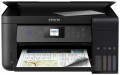 | 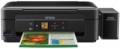 |
|---|---|---|
| Epson EcoTank L4160 | Epson EcoTank L456 | |
| Outdated Product | from $202.00 up to $307.80 | |
| TOP sellers | ||
| Paper size | A4 | A4 |
| Print Type | inkjet | inkjet |
| Output Type | colour | colour |
| Number of colors | 4 | |
Printing and copying | ||
| Max resolution | 5760x1440 dpi | 5760x1440 dpi |
| B/W printing | 33 ppm | 33 ppm |
| Colour printing | 15 ppm | 15 ppm |
| Photo printing | 69 sec/page | 69 sec/page |
| Double-side printing |  |  |
Printing Supplies | ||
| Black Ink Page Yield | 7500 pages | 4000 pages |
| Colour Ink Page Yield | 6000 pages | 6500 pages |
| Built-in CISS | | |
| Ink Type | pigmented / water soluble | |
Features | ||
| Data transfer | PC connection (USB) Wi-Fi 4 (802.11n) card reader Wi-Fi Direct AirPrint | PC connection (USB) Wi-Fi 4 (802.11n) card reader Wi-Fi Direct AirPrint |
| Cloud printing | Mopria, Epson iPrint, Epson Email Print | Epson iPrint |
| Display | colour | colour |
| Diagonal | 1.45 " | 1.45 " |
Hardware | ||
| Grammage (min) | 64 g/m² | 64 g/m² |
| Grammage (max) | 256 g/m² | 255 g/m² |
| Scan resolution | 1200х2400 dpi | 1200х2400 dpi |
General | ||
| Feed tray | 100 sheets | 100 sheets |
| Output Tray | 30 sheets | 30 sheets |
| Noise level | 50 dB | 37 dB |
| Power consumption | 12 W | 13 W |
| Dimensions (WxDxH) | 375x347x187 mm | 482x300x145 mm |
| Weight | 5.5 kg | 4.5 kg |
| Color | ||
| Added to E-Catalog | december 2017 | may 2015 |


Compare Epson EcoTank L4160 and L456
You may be interested in
My comparisons
Epson EcoTank L4160 often compared


Epson EcoTank L456 often compared


Glossary
Number of colors
The color palette that a printer or MFP can print. A large number of colors is required for high-quality photo printing and obtaining color prints with many shades. As a standard, for a color MFP, 4 colors are provided.
Double-side printing
Feature of a double-sided printing function. This mode implies that after printing on one side, a special gear turns over a sheet of paper and feeds it for printing on the other side. This not only saves the user from manual paper turn-overs, but also exclude the risk of printing the second side upside down.
Black Ink Page Yield
Approximate number of pages that the MFP can print in black and white mode without replacing the cartridge. In fact, this greatly depends on the specs of the images to print, so the actual resource may greatly differ from the claimed one in one way or another. Nevertheless, according to this indicator, it is quite possible to evaluate the capabilities of the MFP and compare it with other models.
Colour Ink Page Yield
Approximate number of pages that the MFP can print in colour mode without replacing the cartridge. In fact, this greatly depends on the specs of the images to print, so the actual resource may greatly differ from the claimed one in one way or another. Nevertheless, according to this indicator, it is quite possible to evaluate the capabilities of the MFP and compare it with other models.
Ink Type
— Pigment. Ink based on pigments — solid dyes, which are diluted in the form of microparticles in a liquid filler to a state of suspension. Compared to more popular water-based inks, these inks are noticeably more expensive, and the finished image may turn out to be somewhat less bright (compared to printing with water-based dye on the same MFP). On the other hand, pigment ink gives higher detail, which is especially important for photo printing. In addition, finished images resist humidity better and do not fade as quickly in bright light — this resistance is not enough for outdoor use, but indoors such prints can be stored for a very long time.
— Water soluble. Inks based on water-soluble dyes allow achieving high realism of colour reproduction in colour printing, they are well absorbed into the deep layers of paper and are cheaper than pigment inks. Also, water-soluble ink does not dry as quickly in the cartridge or print head of the MFP. They are recommended for use with inkjet paper — ordinary thin paper strongly absorbs dropsy, which can cause ink to show through on the back of the sheet. At the same time, water-soluble ink is afraid of moisture and direct exposure to ultraviolet light — when water gets on, the paint on paper “floats”, and it fades under the sun light.
— Pigmented / water soluble. Some MFPs have a print head that allows you to print with two types of ink at once. A common case is when their black cartridge is filled with pigment...ink, and the colour one is filled with water-soluble ink.
— Water soluble. Inks based on water-soluble dyes allow achieving high realism of colour reproduction in colour printing, they are well absorbed into the deep layers of paper and are cheaper than pigment inks. Also, water-soluble ink does not dry as quickly in the cartridge or print head of the MFP. They are recommended for use with inkjet paper — ordinary thin paper strongly absorbs dropsy, which can cause ink to show through on the back of the sheet. At the same time, water-soluble ink is afraid of moisture and direct exposure to ultraviolet light — when water gets on, the paint on paper “floats”, and it fades under the sun light.
— Pigmented / water soluble. Some MFPs have a print head that allows you to print with two types of ink at once. A common case is when their black cartridge is filled with pigment...ink, and the colour one is filled with water-soluble ink.
Cloud printing
Cloud-enabled MFPs allow you to work directly with cloud services without connecting to a PC.
The general point of such printing is that the documents sent for printing (and in the case of MFPs, also scanned materials) are stored on a server on the Internet. Thus, the connectivity of the printer/scanner is not limited to the local network — you can send documents for printing and receive scan results from anywhere in the world where there is access to the World Wide Web. In addition, cloud services make it easy to share access to the MFP and other people.
Note that cloud printing can also be used with MFPs, that do not have such a function by themselves — for this, you need to connect the device to a PC with the appropriate software.
The general point of such printing is that the documents sent for printing (and in the case of MFPs, also scanned materials) are stored on a server on the Internet. Thus, the connectivity of the printer/scanner is not limited to the local network — you can send documents for printing and receive scan results from anywhere in the world where there is access to the World Wide Web. In addition, cloud services make it easy to share access to the MFP and other people.
Note that cloud printing can also be used with MFPs, that do not have such a function by themselves — for this, you need to connect the device to a PC with the appropriate software.
Grammage (max)
The maximum grammage that the MFP can print on. The grammage of the paper depends primarily on its thickness; thick paper is strong, but if it is thicker than allowed by MFP's manufacturer, the paper feeder simply cannot handle such sheets.
Noise level
The maximum noise level coming from the MFP during operation. The smaller this value, the more comfortable the use of the device. For office use, this parameter is not so important, but you should pay attention to it if you are going to use the device at home. It is easiest to evaluate a specific noise level using special comparative tables. For example, the quietest modern MFPs can operate with 34-35 dB noise level which is approximately corresponds to a muffled conversation, and the heaviest and most performant models give out up to 75 dB — this is comparable to a scream or a loud laugh at a distance of 1 m.
Power consumption
The maximum power consumed by the MFP during operation. The lower this indicator, the more energy-efficient the device is.