
Comparison MaXpeedingRods MXR2350 vs MaXpeedingRods MXR2300
Add to comparison |  | 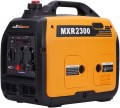 |
|---|---|---|
| MaXpeedingRods MXR2350 | MaXpeedingRods MXR2300 | |
| Outdated Product | from $499.99 | |
| TOP sellers | ||
| Fuel | petrol | petrol |
| Output voltage | 230 B | 230 B |
| Rated power | 1.8 kW | 1.8 kW |
| Max. power | 2 kW | 2.3 kW |
| Alternator | inverter | inverter |
| Alternator winding | copper | |
Engine | ||
| ICE type | 4-stroke | 4-stroke |
| Engine size | 80 cm³ | 80 cm³ |
| Fuel consumption (50% load) | 0.6 l/h | 0.62 l/h |
| Fuel tank volume | 2.4 L | 4 L |
| Starter type | manual | manual |
| Motor cooling | air | air |
Connection (sockets) | ||
| Total number of sockets | 2 | 2 |
| Sockets 230 V | 16 A x2 | 16 A x2 |
| USB charging port |  | |
Features | ||
| Features | display hour metre voltmeter parallel connection | display hour metre voltmeter parallel connection |
General | ||
| Sound insulation cover | | |
| Sound level (7 m) | 58 dB | 58 dB |
| Dimensions | 440x248x405 mm | 480x290x440 mm |
| Weight | 15 kg | 18.5 kg |
| Added to E-Catalog | february 2025 | january 2023 |


Compare MaXpeedingRods MXR2350 and MXR2300
You may be interested in
My comparisons
MaXpeedingRods MXR2350 often compared


MaXpeedingRods MXR2300 often compared


Glossary
Max. power
The maximum power output that the generator can provide.
This power is slightly higher than the nominal (see above), but the maximum performance mode can only be maintained for a very short time - otherwise an overload occurs. Therefore, the practical meaning of this characteristic is mainly to describe the efficiency of the generator when working with increased starting currents.
Let us recall that some types of electrical appliances consume several times more power (and, accordingly, power) at the moment of starting than in the normal mode; this is typical mainly for devices with electric motors, such as power tools, refrigerators, etc. However, increased power for such equipment is needed only for a short time, normal operation is restored in literally a few seconds. And you can estimate the starting characteristics by multiplying the nominal power by the so-called starting coefficient. For equipment of the same type, it is more or less the same (1.2 - 1.3 for most power tools, 2 for a microwave oven, 3.5 for an air conditioner, etc.); more detailed data is available in special sources.
Ideally, the maximum power of the generator should be no less than the total peak power of the connected load - that is, the starting power of equipment with a starting factor greater than 1 plus the rated power of all other equipment. This will minimize the likelihood of overloads.
This power is slightly higher than the nominal (see above), but the maximum performance mode can only be maintained for a very short time - otherwise an overload occurs. Therefore, the practical meaning of this characteristic is mainly to describe the efficiency of the generator when working with increased starting currents.
Let us recall that some types of electrical appliances consume several times more power (and, accordingly, power) at the moment of starting than in the normal mode; this is typical mainly for devices with electric motors, such as power tools, refrigerators, etc. However, increased power for such equipment is needed only for a short time, normal operation is restored in literally a few seconds. And you can estimate the starting characteristics by multiplying the nominal power by the so-called starting coefficient. For equipment of the same type, it is more or less the same (1.2 - 1.3 for most power tools, 2 for a microwave oven, 3.5 for an air conditioner, etc.); more detailed data is available in special sources.
Ideally, the maximum power of the generator should be no less than the total peak power of the connected load - that is, the starting power of equipment with a starting factor greater than 1 plus the rated power of all other equipment. This will minimize the likelihood of overloads.
Alternator winding
— Copper. Copper winding is typical for advanced class generators. The copper alternator is characterized by high conductivity and low resistance. The conductivity of copper is 1.7 times higher than the conductivity of aluminium, such a winding heats up less, and compounds made of this metal endure temperature drops and vibration loads. Among the disadvantages of the copper winding, one can only note the high cost of the alternator. Otherwise, generators with copper winding have high reliability and durability.
— Aluminium. The aluminium winding of the alternator is typical for low-cost-class generators. The main advantages of aluminium are light weight and low price; otherwise, such a winding is usually inferior to copper counterparts. An oxide film is created on the surface of aluminium, it appears everywhere, even in the places of contact soldering. The oxide film undermines the contacts and does not allow the outer protective braid to securely hold the aluminium conductors.
Fuel consumption (50% load)
Fuel consumption of a petrol or diesel generator when operating at half power, and for combined models when using petrol (see “Fuel”).
Fuel consumption usually increases with load. However, generator efficiency is not always linear - fuel consumption may vary disproportionately with different loads. In this case, the approximate amount of fuel consumed by the generator when operating at half power (50% of the rated power) is given. Knowing the fuel consumption and tank capacity, you can at least estimate how long one fill-up will last.
Fuel consumption usually increases with load. However, generator efficiency is not always linear - fuel consumption may vary disproportionately with different loads. In this case, the approximate amount of fuel consumed by the generator when operating at half power (50% of the rated power) is given. Knowing the fuel consumption and tank capacity, you can at least estimate how long one fill-up will last.
Fuel tank volume
The volume of the fuel tank installed in the generator.
Knowing the fuel consumption (see above) and the capacity of the tank, you can calculate the operating time on one gas station (if it is not indicated in the specifications). However, a more capacious tank is also more bulky. Therefore, manufacturers choose tanks based on the general level and "voracity" of the generator — in order to provide an acceptable operating time without a significant increase in size and weight. So in general, this parameter is more of a reference than practically significant.
As for the numbers, in low-power models, tanks are installed for 5 – 10 liters, or even less ; in heavy professional equipment, this figure can exceed 50 liters.
Knowing the fuel consumption (see above) and the capacity of the tank, you can calculate the operating time on one gas station (if it is not indicated in the specifications). However, a more capacious tank is also more bulky. Therefore, manufacturers choose tanks based on the general level and "voracity" of the generator — in order to provide an acceptable operating time without a significant increase in size and weight. So in general, this parameter is more of a reference than practically significant.
As for the numbers, in low-power models, tanks are installed for 5 – 10 liters, or even less ; in heavy professional equipment, this figure can exceed 50 liters.
Weight
The total weight of the unit - usually excluding fuel; the weight on full tank can be easily determined knowing the tank capacity.
In general, more powerful generators are inevitably heavier, but models with similar characteristics can differ significantly in weight. When assessing these differences and generally choosing an option based on weight, it is worth considering the specifics of the generator's use. So, if the device is often to be moved from place to place - for example, when used "on the road" - it may be worth paying attention to lighter units that are more convenient to transport. However, it is worth considering that the downside of a lightweight design is often an increased cost or a reduced degree of protection. But for stationary use, you can not pay special attention to this parameter - or even the opposite: choose a heavier (and, as a rule, more advanced and functional) option.
Regarding specific figures, it is worth noting that modern generators are generally quite massive. Thus, a small weight for such equipment is considered not only < 20 kg, but even 20-30 kg ; many units weigh 150-200 kg, or even more, and the weight of stationary industrial models is measured in tons.
In general, more powerful generators are inevitably heavier, but models with similar characteristics can differ significantly in weight. When assessing these differences and generally choosing an option based on weight, it is worth considering the specifics of the generator's use. So, if the device is often to be moved from place to place - for example, when used "on the road" - it may be worth paying attention to lighter units that are more convenient to transport. However, it is worth considering that the downside of a lightweight design is often an increased cost or a reduced degree of protection. But for stationary use, you can not pay special attention to this parameter - or even the opposite: choose a heavier (and, as a rule, more advanced and functional) option.
Regarding specific figures, it is worth noting that modern generators are generally quite massive. Thus, a small weight for such equipment is considered not only < 20 kg, but even 20-30 kg ; many units weigh 150-200 kg, or even more, and the weight of stationary industrial models is measured in tons.