
Comparison DeWALT DCD708D2T vs Makita DDA351Z
Add to comparison | 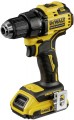 |  |
|---|---|---|
| DeWALT DCD708D2T | Makita DDA351Z | |
from $290.57 | from $229.05 | |
| User reviews | ||
| TOP sellers | ||
The DCD708S2T model comes with 1.5 Ah batteries, the DCD708D2T comes with 2 Ah batteries, and the DCD708P2T comes with 5 Ah batteries. | Model DDA351Z comes without battery, charger and case, and model DDA351RFE comes with two batteries (3 Ah), charger and case | |
| Product type | drill driver | drill |
| Design | gun | angle |
Specs | ||
| Real power | 340 W | |
| Rotation speed | 450/1650 rpm | 1800 rpm |
| Torque | 65 Nm with adjustment 15 steps | |
| Reducer | 2-speed | 1-speed |
| Number of speeds | 2 | 1 |
| Reverse | slider | slider |
| Weight | 1.5 kg | 1.6 kg |
Chuck | ||
| Chuck type | keyless | keyless |
| Chuck diameter | 13 mm | 10 mm |
| Wood drilling max. ⌀ | 30 mm | 25 mm |
| Metal drilling max. ⌀ | 13 mm | 10 mm |
Protective functions | ||
| Motor brake |  | |
| Electronic motor protection | |  |
Features | ||
| Features | brushless motor backlight | backlight |
| In box | case (bag) charger | additional handle without charger |
Power supply | ||
| Power source | battery | battery |
| Battery in set | 2 | no |
| Battery platform | DeWALT 18V XR | Makita 18V LXT |
| Battery voltage | 18 В | 18 В |
| Battery capacity | 2 Ah | |
| Compatible batteries | DCB180, DCB181, DCB182, DCB183, DCB184, DCB185, DCB187, DCB189, DCB546 | BL1815N, BL1820, BL1830, BL1840, BL1850, BL1860 |
| Charging time | 60 min | |
| Added to E-Catalog | march 2020 | february 2017 |


Compare DeWALT DCD708D2T and Makita DDA351Z
You may be interested in
My comparisons
DeWALT DCD708D2T often compared


Glossary
Product type
General type of instrument.
Nowadays, several other types of hand tools are also combined into one category with traditional drills, with a similar design and principle of operation: drill drivers, classic screwdrivers, wrenches and electric screwdrivers. Here is a detailed description of each of these varieties:
— Drill. Traditional drills are power tools for drilling holes in various materials. By specialization and “weight category”, such tools range from miniature cordless models to heavy professional diamond drilling units (see “Intended Use”). Anyway, drills are equipped with chucks for installing drills, as well as engines designed for significant resistance during operation. Also note that many of these units have an impact mode, but the drill is still not able to replace a full-fledged rotary hammer (for more details, see "Functions").
— Screwdriver. In fact, it is an electric (or pneumatic) analogue of a manual screwdriver. It is used primarily for tightening and loosening screws, screws and other similar fasteners using bits — interchangeable nozzles, the shape of which imitates various screwdriver tips (straight, cross-shaped, etc.). Accordingly, the standard type of retainer for the nozzle in such a tool is for a bit (see "Chuck Type"). Screwdrivers differ from electric...screwdrivers (see below) in higher power, better suitability for long-term work and high loads, as well as larger dimensions and rather significant (in comparison, of course) weight.
— Drill driver. Tools (mainly cordless, see "Power source") that combine the functionality of a drill and a screwdriver. See above for more on both, and these "hybrid" devices are extremely popular these days due to their versatility. Switching between drilling and twisting modes in them is carried out by changing the cartridge, and also, in most models, by adjusting the torque (see below). At the same time, it should be noted that compared to traditional drills, the efficiency of such units when drilling is rather low, they are not intended for high loads, hard materials and large drilling diameters. This is due to the fact that in order to achieve high power, it would be necessary to increase the dimensions and weight, which would significantly complicate the use in the format of a screwdriver.
— Screwdriver. A kind of electric and pneumatic analogues of socket wrenches: tools designed to work with nuts and other similar fasteners (for example, bolts with heads without a slot). Nutrunners are in many ways similar to the screwdrivers described above and differ mainly in the type of cartridge — usually it is a square for sockets of different sizes.
— Screwdriver. An electrical analogue of a conventional manual screwdriver (pneumatic drive is not used in such devices for a number of reasons). Some of these models have a straight body shape (see "Construction") and are very similar in appearance to hand tools; others resemble smaller and lighter screwdrivers (see below). Anyway, electric screwdrivers are intended mainly for work where accuracy and accuracy are more important than high efforts (or where these efforts are simply not required). Thus, the low power of such devices is not so much a disadvantage as a feature. In addition, this feature allows you to use battery power without much difficulty, making the tool as autonomous as possible; in fact, electric screwdrivers with mains operation nowadays are almost never found. And the small size and weight, in turn, contribute to the mentioned accuracy and accuracy.
Nowadays, several other types of hand tools are also combined into one category with traditional drills, with a similar design and principle of operation: drill drivers, classic screwdrivers, wrenches and electric screwdrivers. Here is a detailed description of each of these varieties:
— Drill. Traditional drills are power tools for drilling holes in various materials. By specialization and “weight category”, such tools range from miniature cordless models to heavy professional diamond drilling units (see “Intended Use”). Anyway, drills are equipped with chucks for installing drills, as well as engines designed for significant resistance during operation. Also note that many of these units have an impact mode, but the drill is still not able to replace a full-fledged rotary hammer (for more details, see "Functions").
— Screwdriver. In fact, it is an electric (or pneumatic) analogue of a manual screwdriver. It is used primarily for tightening and loosening screws, screws and other similar fasteners using bits — interchangeable nozzles, the shape of which imitates various screwdriver tips (straight, cross-shaped, etc.). Accordingly, the standard type of retainer for the nozzle in such a tool is for a bit (see "Chuck Type"). Screwdrivers differ from electric...screwdrivers (see below) in higher power, better suitability for long-term work and high loads, as well as larger dimensions and rather significant (in comparison, of course) weight.
— Drill driver. Tools (mainly cordless, see "Power source") that combine the functionality of a drill and a screwdriver. See above for more on both, and these "hybrid" devices are extremely popular these days due to their versatility. Switching between drilling and twisting modes in them is carried out by changing the cartridge, and also, in most models, by adjusting the torque (see below). At the same time, it should be noted that compared to traditional drills, the efficiency of such units when drilling is rather low, they are not intended for high loads, hard materials and large drilling diameters. This is due to the fact that in order to achieve high power, it would be necessary to increase the dimensions and weight, which would significantly complicate the use in the format of a screwdriver.
— Screwdriver. A kind of electric and pneumatic analogues of socket wrenches: tools designed to work with nuts and other similar fasteners (for example, bolts with heads without a slot). Nutrunners are in many ways similar to the screwdrivers described above and differ mainly in the type of cartridge — usually it is a square for sockets of different sizes.
— Screwdriver. An electrical analogue of a conventional manual screwdriver (pneumatic drive is not used in such devices for a number of reasons). Some of these models have a straight body shape (see "Construction") and are very similar in appearance to hand tools; others resemble smaller and lighter screwdrivers (see below). Anyway, electric screwdrivers are intended mainly for work where accuracy and accuracy are more important than high efforts (or where these efforts are simply not required). Thus, the low power of such devices is not so much a disadvantage as a feature. In addition, this feature allows you to use battery power without much difficulty, making the tool as autonomous as possible; in fact, electric screwdrivers with mains operation nowadays are almost never found. And the small size and weight, in turn, contribute to the mentioned accuracy and accuracy.
Design
Design describes the overall layout of the tool.
Nowadays, among drills and screwdrivers, you can find models with a pistol, angle, straight, combined pistol-angle, as well as an adjustable design. Here is a more detailed description of each option:
— Pistol. In models with this layout, the handle is perpendicular or almost perpendicular to the body, so that the tool is held in the hands similar to a pistol — hence the name. In general, the pistol design combines convenience, safety, practicality and low cost. Due to this, this option is the most common nowadays, it is widely used in all types of drills and similar tools (see "Device"). In fact, this is a traditional design for such units; other types of layout are used mainly in models designed for special conditions and/or with specific characteristics (see below for more details).
— Corner. The general shape of such tools resembles the letter G: a straight body of relatively large length, which also acts as a handle, and a cartridge bent 90 ° relative to the body. This design option is especially convenient when working in cramped conditions: with the help of an angled tool, you can get into narrow gaps that are inaccessible to traditional pistol-mounted units. On the other hand, the angular layout degrades accuracy somewhat;...it is also poorly suited for jobs that require strong pressure along the axis of rotation of the chuck.
— Direct. Tools of this design have an oblong body, part of which plays the role of a handle; and the axis of rotation of the cartridge in them coincides with the longitudinal axis of the body. This option can be found in two types of tools. The first is small low-power tools (mainly screwdrivers, screwdrivers and wrenches, as well as single models of drills, also characterized by low power). In such cases, a straight body is provided primarily for compactness — a pistol grip would increase the dimensions beyond reasonable limits. The second type of direct units is, on the contrary, separate professional drills with a diamond drilling function (see "Purpose"). Such drills are not designed to be held in hands and are used only with a stand (see "Complete set"); for this format of use, the direct layout is also optimal.
— Pistol / angle. In fact, they are tools of the pistol layout described above, which are supplied with an angular cartridge that allows you to turn the working nozzle 90 ° relative to the standard position. Thus, such models combine the capabilities of both layouts, while retaining the main advantages of a pistol design — convenience and reliability in holding. On the other hand, additional equipment affects the cost, and such versatility is not often required. So this option is not very popular.
— Adjustable. This category includes all models in which you can change the location of the cartridge and/or handle relative to the body. The most popular version of this design is the rotary handle, which allows you to switch the tool from a pistol format to a straight one and vice versa. See above for more on these types of construction, but here we note that the pistol layout is more reliable in holding and versatile, and the straight one is better suited for some delicate work and hard-to-reach places. It is also worth mentioning that the possibilities for adjusting the handle can be different: in some models it has only two extreme positions, in others you can choose the angle of inclination relative to the body. The second, somewhat less common variety of adjustable tools is devices with a rotary chuck. Here we are already talking about switching between a straight and an angular layout — the latter, we recall, is very appropriate when working in cramped conditions. However, the cartridge in such units, usually, can be installed not only at 90 ° relative to the body, but also in several intermediate positions. This further expands the customization options for the specifics of the situation.
Anyway, all adjustable tools are more versatile than non-adjustable ones, but they are more complex in design and less reliable. Therefore, this type of arrangement is found exclusively in low-power units, mainly battery ones (see "Power supply").
Nowadays, among drills and screwdrivers, you can find models with a pistol, angle, straight, combined pistol-angle, as well as an adjustable design. Here is a more detailed description of each option:
— Pistol. In models with this layout, the handle is perpendicular or almost perpendicular to the body, so that the tool is held in the hands similar to a pistol — hence the name. In general, the pistol design combines convenience, safety, practicality and low cost. Due to this, this option is the most common nowadays, it is widely used in all types of drills and similar tools (see "Device"). In fact, this is a traditional design for such units; other types of layout are used mainly in models designed for special conditions and/or with specific characteristics (see below for more details).
— Corner. The general shape of such tools resembles the letter G: a straight body of relatively large length, which also acts as a handle, and a cartridge bent 90 ° relative to the body. This design option is especially convenient when working in cramped conditions: with the help of an angled tool, you can get into narrow gaps that are inaccessible to traditional pistol-mounted units. On the other hand, the angular layout degrades accuracy somewhat;...it is also poorly suited for jobs that require strong pressure along the axis of rotation of the chuck.
— Direct. Tools of this design have an oblong body, part of which plays the role of a handle; and the axis of rotation of the cartridge in them coincides with the longitudinal axis of the body. This option can be found in two types of tools. The first is small low-power tools (mainly screwdrivers, screwdrivers and wrenches, as well as single models of drills, also characterized by low power). In such cases, a straight body is provided primarily for compactness — a pistol grip would increase the dimensions beyond reasonable limits. The second type of direct units is, on the contrary, separate professional drills with a diamond drilling function (see "Purpose"). Such drills are not designed to be held in hands and are used only with a stand (see "Complete set"); for this format of use, the direct layout is also optimal.
— Pistol / angle. In fact, they are tools of the pistol layout described above, which are supplied with an angular cartridge that allows you to turn the working nozzle 90 ° relative to the standard position. Thus, such models combine the capabilities of both layouts, while retaining the main advantages of a pistol design — convenience and reliability in holding. On the other hand, additional equipment affects the cost, and such versatility is not often required. So this option is not very popular.
— Adjustable. This category includes all models in which you can change the location of the cartridge and/or handle relative to the body. The most popular version of this design is the rotary handle, which allows you to switch the tool from a pistol format to a straight one and vice versa. See above for more on these types of construction, but here we note that the pistol layout is more reliable in holding and versatile, and the straight one is better suited for some delicate work and hard-to-reach places. It is also worth mentioning that the possibilities for adjusting the handle can be different: in some models it has only two extreme positions, in others you can choose the angle of inclination relative to the body. The second, somewhat less common variety of adjustable tools is devices with a rotary chuck. Here we are already talking about switching between a straight and an angular layout — the latter, we recall, is very appropriate when working in cramped conditions. However, the cartridge in such units, usually, can be installed not only at 90 ° relative to the body, but also in several intermediate positions. This further expands the customization options for the specifics of the situation.
Anyway, all adjustable tools are more versatile than non-adjustable ones, but they are more complex in design and less reliable. Therefore, this type of arrangement is found exclusively in low-power units, mainly battery ones (see "Power supply").
Real power
The useful power of the tool is the maximum power that it can deliver to the working nozzle. This power is always less than the power consumed (see below), since part of the electricity inevitably goes to heat and friction in the tool mechanisms. In addition, this parameter is not given for every model, often information in the characteristics is limited to power consumption. Nevertheless, the actual capabilities of the tool directly depend on the net power: the higher it is, the greater the speed and/or torque this model is able to develop, the easier it is for it to cope with tasks that require high efforts. So, to compare different devices with each other, it is best to use this parameter (of course, you can only compare models of the same type or similar in type).
Also note that high working power is not always an advantage: it accordingly affects the dimensions, weight and price of the tool, while in fact high speeds and efforts are not always necessary. Detailed recommendations on the optimal values for different tools and different types of work can be found in special sources.
Also note that high working power is not always an advantage: it accordingly affects the dimensions, weight and price of the tool, while in fact high speeds and efforts are not always necessary. Detailed recommendations on the optimal values for different tools and different types of work can be found in special sources.
Rotation speed
The speed of rotation of the working nozzle provided by the tool.
If a single number is indicated in this paragraph (for example, 1800), it can be either a standard, constant, or maximum rotation speed. This refers to the maximum speed if the tool has more than one speed (see "Number of speeds") and/or a speed controller (see "Functions"). In turn, two or three numbers through an oblique line (for example, 1100/2300/3400) are indicated only for models that have the corresponding number of individual speeds. Each of these numbers indicates the standard (and in the presence of a speed controller — the maximum) number of revolutions at one of the speeds.
Anyway, when choosing a tool by the number of revolutions, it is worth considering both its general type (see "Device") and the specifics of the intended work. Detailed recommendations on this matter are quite extensive, it makes no sense to give them in full here — it is better to turn to special sources. We note only a few general points. So, high -speed drills nowadays are considered to be drills capable of delivering more than 3000 rpm. In general, high speed contributes to productivity, but there is also a downside: increasing the speed (for the same power) reduces torque — accordingly, the efficiency of working with stubborn materials and large diameter nozzles decreases. Therefore, it makes sense to specifically look for a "high-speed" tool only if speed is of key impor...tance; it doesn’t hurt to make sure that the model you choose can provide the required efficiency and torque.
If a single number is indicated in this paragraph (for example, 1800), it can be either a standard, constant, or maximum rotation speed. This refers to the maximum speed if the tool has more than one speed (see "Number of speeds") and/or a speed controller (see "Functions"). In turn, two or three numbers through an oblique line (for example, 1100/2300/3400) are indicated only for models that have the corresponding number of individual speeds. Each of these numbers indicates the standard (and in the presence of a speed controller — the maximum) number of revolutions at one of the speeds.
Anyway, when choosing a tool by the number of revolutions, it is worth considering both its general type (see "Device") and the specifics of the intended work. Detailed recommendations on this matter are quite extensive, it makes no sense to give them in full here — it is better to turn to special sources. We note only a few general points. So, high -speed drills nowadays are considered to be drills capable of delivering more than 3000 rpm. In general, high speed contributes to productivity, but there is also a downside: increasing the speed (for the same power) reduces torque — accordingly, the efficiency of working with stubborn materials and large diameter nozzles decreases. Therefore, it makes sense to specifically look for a "high-speed" tool only if speed is of key impor...tance; it doesn’t hurt to make sure that the model you choose can provide the required efficiency and torque.
Torque
Torque is the maximum force with which this model is capable of turning the working nozzle.
Higher torque gives more options, it allows you to cope with complex tasks such as drilling in hard materials, unscrewing stuck screws and nuts, etc. On the other hand, a lot of force requires corresponding power — and this, in turn, affects the dimensions , weight and cost of the tool itself, and also puts forward increased power requirements (mains power, battery capacity or pressure / compressor performance). And for some tasks, excessive torque is basically unacceptable, so for maximum versatility, it is desirable to have torque control — and this affects the cost even more. And the more steps, the more optimally you can configure the tool to perform a particular type of work. So the general rule is this: when choosing, it is worth considering the specifics of the planned work, and not chasing the greatest working effort.
Detailed recommendations on choosing the optimal torque for different types of tools (see "Device") can be found in special sources. Here we note that it is of key importance primarily for screwdrivers, although it is also given for other types of tools. At the same time, in the “weakest” models, the maximum working force does not exceed 15 Nm, in the most powerful ones it is more than 150 Nm.
Higher torque gives more options, it allows you to cope with complex tasks such as drilling in hard materials, unscrewing stuck screws and nuts, etc. On the other hand, a lot of force requires corresponding power — and this, in turn, affects the dimensions , weight and cost of the tool itself, and also puts forward increased power requirements (mains power, battery capacity or pressure / compressor performance). And for some tasks, excessive torque is basically unacceptable, so for maximum versatility, it is desirable to have torque control — and this affects the cost even more. And the more steps, the more optimally you can configure the tool to perform a particular type of work. So the general rule is this: when choosing, it is worth considering the specifics of the planned work, and not chasing the greatest working effort.
Detailed recommendations on choosing the optimal torque for different types of tools (see "Device") can be found in special sources. Here we note that it is of key importance primarily for screwdrivers, although it is also given for other types of tools. At the same time, in the “weakest” models, the maximum working force does not exceed 15 Nm, in the most powerful ones it is more than 150 Nm.
Reducer
The type of gearbox provided in the design of the tool.
A gearbox can be simply described as a mechanism that transmits rotation from an electric motor to a chuck. In this case, usually, the rotation speed decreases, due to which the torque increases. Different types of gearboxes differ just in the number of speeds that can be obtained at the output. The simplest variety of such mechanisms is single-speed, they are as simple as possible, compact and reliable. At the same time, in a tool with a 1-speed gearbox, speed control may well be provided — due to electronic circuits that allow you to adjust the engine speed. On the other hand, reducing the actual speed by means of electronic control does not lead to an increase, but to a decrease in torque.
More advanced are multi-speed gearboxes, usually having 2 to 4 speeds. Such mechanisms are analogous to a gearbox in a car: the speed in them is regulated by changing the gear ratio, so that a decrease in speed leads to an increase in torque, and vice versa. Such an adjustment is considered more practical than the electronic one described above; the downside is the complexity and high cost of multi-speed gearboxes.
A gearbox can be simply described as a mechanism that transmits rotation from an electric motor to a chuck. In this case, usually, the rotation speed decreases, due to which the torque increases. Different types of gearboxes differ just in the number of speeds that can be obtained at the output. The simplest variety of such mechanisms is single-speed, they are as simple as possible, compact and reliable. At the same time, in a tool with a 1-speed gearbox, speed control may well be provided — due to electronic circuits that allow you to adjust the engine speed. On the other hand, reducing the actual speed by means of electronic control does not lead to an increase, but to a decrease in torque.
More advanced are multi-speed gearboxes, usually having 2 to 4 speeds. Such mechanisms are analogous to a gearbox in a car: the speed in them is regulated by changing the gear ratio, so that a decrease in speed leads to an increase in torque, and vice versa. Such an adjustment is considered more practical than the electronic one described above; the downside is the complexity and high cost of multi-speed gearboxes.
Number of speeds
The number of speeds provided in the design of the tool.
First of all, let's clarify that "speed" in this case means high-speed mode. The number of revolutions at each "speed" can be either fixed or adjustable (if there is an appropriate regulator — see "Functions"). Thus, the presence of several speeds can have different meanings. In some models, changing the speed mode is the only option for adjusting the speed; in others (if there is a separate speed controller), changing the mode sets only the maximum speed of rotation of the nozzle, and its actual speed is smoothly changed by the controller (which may also have its own, additional speed limiter).
As for the specific number of speed modes, in many models it is only one. Accordingly, the revolutions in such a tool either do not change at all, or are controlled only by the mentioned regulator; this is often sufficient for simple tasks. However, 2-speed tools are also very widespread — this design provides additional tuning options and at the same time remains relatively simple and inexpensive. And in fairly advanced models, you can find three, or even four or more speed modes; in some cases, this number reaches 8 or even more, which allows you to use speed switching as a full-fledged speed controller.
When choosing according to this characteristic, it should be...taken into account that, other things being equal, a larger number of speeds gives more features for setting operating parameters, but complicates the design and increases its cost.
First of all, let's clarify that "speed" in this case means high-speed mode. The number of revolutions at each "speed" can be either fixed or adjustable (if there is an appropriate regulator — see "Functions"). Thus, the presence of several speeds can have different meanings. In some models, changing the speed mode is the only option for adjusting the speed; in others (if there is a separate speed controller), changing the mode sets only the maximum speed of rotation of the nozzle, and its actual speed is smoothly changed by the controller (which may also have its own, additional speed limiter).
As for the specific number of speed modes, in many models it is only one. Accordingly, the revolutions in such a tool either do not change at all, or are controlled only by the mentioned regulator; this is often sufficient for simple tasks. However, 2-speed tools are also very widespread — this design provides additional tuning options and at the same time remains relatively simple and inexpensive. And in fairly advanced models, you can find three, or even four or more speed modes; in some cases, this number reaches 8 or even more, which allows you to use speed switching as a full-fledged speed controller.
When choosing according to this characteristic, it should be...taken into account that, other things being equal, a larger number of speeds gives more features for setting operating parameters, but complicates the design and increases its cost.
Weight
The total weight of the tool is usually the device itself, without attachments. For battery models (see "Power Source"), usually, the weight is indicated with a standard battery installed; for battery-powered models, the weight can be given both with and without batteries, but in this case this point is not particularly important.
Other things being equal, less weight simplifies work, increases accuracy of movement and allows you to use the tool for longer without tiring. However, note that high power and productivity inevitably increase the mass of the tool; and various tricks to reduce weight increase the price and can reduce reliability. In addition, in some cases, a massive design is more preferable. First of all, this applies to work with a large load — for example, drilling holes of large diameter, or making recesses with impact: a heavy tool is more stable, it is less prone to jerks and shifts due to uneven material, vibration of mechanisms, etc.
It is also worth noting that specific weight values are directly related to the type of tool (see "Device"). Screwdrivers are the lightest — in most of them this figure does not exceed 500 g. Screwdrivers and drill drivers are more "heavy": their average weight is 1.1 – 1.5 kg, although there are many lighter ( 0.6 – 1 kg) and heavier ( 1.6 – 2 kg or more ) models. And clas...sic drills and wrenches have the greatest weight: such a tool must be quite powerful, so for them 1.6 – 2 kg is an average, 2.1 – 2.5 kg is above average, and many units weigh more than 2, 5 kg.
Other things being equal, less weight simplifies work, increases accuracy of movement and allows you to use the tool for longer without tiring. However, note that high power and productivity inevitably increase the mass of the tool; and various tricks to reduce weight increase the price and can reduce reliability. In addition, in some cases, a massive design is more preferable. First of all, this applies to work with a large load — for example, drilling holes of large diameter, or making recesses with impact: a heavy tool is more stable, it is less prone to jerks and shifts due to uneven material, vibration of mechanisms, etc.
It is also worth noting that specific weight values are directly related to the type of tool (see "Device"). Screwdrivers are the lightest — in most of them this figure does not exceed 500 g. Screwdrivers and drill drivers are more "heavy": their average weight is 1.1 – 1.5 kg, although there are many lighter ( 0.6 – 1 kg) and heavier ( 1.6 – 2 kg or more ) models. And clas...sic drills and wrenches have the greatest weight: such a tool must be quite powerful, so for them 1.6 – 2 kg is an average, 2.1 – 2.5 kg is above average, and many units weigh more than 2, 5 kg.
Chuck diameter
The nominal diameter of the chuck supplied with the tool.
This size is indicated by the maximum diameter of the drill (or bit shank) that can be installed in the fixture. There are several standard sizes; the most popular nowadays are the 10 mm cartridge and the 13 mm cartridge ; drills with a 16 mm chuck are noticeably less common, as well as miniature mounts less than 10 mm(usually 8 mm or 6 mm).
The larger the drill, the more power is required for its efficient use; accordingly, larger cartridges are characteristic of heavier and more powerful tools. At the same time, it is quite possible to install a smaller cartridge on the drill, if the possibility of replacement is technically provided for at all. But the possibility of working with larger fasteners (and drills for them) should be clarified separately: not every tool has enough power for this.
This size is indicated by the maximum diameter of the drill (or bit shank) that can be installed in the fixture. There are several standard sizes; the most popular nowadays are the 10 mm cartridge and the 13 mm cartridge ; drills with a 16 mm chuck are noticeably less common, as well as miniature mounts less than 10 mm(usually 8 mm or 6 mm).
The larger the drill, the more power is required for its efficient use; accordingly, larger cartridges are characteristic of heavier and more powerful tools. At the same time, it is quite possible to install a smaller cartridge on the drill, if the possibility of replacement is technically provided for at all. But the possibility of working with larger fasteners (and drills for them) should be clarified separately: not every tool has enough power for this.