
Comparison Procraft K350S vs Procraft K300S
Add to comparison |  | 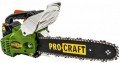 |
|---|---|---|
| Procraft K350S | Procraft K300S | |
| Outdated Product | Outdated Product | |
| TOP sellers | ||
| Product type | chainsaw | chainsaw |
| Type | portable | portable |
| Power source | petrol engine | petrol engine |
Motor | ||
| Engine size | 25.4 cm³ | 28 cm³ |
| Power | 1100 W | |
| Power | 1.5 hp | |
| Idle speed | 3100 rpm | |
| No load speed | 11000 rpm | 11000 rpm |
Cutting equipment | ||
| Bar/blade size | 300 mm | 300 mm |
| Chain pitch | 3/8 " | 0.325 " |
Protective functions | ||
| Chain brake |  | |
| Anti-vibration system |  | |
Features | ||
| In box | chain | chain |
General | ||
| Top handle | | |
| Noise level | 113 dB | 115 dB |
| Fuel tank volume | 0.23 L | 0.23 L |
| Oil tank volume | 0.16 L | 0.16 L |
| Weight | 4 kg | |
| Added to E-Catalog | september 2024 | june 2019 |


Compare Procraft K350S and K300S
You may be interested in
My comparisons
Procraft K350S often compared

Procraft K300S often compared

Glossary
Engine size
The volume of the engine of a gasoline saw (see "Power source"). On the one hand, the power and performance of the tool depend on this indicator, on the other hand, its weight, price and fuel consumption. Accordingly, it is necessary to choose a model taking into account the specifics of the planned work, and it does not always make sense to chase large volumes. In particular, for simple household tasks, an engine capacity of about 40 – 50 cm3 is considered quite sufficient, and in professional models this figure can exceed 100 cm3. More detailed selection recommendations can be found in special sources.
Power
Saw motor power in watts. For petrol tools (see "Power Source"), horsepower is additionally indicated, see below for details.
The higher the power, the better the tool is suitable for voluminous work and hard materials, the greater the depth of cut it can provide and the easier it can cope with significant loads. In addition, for different types of saws and different types of materials, the actual power values \u200b\u200bcan also be different. For example, a power of 2.5 – 3 kW is actually the limit for chain saws, but in chain saws this is an average figure, among such tools there are models of 3 – 4 kW and even more. Detailed selection recommendations for various cases can be found in special sources.
The higher the power, the better the tool is suitable for voluminous work and hard materials, the greater the depth of cut it can provide and the easier it can cope with significant loads. In addition, for different types of saws and different types of materials, the actual power values \u200b\u200bcan also be different. For example, a power of 2.5 – 3 kW is actually the limit for chain saws, but in chain saws this is an average figure, among such tools there are models of 3 – 4 kW and even more. Detailed selection recommendations for various cases can be found in special sources.
Power
The power of the saw engine expressed in horsepower (hp). This designation is traditionally used in gasoline models (see "Power Source") along with watts; 1 HP ≈ 735 W.
For more information about power, see the paragraph of the same name above.
For more information about power, see the paragraph of the same name above.
Idle speed
The speed of rotation of the engine in a saw with an internal combustion engine (see "Power") with no load on the blade and with the speed controller fully released (set to minimum). Theoretically, the lower the idle speed, the lower the fuel consumption without load (ceteris paribus); however, the difference between modern chainsaws is usually so insignificant that this parameter is more of a reference than a real practical value.
Chain pitch
Regular chain pitch for which the chain saw is designed (see "Device"). A step is the distance between two adjacent chain teeth; the greater this distance, the higher the productivity of the saw, however, for a large step, higher power is required, and the cut is rougher. Therefore, this parameter largely determines the class of the saw and the specifics of the work for which it is designed. The current standard options are:
— 1/4". The smallest size, found in a low power tool — 1-1.5 hp. It has not received wide popularity due to poor performance.
— 0.325 ". One of the most popular options among amateur-class tools. Saws for such a chain have a power of up to 3 – 3.5 hp, they are suitable for both cutting branches and felling trees of small thickness.
— 3/8 ". He is 0.375". Slightly larger pitch than 0.325" is better suited for rough scale work. Also considered a household and semi-professional option, very popular.
— 0.404 ". The largest tooth pitch in modern chain saws. Rare, used in the most powerful professional tools designed for heavy work — for example, logging.
Note that it is allowed to install chains on saws with a finer pitch than the regular one, but not with a larger one. The latter is fraught not only with a decrease in the quality of work, but also with a critical increase in loads, with the possibility of tool breakage.
— 1/4". The smallest size, found in a low power tool — 1-1.5 hp. It has not received wide popularity due to poor performance.
— 0.325 ". One of the most popular options among amateur-class tools. Saws for such a chain have a power of up to 3 – 3.5 hp, they are suitable for both cutting branches and felling trees of small thickness.
— 3/8 ". He is 0.375". Slightly larger pitch than 0.325" is better suited for rough scale work. Also considered a household and semi-professional option, very popular.
— 0.404 ". The largest tooth pitch in modern chain saws. Rare, used in the most powerful professional tools designed for heavy work — for example, logging.
Note that it is allowed to install chains on saws with a finer pitch than the regular one, but not with a larger one. The latter is fraught not only with a decrease in the quality of work, but also with a critical increase in loads, with the possibility of tool breakage.
Anti-vibration system
The design or set of special elements that reduce the transmission of vibrations from the engine and cutting part to the user's hands. Anti-vibration system makes work noticeably more comfortable, especially if the saw is used not just for a couple of minutes, but longer and regularly.
Thus, the tool tires the hands and forearms less, and the cutting itself often feels more controlled. It is especially useful in chainsaws and powerful reciprocating saws, where vibrations are more pronounced. In practice, this is convenient when sawing firewood, trimming branches, working on beams, or during prolonged demolition, where extra shaking quickly becomes a hindrance.
Thus, the tool tires the hands and forearms less, and the cutting itself often feels more controlled. It is especially useful in chainsaws and powerful reciprocating saws, where vibrations are more pronounced. In practice, this is convenient when sawing firewood, trimming branches, working on beams, or during prolonged demolition, where extra shaking quickly becomes a hindrance.
Top handle
The handle in the upper plane of the saw body for the convenience of carrying the tool and holding it when performing work. Also , the top handle helps guide the saw in the right direction during work.
Noise level
The noise level produced by the saw during operation. Note that this parameter is rather approximate, because in fact, the “loudness of the work” depends not only on the tool, but also on the material being processed and the characteristics of the environment. Nevertheless, the data given in the characteristics make it possible to assess the comfort of working with the tool. The lower this indicator, the less discomfort the noise will cause, and at high values, even special hearing protection may be needed.
Note that the noise level is usually measured in decibels, and this unit is not linear: for example, a difference of 3 dB corresponds to a difference of 2 times, 10 dB — to 10 times. Therefore, it is easiest to evaluate the noise level using comparative tables. Here is a simplified version of such a table for the range in which modern saws operate:
70 dB — loud conversation of several people in close proximity;
75 dB — a cry in the immediate vicinity;
80 dB — truck engine, mechanical alarm ringing;
85 dB — loud scream;
90 dB — freight car at a distance of 7 – 10 m;
95 dB — subway car at a distance of 7 – 10 m;
100 dB — industrial shop;
110 dB — tractor engine;
120 dB — demolition hammer, thunder from a close lightning strike (pain threshold of auditory perception).
Note that the noise level is usually measured in decibels, and this unit is not linear: for example, a difference of 3 dB corresponds to a difference of 2 times, 10 dB — to 10 times. Therefore, it is easiest to evaluate the noise level using comparative tables. Here is a simplified version of such a table for the range in which modern saws operate:
70 dB — loud conversation of several people in close proximity;
75 dB — a cry in the immediate vicinity;
80 dB — truck engine, mechanical alarm ringing;
85 dB — loud scream;
90 dB — freight car at a distance of 7 – 10 m;
95 dB — subway car at a distance of 7 – 10 m;
100 dB — industrial shop;
110 dB — tractor engine;
120 dB — demolition hammer, thunder from a close lightning strike (pain threshold of auditory perception).
Weight
The total weight of the tool. For petrol models (see "Power Source"), usually, dry weight is indicated, excluding fuel.
In general, it makes sense to pay attention to this parameter primarily when choosing a hand tool. At the same time, note that higher power, a more capacious battery or a capacious tank will inevitably affect weight. However, tools with similar characteristics can and do differ markedly in weight. And here it is worth considering that a lighter model will be more comfortable to work with, but weight reduction may affect reliability and/or cost. In addition, a more massive tool is more stable, it is not so prone to jerks under uneven loads. If we talk about specific numbers, then a weight of 3 kg or less is considered very light, 3–5 kg is relatively small, 5–7 kg is medium, 7–10 kg is significant, and some powerful tools (mainly gasoline) weigh and over 10 kg.
As for stationary saws, weight is of secondary importance for them — it mainly affects the ease of transportation.
In general, it makes sense to pay attention to this parameter primarily when choosing a hand tool. At the same time, note that higher power, a more capacious battery or a capacious tank will inevitably affect weight. However, tools with similar characteristics can and do differ markedly in weight. And here it is worth considering that a lighter model will be more comfortable to work with, but weight reduction may affect reliability and/or cost. In addition, a more massive tool is more stable, it is not so prone to jerks under uneven loads. If we talk about specific numbers, then a weight of 3 kg or less is considered very light, 3–5 kg is relatively small, 5–7 kg is medium, 7–10 kg is significant, and some powerful tools (mainly gasoline) weigh and over 10 kg.
As for stationary saws, weight is of secondary importance for them — it mainly affects the ease of transportation.