
Comparison STIHL MS 172 vs STIHL MS 162
Add to comparison | 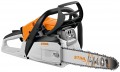 |  |
|---|---|---|
| STIHL MS 172 | STIHL MS 162 | |
| Outdated Product | Outdated Product | |
| TOP sellers | ||
| Product type | chainsaw | chainsaw |
| Type | portable | portable |
| Power source | petrol engine | petrol engine |
Motor | ||
| Engine size | 31.8 cm³ | 30.1 cm³ |
| Power | 1500 W | 1300 W |
| Power | 2.04 hp | 1.77 hp |
| Idle speed | 2800 rpm | |
| No load speed | 8500 rpm | |
Cutting equipment | ||
| Bar/blade size | 350 mm | 350 mm |
| Chain pitch | 3/8 " | 3/8 " |
Protective functions | ||
| Chain brake |  | |
| Anti-vibration system | | |
Features | ||
| In box | chain | chain |
General | ||
| Noise level | 111 dB | 112 dB |
| Fuel tank volume | 0.4 L | 0.4 L |
| Oil tank volume | 0.28 L | 0.28 L |
| Weight | 4.5 kg | 4.5 kg |
| Added to E-Catalog | june 2024 | june 2024 |


Compare STIHL MS 172 and MS 162
You may be interested in
My comparisons
STIHL MS 172 often compared


STIHL MS 162 often compared


Glossary
Engine size
The volume of the engine of a gasoline saw (see "Power source"). On the one hand, the power and performance of the tool depend on this indicator, on the other hand, its weight, price and fuel consumption. Accordingly, it is necessary to choose a model taking into account the specifics of the planned work, and it does not always make sense to chase large volumes. In particular, for simple household tasks, an engine capacity of about 40 – 50 cm3 is considered quite sufficient, and in professional models this figure can exceed 100 cm3. More detailed selection recommendations can be found in special sources.
Power
Saw motor power in watts. For petrol tools (see "Power Source"), horsepower is additionally indicated, see below for details.
The higher the power, the better the tool is suitable for voluminous work and hard materials, the greater the depth of cut it can provide and the easier it can cope with significant loads. In addition, for different types of saws and different types of materials, the actual power values \u200b\u200bcan also be different. For example, a power of 2.5 – 3 kW is actually the limit for chain saws, but in chain saws this is an average figure, among such tools there are models of 3 – 4 kW and even more. Detailed selection recommendations for various cases can be found in special sources.
The higher the power, the better the tool is suitable for voluminous work and hard materials, the greater the depth of cut it can provide and the easier it can cope with significant loads. In addition, for different types of saws and different types of materials, the actual power values \u200b\u200bcan also be different. For example, a power of 2.5 – 3 kW is actually the limit for chain saws, but in chain saws this is an average figure, among such tools there are models of 3 – 4 kW and even more. Detailed selection recommendations for various cases can be found in special sources.
Power
The power of the saw engine expressed in horsepower (hp). This designation is traditionally used in gasoline models (see "Power Source") along with watts; 1 HP ≈ 735 W.
For more information about power, see the paragraph of the same name above.
For more information about power, see the paragraph of the same name above.
Idle speed
The speed of rotation of the engine in a saw with an internal combustion engine (see "Power") with no load on the blade and with the speed controller fully released (set to minimum). Theoretically, the lower the idle speed, the lower the fuel consumption without load (ceteris paribus); however, the difference between modern chainsaws is usually so insignificant that this parameter is more of a reference than a real practical value.
No load speed
The highest speed that the saw engine is capable of delivering in normal operation.
We emphasize that this parameter should not be confused with the maximum disk speed (see below) — here we are talking exclusively about the speed of rotation of the motor shaft. It can be specified for all types of saws, not only for models using discs. However, in general, engine speed is more of a reference than really significant information. In fact, it is needed mainly for some specific tool maintenance tasks; when choosing, it is better to focus on indicators that are more “close to life” — engine power, cutting depth, chain / tape speed or disk speed, etc.
We emphasize that this parameter should not be confused with the maximum disk speed (see below) — here we are talking exclusively about the speed of rotation of the motor shaft. It can be specified for all types of saws, not only for models using discs. However, in general, engine speed is more of a reference than really significant information. In fact, it is needed mainly for some specific tool maintenance tasks; when choosing, it is better to focus on indicators that are more “close to life” — engine power, cutting depth, chain / tape speed or disk speed, etc.
Noise level
The noise level produced by the saw during operation. Note that this parameter is rather approximate, because in fact, the “loudness of the work” depends not only on the tool, but also on the material being processed and the characteristics of the environment. Nevertheless, the data given in the characteristics make it possible to assess the comfort of working with the tool. The lower this indicator, the less discomfort the noise will cause, and at high values, even special hearing protection may be needed.
Note that the noise level is usually measured in decibels, and this unit is not linear: for example, a difference of 3 dB corresponds to a difference of 2 times, 10 dB — to 10 times. Therefore, it is easiest to evaluate the noise level using comparative tables. Here is a simplified version of such a table for the range in which modern saws operate:
70 dB — loud conversation of several people in close proximity;
75 dB — a cry in the immediate vicinity;
80 dB — truck engine, mechanical alarm ringing;
85 dB — loud scream;
90 dB — freight car at a distance of 7 – 10 m;
95 dB — subway car at a distance of 7 – 10 m;
100 dB — industrial shop;
110 dB — tractor engine;
120 dB — demolition hammer, thunder from a close lightning strike (pain threshold of auditory perception).
Note that the noise level is usually measured in decibels, and this unit is not linear: for example, a difference of 3 dB corresponds to a difference of 2 times, 10 dB — to 10 times. Therefore, it is easiest to evaluate the noise level using comparative tables. Here is a simplified version of such a table for the range in which modern saws operate:
70 dB — loud conversation of several people in close proximity;
75 dB — a cry in the immediate vicinity;
80 dB — truck engine, mechanical alarm ringing;
85 dB — loud scream;
90 dB — freight car at a distance of 7 – 10 m;
95 dB — subway car at a distance of 7 – 10 m;
100 dB — industrial shop;
110 dB — tractor engine;
120 dB — demolition hammer, thunder from a close lightning strike (pain threshold of auditory perception).