
Comparison Romsat T7070HD vs Romsat T8030HD
Add to comparison | 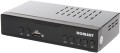 | 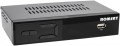 |
|---|---|---|
| Romsat T7070HD | Romsat T8030HD | |
| Outdated Product | from $14.18 up to $19.26 | |
| User reviews | ||
| TOP sellers | ||
8K support. High performance. 64 GB internal memory. Airplay streaming support. PVR and TimeShift support. | ||
| Type | TV tuner | TV tuner |
| Digital tuner | DVB-T (terrestrial) DVB-T2 (terrestrial) DVB-C (cable) | DVB-T (terrestrial) DVB-T2 (terrestrial) DVB-C (cable) |
Connectivity and interfaces | ||
| Wi-Fi | Wi-Fi ready | Wi-Fi ready |
| IPTV support |  |  |
Connectors | ||
| HDMI | 1 | 1 |
| USB-A 2.0 | 1 pcs | 1 pcs |
| AV output | | |
| Coaxial output | | |
| Antenna input | | |
| More features | RF Out | Antenna output (TV) |
General | ||
| Video decoders | H.264 | |
| Remote control | + | + |
| Dimensions (WxHxD) | 168x95x38 mm | |
| Added to E-Catalog | march 2025 | february 2020 |


Compare Romsat T7070HD and T8030HD
You may be interested in
My comparisons
Romsat T7070HD often compared


Romsat T8030HD often compared


Glossary
IPTV support
IPTV service support — broadcasting by the IP protocol, using computer networks (including the Internet).
This feature should not be confused with online TV: in fact, IPTV is a type of cable television, where not an antenna cable is used to transmit the signal, but network equipment. Otherwise, IPTV and cable TV are completely similar: broadcasting is carried out through the operator; the choice of channels is limited by the assortment presented by the operator; and additional charges may apply for access. At the same time, the possibilities of IPTV are much wider than those of traditional cable broadcasting. Most specialized applications have a Time Shift feature (see below); any excerpt of a recently watched broadcast can be re-watched; in addition, it is often also possible to rewind the broadcast to a point in time before the start of viewing (if you turned on such a TV later than you planned). Other features may be provided for additional convenience, such as favorite channel lists, parental guaid, etc.
This feature should not be confused with online TV: in fact, IPTV is a type of cable television, where not an antenna cable is used to transmit the signal, but network equipment. Otherwise, IPTV and cable TV are completely similar: broadcasting is carried out through the operator; the choice of channels is limited by the assortment presented by the operator; and additional charges may apply for access. At the same time, the possibilities of IPTV are much wider than those of traditional cable broadcasting. Most specialized applications have a Time Shift feature (see below); any excerpt of a recently watched broadcast can be re-watched; in addition, it is often also possible to rewind the broadcast to a point in time before the start of viewing (if you turned on such a TV later than you planned). Other features may be provided for additional convenience, such as favorite channel lists, parental guaid, etc.
Video decoders
Codec — from the phrase "Encoder-DECoder" — in this case is the format used for encoding digital video during storage/transmission and decoding during playback (without encoding, video data would take up an unjustifiably large amount of space). Do not confuse this parameter with the format of video files: different files of the same format can be encoded with different codecs, and if the corresponding codec is not supported by the player, video playback will be impossible, even if the file format itself corresponds to the capabilities of the device. And in models with online TV support (see "Features") this nuance also determines compatibility with a specific broadcast: the general format of the broadcast is indicated by the codec used for this.
In general, modern devices usually have quite extensive sets of codecs (one of the most advanced is H.265, AV1 codecis also popular), and there are usually no problems with video playback; in extreme cases, you can use special programs for transcoding files. As for specific codecs, detailed data on them can be found in special sources, but with standard use of media players, such details are not needed.
In general, modern devices usually have quite extensive sets of codecs (one of the most advanced is H.265, AV1 codecis also popular), and there are usually no problems with video playback; in extreme cases, you can use special programs for transcoding files. As for specific codecs, detailed data on them can be found in special sources, but with standard use of media players, such details are not needed.