
Comparison Bosch WTH 8627G PL vs Samsung DV90TA040AE
Add to comparison |  | 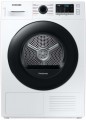 |
|---|---|---|
| Bosch WTH 8627G PL | Samsung DV90TA040AE | |
| Outdated Product | from $629.00 | |
| User reviews | ||
| TOP sellers | ||
| Drying type | condensing (heat pump) | condensing (heat pump) |
| Capacity | 8 kg | 9 kg |
| Drum volume | 112 L | |
Features | ||
| Number of drying programmes | 15 | 14 |
| Anti-crease function |  | |
| Moisture sensor | | |
| Delay start timer | | |
| Quick dry | | |
| Refresh cycle |  | |
| Drum lighting | | |
| Drain into sewer | | |
| Condensate tank indicator | | |
Efficiency classes | ||
| Drying class | B | B |
| Energy class | A++ | A++ |
| Noise level | 65 dB | 65 dB |
More specs | ||
| Controls | rotary knob + touch controls | rotary knob + touch controls |
| Display | LED | LED |
| Child lock | | |
| Door shape | round with glass | round with glass |
| Door opening | rightward | left/right |
| Dimensions (HxWxD) | 84.2x59.8x64.8 cm | 85x60x65 cm |
| Color | ||
| Added to E-Catalog | october 2024 | march 2021 |


Compare Bosch WTH 8627G PL and Samsung DV90TA040AE
You may be interested in
Bosch WTH 8627G PL often compared


Samsung DV90TA040AE often compared


Glossary
Capacity
The maximum amount of laundry that can be loaded into the dryer; in other words, the largest weight of laundry that the machine can efficiently process in one cycle.
Capacity is usually indicated by the weight of the dry laundry. Thanks to this, when preparing the laundry for washing, you can immediately assess whether it will fit in the dryer at a time or, on the contrary, you can get by with a small drying. However, even the most modest modern dryers (and even slim ones up to 50 cm) in most cases hold 7 kg — this is comparable to loading the drum of a medium-capacity washing machine. And in the most capacious models, this figure can reach 10 – 11 kg. It is quite enough for domestic and even professional use (for example, in laundromats or laundries of hotels, etc.). However, the typical figures are drying for 8 kg and models for 9 kg of laundry. Bigger capacity is relevant for industrial equipment and is not found in consumer-level models.
Also, when choosing, note that in the specs the maximum capacity is usually indicated for linen made of cotton fabric. For other, more voluminous materials, the capacity can be noticeably less — for example, the weight limit for wool products is usually 4-5 times less than for cotton.
Capacity is usually indicated by the weight of the dry laundry. Thanks to this, when preparing the laundry for washing, you can immediately assess whether it will fit in the dryer at a time or, on the contrary, you can get by with a small drying. However, even the most modest modern dryers (and even slim ones up to 50 cm) in most cases hold 7 kg — this is comparable to loading the drum of a medium-capacity washing machine. And in the most capacious models, this figure can reach 10 – 11 kg. It is quite enough for domestic and even professional use (for example, in laundromats or laundries of hotels, etc.). However, the typical figures are drying for 8 kg and models for 9 kg of laundry. Bigger capacity is relevant for industrial equipment and is not found in consumer-level models.
Also, when choosing, note that in the specs the maximum capacity is usually indicated for linen made of cotton fabric. For other, more voluminous materials, the capacity can be noticeably less — for example, the weight limit for wool products is usually 4-5 times less than for cotton.
Drum volume
The internal volume of the dryer drum.
A larger drum can accommodate more laundry, but there is no rigid dependence here: models with the same volume may differ in maximum load. It is because to process a large mass of laundry, one need not only a capacious drum but also an engine of appropriate power. At the same time, in a larger drum, the same mass of laundry will dry more efficiently than in a small one, because laundry will be more freely distributed over the drum, crumpled less, and warm air will better penetrate the folds of the fabric. As a result, for the same drum volume, a model with a smaller load will be more efficient and performant than a model with a larger load. On the other hand, a volumetric drum takes up more space and the dimensions of the dryer are largely determined by the dimensions of the drum.
A larger drum can accommodate more laundry, but there is no rigid dependence here: models with the same volume may differ in maximum load. It is because to process a large mass of laundry, one need not only a capacious drum but also an engine of appropriate power. At the same time, in a larger drum, the same mass of laundry will dry more efficiently than in a small one, because laundry will be more freely distributed over the drum, crumpled less, and warm air will better penetrate the folds of the fabric. As a result, for the same drum volume, a model with a smaller load will be more efficient and performant than a model with a larger load. On the other hand, a volumetric drum takes up more space and the dimensions of the dryer are largely determined by the dimensions of the drum.
Number of drying programmes
The number of preset drying programmes. Such programmes are often optimized for a specific type of fabric: linen, silk, synthetics, etc. The more drying programmes, the more versatile and easier the dryer is to use. However, a specific set of modes in different models may be different, and even a large variety of programmes does not guarantee that one of them will be suitable. So before buying, it is advisable to specify not only the quantity but the list of claimed programmes.
Refresh cycle
A programme designed to remove odours from clothes, such as tobacco smoke, or an unpleasant odour that appears after a long period of storage. The refresh programme is useful if the clothes are clean, but the smell still needs to be eliminated — refreshing in the dryer takes less time and effort than quick washing and then drying (even if using the same dryer). This function is especially relevant for drying cabinets.
Drum lighting
Lighting system for the internal volume of the device. It usually turns on automatically when the dryer door is opened - thus reducing the likelihood that some items (especially small and dark ones) will be forgotten in the drum.
Condensate tank indicator
It is an indicator signalling the filling of the tank with condensate and the need to empty it. It is used exclusively in models with a condensing type of drying (see above). The specific device and functionality of the indicator may be different: in some models, it only warns of a critical liquid level. In others, it can display the exact amount of condensate collected. However, this feature greatly simplifies the monitoring of the operation of the dryer and reduces the risk of flood and other troubles that can lead to an overflow of the tank.
Door opening
The direction in which the door of the dryer opens.
Most users are right-handed, so from this point of view, the best option is leftward opening — the free space for loading and unloading laundry is just under the right hand. However, specifically in dryers, the rightward opening is noticeably more common. It is because such units usually complement washing machines and are most often installed side by side. And in most washers, the door opens just to the left (again, based on convenience for right-handed people). Therefore, it is most convenient to place the dryer on the right and equip it with a hatch that opens to the right — this will allow you to overload the laundry from washer to dryer with minimal effort and time. And vice versa, if the door in the washing machine opens to the right, then it is better to choose a dryer with a leftward opening and install it on the left.
Sometimes both machines are installed as a column — a dryer on top of a washing machine. In such cases, the hatches of both machines should open in one direction — this is more convenient both from the point of view of ergonomics and purely psychologically. Moreover, if the "column” adjoins the wall sideways, then the opening should also occur towards the wall; otherwise, the laundry will have to be loaded and unloaded through the space between the open hatch and the wall, which can be very inconvenient....
Note that in some dryers both opening options are claimed. It usually means that the door has a reversible mount, and the direction of opening can be chosen at your discretion. However, this feature does not hurt to clarify before buying.
Most users are right-handed, so from this point of view, the best option is leftward opening — the free space for loading and unloading laundry is just under the right hand. However, specifically in dryers, the rightward opening is noticeably more common. It is because such units usually complement washing machines and are most often installed side by side. And in most washers, the door opens just to the left (again, based on convenience for right-handed people). Therefore, it is most convenient to place the dryer on the right and equip it with a hatch that opens to the right — this will allow you to overload the laundry from washer to dryer with minimal effort and time. And vice versa, if the door in the washing machine opens to the right, then it is better to choose a dryer with a leftward opening and install it on the left.
Sometimes both machines are installed as a column — a dryer on top of a washing machine. In such cases, the hatches of both machines should open in one direction — this is more convenient both from the point of view of ergonomics and purely psychologically. Moreover, if the "column” adjoins the wall sideways, then the opening should also occur towards the wall; otherwise, the laundry will have to be loaded and unloaded through the space between the open hatch and the wall, which can be very inconvenient....
Note that in some dryers both opening options are claimed. It usually means that the door has a reversible mount, and the direction of opening can be chosen at your discretion. However, this feature does not hurt to clarify before buying.