
Comparison Intertool BX-0326 vs Intertool BX-1024
Add to comparison | 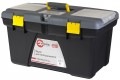 | 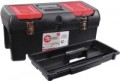 |
|---|---|---|
| Intertool BX-0326 | Intertool BX-1024 | |
from $30.72 up to $39.96 | from $20.80 up to $26.16 | |
| TOP sellers | ||
| Type | box | box |
| Suitable for | tools and small items | tools and small items |
Specs | ||
| Size | 26.5" | 24" |
| Lid organizer |  | |
| Organizer slots | 10 | 8 |
| Place for bits and sockets | |  |
| Detachable tray | | |
| Recessed handle | | |
General | ||
| Material | plastic | plastic |
| Lock material | plastic | metal |
| Dimensions | 670x393x370 mm | 610x255x251 mm |
| Added to E-Catalog | february 2016 | june 2015 |


Compare Intertool BX-0326 and BX-1024
You may be interested in
Intertool BX-1024 often compared

Glossary
Size
The main size of the container for tools. Inches are traditionally used for this designation, and the length is usually indicated as the main size. This information allows you to evaluate the "weight category" of the product as a whole, as well as to determine whether it is suitable for a particular instrument of large sizes. At the same time, the characteristics usually indicate the overall dimensions on all three main sides (in millimetres), however, it is more convenient for many craftsmen to use the size designation in inches.
For kits (see below), this paragraph indicates the dimensions of all containers supplied in the kit.
For kits (see below), this paragraph indicates the dimensions of all containers supplied in the kit.
Organizer slots
The number of individual cells provided in the organizer. In this case, we can talk about an organizer as a separate device (see "Type"), or a set of cells built into the lid of the box (see "Lid with an organizer"). And for solutions with removable partitions, in which cells can be combined, the maximum number is indicated — with all installed partitions.
Organizers, by definition, are designed mainly for small things. Therefore, the more cells there are, the more varieties of small items can be stored in a container. For example, in 10 cells you can keep bolts of five different sizes and separately nuts for them. Such a number of compartments — up to 10 — is generally considered small, but in fact it is often quite enough. 11 – 20 cells can be called an average, and the most capacious organizers have up to 30 compartments. However it is worth considering that with the same dimensions of the container, an increase in the number of cells leads to a decrease in their volume.
Organizers, by definition, are designed mainly for small things. Therefore, the more cells there are, the more varieties of small items can be stored in a container. For example, in 10 cells you can keep bolts of five different sizes and separately nuts for them. Such a number of compartments — up to 10 — is generally considered small, but in fact it is often quite enough. 11 – 20 cells can be called an average, and the most capacious organizers have up to 30 compartments. However it is worth considering that with the same dimensions of the container, an increase in the number of cells leads to a decrease in their volume.
Place for bits and sockets
The presence on the lid of the box (may occur in other versions, but very rarely) of separate niches for bits and end heads. Something similar is implemented in tool kits, where each accessory has its place and clearly lies in it.
Lock material
The material from which the container locks are made. Most often we are talking about fasteners that close a case or drawer, but sometimes this information is indicated for fasteners in bags, backpacks, etc. The main materials for their manufacture are:
- Plastic. Plastic is inexpensive, but in general it is inferior to metal in terms of strength and reliability. However, often these moments do not play a decisive role (or are compensated by design features - for example, the large thickness of individual parts).
- Metal. Metal locks are very durable and reliable, but they are more expensive than plastic ones. Tool boxes and containers made of almost any material can be equipped with such locks.
— Plastic with metal. This combination is not uncommon in the design of tool boxes and containers. As a rule, the locking bracket of the lock is made of metal, which bears the main load in the locking mechanism, and the “tongue” is made of plastic.
- Plastic. Plastic is inexpensive, but in general it is inferior to metal in terms of strength and reliability. However, often these moments do not play a decisive role (or are compensated by design features - for example, the large thickness of individual parts).
- Metal. Metal locks are very durable and reliable, but they are more expensive than plastic ones. Tool boxes and containers made of almost any material can be equipped with such locks.
— Plastic with metal. This combination is not uncommon in the design of tool boxes and containers. As a rule, the locking bracket of the lock is made of metal, which bears the main load in the locking mechanism, and the “tongue” is made of plastic.