
Comparison OfficePro MA452B vs 2E Kiy
Add to comparison |  | 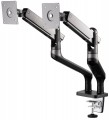 |
|---|---|---|
| OfficePro MA452B | 2E Kiy | |
| Outdated Product | Outdated Product | |
| User reviews | ||
| TOP sellers | ||
| Type | desktop mount | desktop mount |
| Number of mounts | for 2 panels | for 2 panels |
| Installation | universal | universal |
Specs | ||
| Minimum size | 17 " | 17 " |
| Max. size | 35 " | 32 " |
| Max. weight | 12 kg | 9 kg |
| Adjustments | for curved TV tilt turn depth adjustment slide rotation height adjustment | for curved TV tilt turn depth adjustment slide rotation height adjustment |
Angles and dimensions | ||
| Upward tilt angle | 90 ° | 40 ° |
| Downward tilt angle | 90 ° | 40 ° |
| Turn angle | 360 ° | 180 ° |
| Rotation angle | 180 ° | 180 ° |
| VESA | 75x75mm 100x100 mm | 75x75mm 100x100 mm |
| Removable VESA plate |  |  |
General | ||
| USB hub | 1xUSB A 5 Gbps + 1xUSB C 5 Gbps | |
| Cable management | | |
| Dimensions (WxHxD) | 1070x122x630 mm | |
| Color | ||
| Added to E-Catalog | july 2025 | april 2023 |


Compare OfficePro MA452B and 2E Kiy
You may be interested in
OfficePro MA452B often compared


2E Kiy often compared


Glossary
Max. size
The maximum size of the TV screen that can be installed on the stand/mount. Like the minimum size (see above), it is in some way a conditional indicator — TVs with a larger size can also fit for the mount, and then the main determining parameter will be the maximum weight (see below).
Max. weight
The maximum weight of the TV that can be installed on the mount/stand; more specifically, it is the maximum weight that the mount/stand can support for an indefinitely long time without any negative consequences. Unlike the screen size described above, this parameter is accurate and should not be exceeded: perhaps the stand/mount will not break immediately under excess weight, but this can happen at any time, and such a breakdown is not covered by the warranty.
It is worth considering that for classic stands with several shelves (see "Type"), the maximum wheight is usually indicated for the entire structure as a whole and is the sum of the loads for each individual shelf. Thus, the maximum weight of the TV is not limited by the total maximum wheight, but by the maximum wheight for one shelf. This does not apply to stands with mounts; they usually list the maximum wheight on the mount, in which case it corresponds to the maximum weight of the TV.
The screen size is directly related to the maximum wheight (after all, a large TV weighs more). Typically, for screens up to 24", structures with a maximum wheight of about 5-6 kg are usually quite enough, for a 32" device, about 12 kg may be needed, large 55" screens reach a maximum weight of about 25-30 kg, and in the case of plasma panels, these figures increase by 1.5-2 times However, anyway, before choosing, you should clarify the weight of the specific TV model for which the stand/mount is selected.
It is worth considering that for classic stands with several shelves (see "Type"), the maximum wheight is usually indicated for the entire structure as a whole and is the sum of the loads for each individual shelf. Thus, the maximum weight of the TV is not limited by the total maximum wheight, but by the maximum wheight for one shelf. This does not apply to stands with mounts; they usually list the maximum wheight on the mount, in which case it corresponds to the maximum weight of the TV.
The screen size is directly related to the maximum wheight (after all, a large TV weighs more). Typically, for screens up to 24", structures with a maximum wheight of about 5-6 kg are usually quite enough, for a 32" device, about 12 kg may be needed, large 55" screens reach a maximum weight of about 25-30 kg, and in the case of plasma panels, these figures increase by 1.5-2 times However, anyway, before choosing, you should clarify the weight of the specific TV model for which the stand/mount is selected.
Upward tilt angle
The maximum upwards tilt angle from the vertical of the installed screen. The larger the tilt angle, the wider the adjustment possibilities, however, in fact, an angle of more than 5° is rarely required.
Downward tilt angle
The maximum downward tilt angle from the vertical for the installed screen. As with the upward tilt angle, the larger this angle, the wider the adjustment possibilities; however, downward tilt is usually required more frequently (the TV may be installed under the ceiling), and its angle can be as high as 15-20°.
Turn angle
The angle within which the screen installed on the mount can rotate. Measured from far left to far right. In modern models, it can reach 180°.
Removable VESA plate
"Quick-release" interface between TV/monitor and bracket: a thin plate is screwed to the screen according to the VESA standard (usually 75×75, 100×100, 200×200, and larger), then clicks into the base on the bracket with one motion and is fixed with a locking screw or latch. This solution speeds up installation and maintenance: you can hang a heavy monitor solo, quickly remove the TV for cable management or cleaning, and easily move the screen from wall mounting to a desktop arm. Compared to a fixed plate, it's more convenient and there's less risk of missing the holes; the downsides are a slight increase in extension and possible play in cheap mechanisms. Typical scenarios include an office with frequent monitor rotation, a digital menu and display service, and a home setup where the screen is periodically removed for port access.
USB hub
A set of additional USB ports provided in the design of the stand or mount. Brackets with a USB hub allow you to covertly lay wires, they are also used to connect flash drives and various peripherals. In some cases, the hub has an autonomous power source, so you can power all kinds of USB gadgets from it. Typically, a USB hub includes two or four USB 3.2 gen1 ports.