
Comparison Hator Hypergang 3 vs HyperX Cloud Alpha
Add to comparison |  | 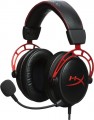 |
|---|---|---|
| Hator Hypergang 3 | HyperX Cloud Alpha | |
| Outdated Product | Compare prices 7 | |
| User reviews | ||
| TOP sellers | ||
Hi-Res certification and wide frequency range. | ||
Connection and design | ||
| Features | gaming | gaming |
| Design | overhead, closed full size Over-Ear | overhead, closed full size Over-Ear |
| Connection type | wired | wired |
| Connection | mini-Jack (3.5 mm) mini-Jack (2 x 3.5 mm) | mini-Jack (3.5 mm) mini-Jack (2 x 3.5 mm) |
| Plug | straight | straight |
| Cable supply | single-sided | single-sided |
| Cable length | 1.3 m | 1.3 m |
| Cable type | round | round, braided |
| Detachable cable |  | |
Specs | ||
| Hi-Res Audio | |  |
| Impedance | 32 Ohm | 65 Ohm |
| Power | 30 mW | |
| Frequency range | 10 – 44000 Hz | 13 – 27000 Hz |
| Sensitivity | 112 dB | 98 dB |
| Speaker size | 53 mm | 50 mm |
| Emitter type | dynamic | dynamic |
| Harmonic distortion coefficient | < 1 % | |
Microphone specs | ||
| Microphone | detachable at the shackle | detachable at the shackle |
| Frequency range | 50 – 18000 Hz | |
| Sensitivity | -38 dB | -43 dB |
| Microphone noise canceling | ENC | |
| Microphone mute | | |
| Flexible design | | |
Features | ||
| Volume control | | |
General | ||
| Ear cushion material | leatherette | leatherette |
| Weight | 310 g | 298 g |
| In box | additional cable | case extension lead |
| Color | ||
| Added to E-Catalog | march 2025 | august 2017 |





Compare Hator Hypergang 3 and HyperX Cloud Alpha
Price comparison
You may be interested in
My comparisons
Hator Hypergang 3 often compared


HyperX Cloud Alpha often compared


Glossary
Cable type
The type of cable provided in the design or delivery of the headphones. Note that this parameter is relevant both for wired or combined models (see “Connection type”), and for some wireless models - in particular, earbuds and in-ear headphones without a mount, where a wire connects one earphone to another.
- Round. The classic round wire is straight, without braiding or other additional accessories. It is inexpensive and in most cases quite practical, which is why it is found in most modern headphones. The disadvantage is that if the thickness is small, the round wire is prone to tangling; therefore, this option is considered not very convenient for compact headphones, such as in-ear or in-ear (see “Design”), which often have to be carried in a pocket or bag.
- Flat. The main advantage of a flat cable is that it does not get tangled as much as a round cable, and if something happens it is much easier to untangle. This is especially important for earbuds and in-ear headphones, which are often rolled up for storage or transport. However, larger overhead models can also be equipped with a flat wire.
— Round, braided. A round wire with an outer braid, usually fabric. See above for details on round wire. And the presence of a braid gives such a cable a number of advantages over the classic one with “bare” insula...tion. Thus, the wire turns out to be more durable, reliable and resistant to kinks and pressure, tangles less, has a solid appearance, and in some models the braiding also provides shielding from external interference. The downside of these advantages is the increased price.
— Spiral. A round cable, coiled into a spring. The main advantages of a spiral wire are that it practically does not tangle and can significantly stretch relative to its original length. The latter is very convenient if, as you use your ears, you have to change the distance to the signal source. The disadvantages of spiral cable are bulkiness and relatively high cost. Therefore, it is often used in mid-range and top-end headphones (including professional models).
- Round, braided. A cable in the form of two wires twisted into a spiral. This option should not be confused with a spiral wire - in this case we are not talking about a spring. This cable is notable primarily for its unusual appearance; For greater originality, the wiring can be made in different colors. It is also somewhat more tangle-resistant than the classic round one, although a lot depends on the thickness. At the same time, individual wires can be noticeably thinner than a solid round wire, which somewhat reduces reliability.
- Round. The classic round wire is straight, without braiding or other additional accessories. It is inexpensive and in most cases quite practical, which is why it is found in most modern headphones. The disadvantage is that if the thickness is small, the round wire is prone to tangling; therefore, this option is considered not very convenient for compact headphones, such as in-ear or in-ear (see “Design”), which often have to be carried in a pocket or bag.
- Flat. The main advantage of a flat cable is that it does not get tangled as much as a round cable, and if something happens it is much easier to untangle. This is especially important for earbuds and in-ear headphones, which are often rolled up for storage or transport. However, larger overhead models can also be equipped with a flat wire.
— Round, braided. A round wire with an outer braid, usually fabric. See above for details on round wire. And the presence of a braid gives such a cable a number of advantages over the classic one with “bare” insula...tion. Thus, the wire turns out to be more durable, reliable and resistant to kinks and pressure, tangles less, has a solid appearance, and in some models the braiding also provides shielding from external interference. The downside of these advantages is the increased price.
— Spiral. A round cable, coiled into a spring. The main advantages of a spiral wire are that it practically does not tangle and can significantly stretch relative to its original length. The latter is very convenient if, as you use your ears, you have to change the distance to the signal source. The disadvantages of spiral cable are bulkiness and relatively high cost. Therefore, it is often used in mid-range and top-end headphones (including professional models).
- Round, braided. A cable in the form of two wires twisted into a spiral. This option should not be confused with a spiral wire - in this case we are not talking about a spring. This cable is notable primarily for its unusual appearance; For greater originality, the wiring can be made in different colors. It is also somewhat more tangle-resistant than the classic round one, although a lot depends on the thickness. At the same time, individual wires can be noticeably thinner than a solid round wire, which somewhat reduces reliability.
Hi-Res Audio
Headphone support for Hi-Res Audio. The corresponding format is designed to provide a sound close to that recorded in the studio. Hi-Res Audio refers to a digital signal with parameters from 96 kHz / 24 bits, and for analog technology, the requirement for an extended frequency response is set from 40 kHz. Audio tracks in this format sound as close as possible to the original ideas of the authors of the compositions. The Hi-Res license marks premium headphones for avid audiophiles.
Impedance
Impedance refers to the headphone's nominal resistance to AC current, such as an audio signal.
Other things being equal, a higher impedance reduces distortion, but requires a more powerful amplifier — otherwise the headphones simply will not be able to produce sufficient volume. Thus, the choice of resistance depends primarily on which signal source you plan to connect the "ears". So, for a portable gadget (smartphone, pocket player), an indicator of 16 ohms or less is considered optimal, 17 – 32 ohms is not bad. Higher values — 33 – 64 ohms and 65 – 96 ohms — will require quite powerful amplifiers, like those used in computers and televisions. And models with a resistance of 96 – 250 ohms and above are designed mainly for Hi-End audio equipment and professional use; for such cases, detailed recommendations for selection can be found in special sources.
Other things being equal, a higher impedance reduces distortion, but requires a more powerful amplifier — otherwise the headphones simply will not be able to produce sufficient volume. Thus, the choice of resistance depends primarily on which signal source you plan to connect the "ears". So, for a portable gadget (smartphone, pocket player), an indicator of 16 ohms or less is considered optimal, 17 – 32 ohms is not bad. Higher values — 33 – 64 ohms and 65 – 96 ohms — will require quite powerful amplifiers, like those used in computers and televisions. And models with a resistance of 96 – 250 ohms and above are designed mainly for Hi-End audio equipment and professional use; for such cases, detailed recommendations for selection can be found in special sources.
Power
Headphone power is expressed in milliwatts (mW) - this figure can vary from a modest figure of 1 mW to an impressive level of 5000 mW. For the vast majority of headphones, power is not a decisive factor. In essence, this is an indicator of how loud the sound can be without the risk of damaging the drivers. At the same time, the parameter is important for some professional studio and audiophile models - in this case, power means the maximum audio signal level that is allowed to be supplied to the headphones from the sound source. If the headphones are used with a device that supplies too strong a signal, they may distort the sound or fail.
Frequency range
The range of sound frequencies that headphones can reproduce.
The wider this range, the more fully the headphones reproduce the spectrum of sound frequencies, the lower the likelihood that too low or too high frequencies will be inaccessible. However, there are some nuances to consider here. First of all, let us remind you that the perceptual range of the human ear is on average from 16 Hz to 22 kHz, and for the complete picture it is enough for headphones to cover this range. However, modern models can significantly exceed these boundaries: in many devices the lower threshold does not exceed 15 Hz, or even 10 Hz, and the upper limit can reach 25 kHz, 30 kHz and even more. Such wide ranges in themselves do not provide practical advantages, but they usually indicate a high class of headphones, and are sometimes given only for advertising purposes.
The second important point is that a wide frequency range in itself is not a guarantee of good sound: sound quality also depends on a number of parameters, primarily the amplitude-frequency response of the headphones.
The wider this range, the more fully the headphones reproduce the spectrum of sound frequencies, the lower the likelihood that too low or too high frequencies will be inaccessible. However, there are some nuances to consider here. First of all, let us remind you that the perceptual range of the human ear is on average from 16 Hz to 22 kHz, and for the complete picture it is enough for headphones to cover this range. However, modern models can significantly exceed these boundaries: in many devices the lower threshold does not exceed 15 Hz, or even 10 Hz, and the upper limit can reach 25 kHz, 30 kHz and even more. Such wide ranges in themselves do not provide practical advantages, but they usually indicate a high class of headphones, and are sometimes given only for advertising purposes.
The second important point is that a wide frequency range in itself is not a guarantee of good sound: sound quality also depends on a number of parameters, primarily the amplitude-frequency response of the headphones.
Sensitivity
Rated headphone sensitivity. Technically, this is the volume at which they sound when a certain standard signal from the amplifier is connected to them. Thus, sensitivity is one of the parameters that determine the overall volume of the headphones: the higher it is, the louder the sound will be with the same input signal level and other things being equal. However, we must not forget that the volume level also depends on the resistance (impedance, see above); moreover, it is worth choosing “ears” for a specific device first by impedance, and only then by sensitivity. In this case, one parameter can be compensated for by another: for example, a model with high resistance and high sensitivity can work even on a relatively weak amplifier.
As for specific figures, headphones with indicators of 100 dB or less are designed mainly for use in a quiet environment (in some similar models, the sensitivity does not exceed 90 dB). For use on the street, in transport and other similar conditions, it is desirable to have more sensitive headphones — about 101 – 105 dB, or even 110 dB. And in some models, this figure can reach 116 – 120 dB. and even more.
It is also worth noting that this parameter is relevant only for a wired connection according to the analogue standard — for example, via a 3.5 mm mini-...jack. When using digital interfaces like USB and wireless channels like Bluetooth, the sound is processed in the built-in headphone converter, and if you plan to mainly use this kind of application, you can not pay much attention to sensitivity.
As for specific figures, headphones with indicators of 100 dB or less are designed mainly for use in a quiet environment (in some similar models, the sensitivity does not exceed 90 dB). For use on the street, in transport and other similar conditions, it is desirable to have more sensitive headphones — about 101 – 105 dB, or even 110 dB. And in some models, this figure can reach 116 – 120 dB. and even more.
It is also worth noting that this parameter is relevant only for a wired connection according to the analogue standard — for example, via a 3.5 mm mini-...jack. When using digital interfaces like USB and wireless channels like Bluetooth, the sound is processed in the built-in headphone converter, and if you plan to mainly use this kind of application, you can not pay much attention to sensitivity.
Speaker size
The diameter of the speaker installed in the headphones; models with multiple drivers (see "Number of drivers"), usually, the size of the largest speaker is taken into account, other dimensions can be specified in the notes.
In general, this parameter is relevant primarily for over-ear headphones (see "Design"). In them, emitters can have different sizes; the larger it is, the more saturated the sound is and the better the speaker reproduces the bass, however, large emitters have a corresponding effect on the dimensions, weight and price of the headphones. But in-ear "ears" and earbuds, by definition, have very small speakers, and rich bass in them is achieved due to other design features.
In general, this parameter is relevant primarily for over-ear headphones (see "Design"). In them, emitters can have different sizes; the larger it is, the more saturated the sound is and the better the speaker reproduces the bass, however, large emitters have a corresponding effect on the dimensions, weight and price of the headphones. But in-ear "ears" and earbuds, by definition, have very small speakers, and rich bass in them is achieved due to other design features.
Harmonic distortion coefficient
The coefficient of harmonic distortion produced by this model of headphones.
This parameter determines the amount of non-linear distortion introduced by the headphones into the reproduced sound. The lower it is, the less such distortions, the cleaner and closer to the original sound is. So, an indicator of 1% or more can be considered tolerable at best, from 0.5% to 1% — good, less than 0.5% — excellent (such indicators are acceptable even for monitor headphones), and less than 0.1% — almost perfect.
Note that a low harmonic coefficient in itself does not guarantee high-quality sound — a lot depends on other features of the headphones, primarily the frequency response.
This parameter determines the amount of non-linear distortion introduced by the headphones into the reproduced sound. The lower it is, the less such distortions, the cleaner and closer to the original sound is. So, an indicator of 1% or more can be considered tolerable at best, from 0.5% to 1% — good, less than 0.5% — excellent (such indicators are acceptable even for monitor headphones), and less than 0.1% — almost perfect.
Note that a low harmonic coefficient in itself does not guarantee high-quality sound — a lot depends on other features of the headphones, primarily the frequency response.
Frequency range
The range of audio frequencies that the headphone's own microphone can normally "hear".
Theoretically, the wider this range, the more advanced and high-quality the microphone is, the closer the sound transmitted by it is to the real one. In fact, extensive frequency coverage is not always required. So, the working range of the human ear is about 16 – 22,000 Hz, and even then not everyone hears its upper part. And human speech usually covers frequencies from 500 Hz to 2 kHz, at least this range is considered quite sufficient for its transmission. So if you need a microphone for simple tasks like voice communication on the Internet or game chat, you can not pay much attention to the frequency range: even in the most modest models, it is more than sufficient for normal speech transmission.
Theoretically, the wider this range, the more advanced and high-quality the microphone is, the closer the sound transmitted by it is to the real one. In fact, extensive frequency coverage is not always required. So, the working range of the human ear is about 16 – 22,000 Hz, and even then not everyone hears its upper part. And human speech usually covers frequencies from 500 Hz to 2 kHz, at least this range is considered quite sufficient for its transmission. So if you need a microphone for simple tasks like voice communication on the Internet or game chat, you can not pay much attention to the frequency range: even in the most modest models, it is more than sufficient for normal speech transmission.