
Comparison JBL Quantum 100M2 vs JBL Quantum 100
Add to comparison |  | 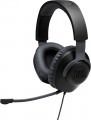 |
|---|---|---|
| JBL Quantum 100M2 | JBL Quantum 100 | |
| Compare prices 5 | Compare prices 8 | |
| User reviews | ||
| TOP sellers | ||
Connection and design | ||
| Features | gaming | gaming |
| Design | overhead, closed full size Over-Ear swiveling earcups | overhead, closed full size Over-Ear swiveling earcups |
| Connection type | wired | wired |
| Connection | mini-Jack (3.5 mm) | mini-Jack (3.5 mm) |
| Plug | 45° angle | |
| Cable length | 1.2 m | 1.2 m |
| Cable type | round | round |
Specs | ||
| Impedance | 32 Ohm | 32 Ohm |
| Power | 20 mW | |
| Frequency range | 20 – 20000 Hz | 20 – 20000 Hz |
| Sensitivity | 96 dB | 96 dB |
| Speaker size | 40 mm | 40 mm |
| Emitter type | dynamic | dynamic |
Microphone specs | ||
| Microphone | detachable at the shackle | detachable at the shackle |
| Frequency range | 100 – 10000 Hz | 100 – 10000 Hz |
| Sensitivity | -42 dB | -42 dB |
| Microphone mute |  | |
Features | ||
| Volume control | | |
General | ||
| Ear cushion material | textiles | leatherette |
| Weight | 220 g | 220 g |
| In box | microphone windscreen | microphone windscreen |
| Color | ||
| Added to E-Catalog | september 2024 | april 2020 |





Compare JBL Quantum 100M2 and Quantum 100
Price comparison
You may be interested in
My comparisons
JBL Quantum 100M2 often compared

JBL Quantum 100 often compared


Glossary
Plug
The design of the plug provided in the headphones. This parameter is relevant primarily for models with a mini-Jack interface (see "Connection") — the rest of the plugs are made straight in most cases, exceptions are extremely rare.
— Direct. The traditional, most simple and unpretentious option is plugs that do not have any bends. Usually, they are compatible without restrictions with stationary audio equipment, PCs, laptops, etc. But for smartphones and other portable gadgets, this option is not always optimal — it all depends on how the gadget is located in your pocket or case. In some cases — for example, when carrying a smartphone in a regular pants pocket — such a wire can be strongly bent around the plug, which quickly becomes unusable; in such cases it is worth paying attention to L-shaped or curved plugs (see below).
— L-shaped. Plugs angled at 90° in the shape of the letter L. Designed primarily for use with smartphones and other handheld devices: such devices, when worn, can be positioned in such a way that a bent plug is more convenient than a straight one. However, the L-shaped design may also be the best choice for stationary equipment, where the headphone wire approaches the connector at a right angle — for example, this situation is often found in computers and laptops.
— At an angle of 45°. A variation of the L-shaped plug...described above, bent not at a straight line, but at a smaller angle (not necessarily exactly 45 °). It is also designed primarily for pocket equipment, and with such an application, such plugs are considered even more convenient and reliable than traditional L-shaped ones. But for stationary devices, it hardly makes sense to specifically look for a model with a similar connector (although such an application is technically quite possible).
— Direct. The traditional, most simple and unpretentious option is plugs that do not have any bends. Usually, they are compatible without restrictions with stationary audio equipment, PCs, laptops, etc. But for smartphones and other portable gadgets, this option is not always optimal — it all depends on how the gadget is located in your pocket or case. In some cases — for example, when carrying a smartphone in a regular pants pocket — such a wire can be strongly bent around the plug, which quickly becomes unusable; in such cases it is worth paying attention to L-shaped or curved plugs (see below).
— L-shaped. Plugs angled at 90° in the shape of the letter L. Designed primarily for use with smartphones and other handheld devices: such devices, when worn, can be positioned in such a way that a bent plug is more convenient than a straight one. However, the L-shaped design may also be the best choice for stationary equipment, where the headphone wire approaches the connector at a right angle — for example, this situation is often found in computers and laptops.
— At an angle of 45°. A variation of the L-shaped plug...described above, bent not at a straight line, but at a smaller angle (not necessarily exactly 45 °). It is also designed primarily for pocket equipment, and with such an application, such plugs are considered even more convenient and reliable than traditional L-shaped ones. But for stationary devices, it hardly makes sense to specifically look for a model with a similar connector (although such an application is technically quite possible).
Power
Headphone power is expressed in milliwatts (mW) - this figure can vary from a modest figure of 1 mW to an impressive level of 5000 mW. For the vast majority of headphones, power is not a decisive factor. In essence, this is an indicator of how loud the sound can be without the risk of damaging the drivers. At the same time, the parameter is important for some professional studio and audiophile models - in this case, power means the maximum audio signal level that is allowed to be supplied to the headphones from the sound source. If the headphones are used with a device that supplies too strong a signal, they may distort the sound or fail.
Ear cushion material
For full-size headphones, ear pads are often made of genuine leather, leatherette, textile, velor, leatherette, memory foam, as well as their combined variations. In the caste of in-ear headphones, completely different materials are used - the most common are silicone pads, which gently adapt to the individual structure of the auricle, and as an alternative to them, foam ear pads with a porous structure (so-called “sponges”) are offered. Here are some features of commonly used ear pad materials:
- Textiles. Fabric ear pads are usually found in budget headphone models, but sometimes they are also used in the premium segment. The tactile textile ear pads are pleasant to the touch, and they also allow air to pass through well. In terms of acoustic properties, these are completely neutral materials. Note that such ear pads can be made from various types of fabrics (for example, microfiber).
- Leatherette. Artificial leather substitutes are used in headphones of all price categories. In fact, the properties of this material depend on the specific type of leatherette: ear pads made of conventional eco-leather can have excellent “breathing” qualities, while low-grade leatherette often provokes increased sweating of the ears (especially in the hot season).
- Genuine Leather. Genuine leather is a premium product used in corresponding flagship-level...headphone models. Thick leather provides proper sound insulation and deep bass response. At the same time, your ears may sweat when using leather ear pads. To avoid increased sweating, the leather is often made perforated.
— Velor. The most delicate material to the touch with excellent sound-absorbing abilities. Velor ear pads provide good noise insulation, and headphones with them do not cause fatigue even after a long stay on the head. However, the material also has disadvantages: it gets dirty easily, attracts dust and pet hair, and wears out quickly.
- Alcantara. Ear pads made of artificial suede, which are as close as possible in properties and tactile sensations to velor products. However, Alcantara is easier to clean from dirt and lasts much longer. Alcantara ear pads are found in top-level headphones.
- Foam rubber. Foam ear pads are the prerogative of budget over-ear headphones. The fact is that this is a short-lived material that often requires replacement due to its low strength. Partially, special impregnations solve the problem, but foam rubber still retains its structure for a relatively short time.
- Fur. Quite a rare type of material for making ear pads. Headphones with characteristic fur ear pads perform a practical function - they warm the listener’s ears during the cold season.
- Textiles. Fabric ear pads are usually found in budget headphone models, but sometimes they are also used in the premium segment. The tactile textile ear pads are pleasant to the touch, and they also allow air to pass through well. In terms of acoustic properties, these are completely neutral materials. Note that such ear pads can be made from various types of fabrics (for example, microfiber).
- Leatherette. Artificial leather substitutes are used in headphones of all price categories. In fact, the properties of this material depend on the specific type of leatherette: ear pads made of conventional eco-leather can have excellent “breathing” qualities, while low-grade leatherette often provokes increased sweating of the ears (especially in the hot season).
- Genuine Leather. Genuine leather is a premium product used in corresponding flagship-level...headphone models. Thick leather provides proper sound insulation and deep bass response. At the same time, your ears may sweat when using leather ear pads. To avoid increased sweating, the leather is often made perforated.
— Velor. The most delicate material to the touch with excellent sound-absorbing abilities. Velor ear pads provide good noise insulation, and headphones with them do not cause fatigue even after a long stay on the head. However, the material also has disadvantages: it gets dirty easily, attracts dust and pet hair, and wears out quickly.
- Alcantara. Ear pads made of artificial suede, which are as close as possible in properties and tactile sensations to velor products. However, Alcantara is easier to clean from dirt and lasts much longer. Alcantara ear pads are found in top-level headphones.
- Foam rubber. Foam ear pads are the prerogative of budget over-ear headphones. The fact is that this is a short-lived material that often requires replacement due to its low strength. Partially, special impregnations solve the problem, but foam rubber still retains its structure for a relatively short time.
- Fur. Quite a rare type of material for making ear pads. Headphones with characteristic fur ear pads perform a practical function - they warm the listener’s ears during the cold season.