
Comparison Pro-Ject Debut Evo 2 vs Pro-Ject Juke Box E
Add to comparison |  | 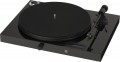 |
|---|---|---|
| Pro-Ject Debut Evo 2 | Pro-Ject Juke Box E | |
from $799.00 | from $799.00 | |
| User reviews | ||
| TOP sellers | ||
Built-in amplifier for connecting a pair of passive speakers 50 W (4 ohms). bluetooth interface. 2 pairs of RCA outputs (phono, preamp). 3 colour options. Display. Remote control. Outdated version of Bluetooth 2.1. | ||
Pickup | ||
| Model | OM5e | |
| Type | MM | MM |
| Needle shape | elliptical | |
| Output level | 4 mV | |
| Downforce | 1.5 – 2 g | |
| Pickup weight | 5 g | |
Tonearm | ||
| Type | radial | radial |
| Shape | straight | straight |
| Material | carbon | aluminium |
| Tonearm effective length | 219 mm | 219 mm |
| Tonearm weight | 10 g | 8 g |
Design | ||
| Drive unit | belt | belt |
| Speed control | mechanical (manual) | electronic (automatic) |
| Display |  |  |
| Remote control | | |
| Cover | | |
| External power supply | | |
| Phono stage | in absent | switchable |
Features | ||
| Features | adjustable counterweight anti-skating | adjustable counterweight anti-skating |
| Connection | Bluetooth audio input | |
Specs | ||
| Frequency range | 20 – 20000 Hz | 20 – 20000 Hz |
| Signal to noise ratio | 68 dB | 65 dB |
| Knock ratio | 0.29 % | |
| Speed deviation | 0.8 % | |
General | ||
| Power consumption | 4 W | 110 W |
| Base material | MDF/Fibreboard | MDF/Fibreboard |
| Platter material | aluminium | MDF |
| Platter size | 300 mm | 300 mm |
| Adjustable feet | | |
| Dimensions (WxDxH) | 415x320x113 mm | 415x334x118 mm |
| Turntable weight | 6 kg | 5 kg |
| Color | ||
| Added to E-Catalog | july 2025 | december 2018 |


Compare Pro-Ject Debut Evo 2 and Juke Box E
You may be interested in
My comparisons
Pro-Ject Debut Evo 2 often compared

Pro-Ject Juke Box E often compared


Glossary
Model
Model of the pickup (cartridge) supplied with the player. The pickup is one of the most important parts of any vinyl player, the quality of the received sound largely depends on its quality. Knowing the name of the model, you can find detailed data on it and determine how satisfied you are with this particular cartridge.
Needle shape
The shape of the needle in the pickup (cartridge) that the player is equipped with.
— Conical. It may also be called spherical. The simplest type of needles for vinyl players. Such needles are inexpensive, but the sound quality when using them is relatively low — due to the fact that the shape of the needle rather weakly matches the shape of the groove on the record.
— Elliptical. Elliptical needles have a narrower shape than conical (spherical) needles, which improves contact and allows, in particular, more accurate reproduction of high frequencies, and also reduces record wear. Due to the good value for money, this option is very popular.
— Linear. The most advanced variety: sharply sharpened needles of complex shape, following the contours of the grooves on the plate as accurately as possible and having the largest contact area among all types. The downside of this is the complexity in production and, accordingly, the high cost.
— Conical. It may also be called spherical. The simplest type of needles for vinyl players. Such needles are inexpensive, but the sound quality when using them is relatively low — due to the fact that the shape of the needle rather weakly matches the shape of the groove on the record.
— Elliptical. Elliptical needles have a narrower shape than conical (spherical) needles, which improves contact and allows, in particular, more accurate reproduction of high frequencies, and also reduces record wear. Due to the good value for money, this option is very popular.
— Linear. The most advanced variety: sharply sharpened needles of complex shape, following the contours of the grooves on the plate as accurately as possible and having the largest contact area among all types. The downside of this is the complexity in production and, accordingly, the high cost.
Output level
The signal level at the output of the pickup supplied with the player is, in fact, the power of the signal coming from the pickup to the phono stage. This parameter is necessary, first of all, in cases where the player is planned to be connected to an external phono stage: such equipment must be designed for the corresponding power of the signal coming from the pickup.
Downforce
The force of pressing the needle on the plate, which the complete pickup (cartridge) is designed for.
This force depends on the rigidity (compliance) of the needle: the greater the clamping force, the harder the cartridge, respectively, the less pliable it is. It is also believed that less pressing force wears out the record less, but it cannot be said that "light" cartridges are definitely better — there are many other nuances. So in fact, information about the pressing force of a complete pickup is needed mainly in case of its replacement. Usually, the pressing force provided by the arm of the turntable is regulated within these limits, so the new cartridge must also be rated for the same values of downforce — otherwise there is a chance that the turntable will not be able to correctly align.
This force depends on the rigidity (compliance) of the needle: the greater the clamping force, the harder the cartridge, respectively, the less pliable it is. It is also believed that less pressing force wears out the record less, but it cannot be said that "light" cartridges are definitely better — there are many other nuances. So in fact, information about the pressing force of a complete pickup is needed mainly in case of its replacement. Usually, the pressing force provided by the arm of the turntable is regulated within these limits, so the new cartridge must also be rated for the same values of downforce — otherwise there is a chance that the turntable will not be able to correctly align.
Pickup weight
The weight of the pickup (cartridge) supplied with the turntable.
The weight of the cartridge determines the characteristics of balancing the tonearm to set the optimal tracking force. However, pickups in set are usually optimally compatible with the corresponding tonearms, so there are no problems with adjusting the turntable. But when buying a replacement cartridge, you should pay attention to this parameter: it is advisable that the new cartridge does not differ too much in weight from the old one, otherwise the tonearm adjustment range may not be enough for the correct balance.
The weight of the cartridge determines the characteristics of balancing the tonearm to set the optimal tracking force. However, pickups in set are usually optimally compatible with the corresponding tonearms, so there are no problems with adjusting the turntable. But when buying a replacement cartridge, you should pay attention to this parameter: it is advisable that the new cartridge does not differ too much in weight from the old one, otherwise the tonearm adjustment range may not be enough for the correct balance.
Material
The main material used in the construction of a complete tonearm.
- Aluminum. This is a fairly lightweight and durable material that has average characteristics in terms of sound quality: it does not dampen extraneous vibrations as well as carbon, but for entry-level and mid-level turntables this is quite enough; in expensive models, you can use other methods of eliminating interference, and aluminum is noticeably cheaper.
— Carbon. A high-quality material that is lighter in weight and has more advanced anti-resonance properties than the metal described above. The main disadvantage of carbon fiber is its rather high cost.
- Plastic. Plastic is inexpensive, but this is perhaps its only key advantage: the performance characteristics of this material are quite modest. That is why it is used extremely rarely - mainly in retro-style players, where a plastic tonearm is a necessary part from a design point of view.
- Aluminum. This is a fairly lightweight and durable material that has average characteristics in terms of sound quality: it does not dampen extraneous vibrations as well as carbon, but for entry-level and mid-level turntables this is quite enough; in expensive models, you can use other methods of eliminating interference, and aluminum is noticeably cheaper.
— Carbon. A high-quality material that is lighter in weight and has more advanced anti-resonance properties than the metal described above. The main disadvantage of carbon fiber is its rather high cost.
- Plastic. Plastic is inexpensive, but this is perhaps its only key advantage: the performance characteristics of this material are quite modest. That is why it is used extremely rarely - mainly in retro-style players, where a plastic tonearm is a necessary part from a design point of view.
Tonearm weight
Operating weight of the complete tonearm. It is believed that this indicator should be as low as possible — in order not to create excessive pressure and to minimize the wear of the needle and records. On the other hand, a rigid pickup on a light arm can bounce on uneven records, and in general, such a discrepancy does not improve the sound quality. However, complete tonearms are usually optimally compatible with complete pickups; therefore, you should only be interested in compatibility when buying a cartridge of a different model.
Speed control
A method for switching the disc rotation speed provided in the player.
— Manual. This option is only found on belt driven models (see above). It provides the transfer of the belt to another pulley, due to which the gear ratio and, accordingly, the rotation speed change. This method is not as fast and convenient as automatic, however, it allows you to do without unnecessary electronic circuits (many audiophiles appreciate this feature, because additional electronics can interfere and degrade sound quality).
— Electronic. Speed switching, carried out by changing the parameters of the electric motor — usually, the user just needs to press a button or move the regulator. This method is much faster and more convenient than mechanical, and for direct drive models (see above) is generally the only possible option. However, the electronics responsible for switching the speed affect the cost of the player and can become a source of additional interference; however, the latter can be compensated by installing control circuits in an external power supply (see below).
— Manual. This option is only found on belt driven models (see above). It provides the transfer of the belt to another pulley, due to which the gear ratio and, accordingly, the rotation speed change. This method is not as fast and convenient as automatic, however, it allows you to do without unnecessary electronic circuits (many audiophiles appreciate this feature, because additional electronics can interfere and degrade sound quality).
— Electronic. Speed switching, carried out by changing the parameters of the electric motor — usually, the user just needs to press a button or move the regulator. This method is much faster and more convenient than mechanical, and for direct drive models (see above) is generally the only possible option. However, the electronics responsible for switching the speed affect the cost of the player and can become a source of additional interference; however, the latter can be compensated by installing control circuits in an external power supply (see below).
Display
The presence of its own display in the design of the player. The display can be used to display a variety of service data, it is more informative than indicator lights; and in some models, touch screens can even be installed through which the device is controlled. However all these features are relevant mainly for advanced models with an abundance of fine settings; in simpler players, you can do without screens. Therefore, the presence of a display, usually, indicates that the player belongs to the premium class.