
Comparison Lenco LS-310WD vs Lenco LS-101BK
Add to comparison | 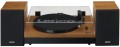 |  |
|---|---|---|
| Lenco LS-310WD | Lenco LS-101BK | |
| Outdated Product | from $372.66 | |
| TOP sellers | ||
Includes 2 columns. | The set includes 2 external speakers with a power of 10 W and an impedance of 4 ohms. | |
Pickup | ||
| Non-removable |  |  |
| Type | MM | |
| Needle shape | conical | |
| Output level | 2.5 mV | |
| Downforce | 3.5 g | |
| Pickup weight | 5.8 g | |
Tonearm | ||
| Type | radial | |
| Shape | J-shaped | |
| Material | aluminium | |
Design | ||
| Drive unit | belt | belt |
| Speed control | mechanical (manual) | electronic (automatic) |
| Cover | | |
| External power supply | | |
| Phono stage | in absent | in absent |
Features | ||
| Features | auto-stop | auto-stop speed 78 rpm |
| Connection | Bluetooth | Bluetooth audio input headphone output |
Specs | ||
| Frequency range | 0 – 10000 Hz | |
| Signal to noise ratio | 40 dB | |
| Speed deviation | 0.35 % | |
General | ||
| Power consumption | 24 W | 24 W |
| Base material | MDF/Fibreboard | MDF/Fibreboard |
| Platter material | plastic | plastic |
| Platter size | 300 mm | 200 mm |
| Dimensions (WxDxH) | 424x347x141 mm | 340x320x100 mm |
| Turntable weight | 6.1 kg | 4.07 kg |
| Color | ||
| Added to E-Catalog | january 2024 | february 2023 |


Compare Lenco LS-310WD and LS-101BK
You may be interested in
My comparisons
Lenco LS-310WD often compared

Lenco LS-101BK often compared


Glossary
Non-removable
The presence of a non-removable pickup in the design of the player.
The pickup (cartridge) is a key part for any turntable; failure of this part renders the entire device unusable. Therefore, non-removable (that is, unsuitable for replacement without disassembly in a workshop) pickups are made mainly in low-cost players, where the manufacturer tries to simplify and, accordingly, reduce the cost of construction. However, even in such models, usually, it is possible to replace the most delicate part of the pickup — the needle.
The pickup (cartridge) is a key part for any turntable; failure of this part renders the entire device unusable. Therefore, non-removable (that is, unsuitable for replacement without disassembly in a workshop) pickups are made mainly in low-cost players, where the manufacturer tries to simplify and, accordingly, reduce the cost of construction. However, even in such models, usually, it is possible to replace the most delicate part of the pickup — the needle.
Type
The type of pickup (cartridge) supplied with the turntable.
- MM(with moving magnet). The most common type of cartridges nowadays. The electrical signal in such devices is created by the oscillation of a moving magnet connected to the pickup stylus between special coils. These cartridges give a good output level, making them compatible with the simplest phono stages, they are easy to set up, and the needles in many models can be replaced by the user himself.
- MC(moving coil). Pickups in which the magnets are made stationary, and the signal is created by a moving coil that vibrates from the vibrations of the needle. This design allows you to reduce the mass of moving parts (compared to MM), which has a positive effect on the accuracy and reliability of sound transmission: MC cartridges are capable of transmitting almost all the nuances of sound. On the other hand, their output signal level is low, which puts forward increased demands on the quality of phono stages and significantly affects the cost. So pickups of this type are typical mainly for high-end equipment.
- MI (with a movable iron element). Quite an exotic type of pickups: the coils and magnets in them are made stationary, and the vibration of the needle sets in motion a miniature piece of magnetic material (for example, iron), which moves between the coils and changes their inductance. Theoretically, such cartrid...ges can compete with MCs in terms of overall sound quality and detail, while MI technology allows you to achieve a high level of signal output, which does not require expensive phono stages. However, in fact, such pickups are rare for a number of reasons.
Anyway, for the normal operation of the player, a phono stage is required for the corresponding type of pickup; A phono stage may also be built-in (see “Characteristics”), however, if external equipment is used, it is necessary to know the type of pickup to select it.
- MM(with moving magnet). The most common type of cartridges nowadays. The electrical signal in such devices is created by the oscillation of a moving magnet connected to the pickup stylus between special coils. These cartridges give a good output level, making them compatible with the simplest phono stages, they are easy to set up, and the needles in many models can be replaced by the user himself.
- MC(moving coil). Pickups in which the magnets are made stationary, and the signal is created by a moving coil that vibrates from the vibrations of the needle. This design allows you to reduce the mass of moving parts (compared to MM), which has a positive effect on the accuracy and reliability of sound transmission: MC cartridges are capable of transmitting almost all the nuances of sound. On the other hand, their output signal level is low, which puts forward increased demands on the quality of phono stages and significantly affects the cost. So pickups of this type are typical mainly for high-end equipment.
- MI (with a movable iron element). Quite an exotic type of pickups: the coils and magnets in them are made stationary, and the vibration of the needle sets in motion a miniature piece of magnetic material (for example, iron), which moves between the coils and changes their inductance. Theoretically, such cartrid...ges can compete with MCs in terms of overall sound quality and detail, while MI technology allows you to achieve a high level of signal output, which does not require expensive phono stages. However, in fact, such pickups are rare for a number of reasons.
Anyway, for the normal operation of the player, a phono stage is required for the corresponding type of pickup; A phono stage may also be built-in (see “Characteristics”), however, if external equipment is used, it is necessary to know the type of pickup to select it.
Needle shape
The shape of the needle in the pickup (cartridge) that the player is equipped with.
— Conical. It may also be called spherical. The simplest type of needles for vinyl players. Such needles are inexpensive, but the sound quality when using them is relatively low — due to the fact that the shape of the needle rather weakly matches the shape of the groove on the record.
— Elliptical. Elliptical needles have a narrower shape than conical (spherical) needles, which improves contact and allows, in particular, more accurate reproduction of high frequencies, and also reduces record wear. Due to the good value for money, this option is very popular.
— Linear. The most advanced variety: sharply sharpened needles of complex shape, following the contours of the grooves on the plate as accurately as possible and having the largest contact area among all types. The downside of this is the complexity in production and, accordingly, the high cost.
— Conical. It may also be called spherical. The simplest type of needles for vinyl players. Such needles are inexpensive, but the sound quality when using them is relatively low — due to the fact that the shape of the needle rather weakly matches the shape of the groove on the record.
— Elliptical. Elliptical needles have a narrower shape than conical (spherical) needles, which improves contact and allows, in particular, more accurate reproduction of high frequencies, and also reduces record wear. Due to the good value for money, this option is very popular.
— Linear. The most advanced variety: sharply sharpened needles of complex shape, following the contours of the grooves on the plate as accurately as possible and having the largest contact area among all types. The downside of this is the complexity in production and, accordingly, the high cost.
Output level
The signal level at the output of the pickup supplied with the player is, in fact, the power of the signal coming from the pickup to the phono stage. This parameter is necessary, first of all, in cases where the player is planned to be connected to an external phono stage: such equipment must be designed for the corresponding power of the signal coming from the pickup.
Downforce
The force of pressing the needle on the plate, which the complete pickup (cartridge) is designed for.
This force depends on the rigidity (compliance) of the needle: the greater the clamping force, the harder the cartridge, respectively, the less pliable it is. It is also believed that less pressing force wears out the record less, but it cannot be said that "light" cartridges are definitely better — there are many other nuances. So in fact, information about the pressing force of a complete pickup is needed mainly in case of its replacement. Usually, the pressing force provided by the arm of the turntable is regulated within these limits, so the new cartridge must also be rated for the same values of downforce — otherwise there is a chance that the turntable will not be able to correctly align.
This force depends on the rigidity (compliance) of the needle: the greater the clamping force, the harder the cartridge, respectively, the less pliable it is. It is also believed that less pressing force wears out the record less, but it cannot be said that "light" cartridges are definitely better — there are many other nuances. So in fact, information about the pressing force of a complete pickup is needed mainly in case of its replacement. Usually, the pressing force provided by the arm of the turntable is regulated within these limits, so the new cartridge must also be rated for the same values of downforce — otherwise there is a chance that the turntable will not be able to correctly align.
Pickup weight
The weight of the pickup (cartridge) supplied with the turntable.
The weight of the cartridge determines the characteristics of balancing the tonearm to set the optimal tracking force. However, pickups in set are usually optimally compatible with the corresponding tonearms, so there are no problems with adjusting the turntable. But when buying a replacement cartridge, you should pay attention to this parameter: it is advisable that the new cartridge does not differ too much in weight from the old one, otherwise the tonearm adjustment range may not be enough for the correct balance.
The weight of the cartridge determines the characteristics of balancing the tonearm to set the optimal tracking force. However, pickups in set are usually optimally compatible with the corresponding tonearms, so there are no problems with adjusting the turntable. But when buying a replacement cartridge, you should pay attention to this parameter: it is advisable that the new cartridge does not differ too much in weight from the old one, otherwise the tonearm adjustment range may not be enough for the correct balance.
Type
The design of the tonearm with which the turntable is standardly equipped.
— Radial (lever). The classic and most popular design option: one side of the tonearm is fixed on the axis, and as the record plays and the pickup moves toward its center, the tonearm smoothly rotates on this axis. The rotary mount is simple and inexpensive, but it also has disadvantages: the angle between the longitudinal axis of the pickup and the direction of movement of the track under the needle is inconsistent and gradually changes as the needle moves from the edge to the center (although ideally it should be zero). To compensate for this disadvantage, the tonearm has to be made quite long, which can create its own difficulties (see "Effective Length").
— Tangential. The tangential tonearm mount is designed in such a way that the arm does not rotate as the record plays, but moves parallel to the line connecting the point of contact of the needle and the center of the record. Due to this, the longitudinal axis of the pickup is always parallel to the direction of movement of the track under the needle, regardless of whether the needle is at the beginning or at the end of the record. This has a positive effect on the sound quality, but tangential tonearms are distinguished by a complex design and high cost, and therefore are quite rare, mainly in top models of "turntables".
— Radial (lever). The classic and most popular design option: one side of the tonearm is fixed on the axis, and as the record plays and the pickup moves toward its center, the tonearm smoothly rotates on this axis. The rotary mount is simple and inexpensive, but it also has disadvantages: the angle between the longitudinal axis of the pickup and the direction of movement of the track under the needle is inconsistent and gradually changes as the needle moves from the edge to the center (although ideally it should be zero). To compensate for this disadvantage, the tonearm has to be made quite long, which can create its own difficulties (see "Effective Length").
— Tangential. The tangential tonearm mount is designed in such a way that the arm does not rotate as the record plays, but moves parallel to the line connecting the point of contact of the needle and the center of the record. Due to this, the longitudinal axis of the pickup is always parallel to the direction of movement of the track under the needle, regardless of whether the needle is at the beginning or at the end of the record. This has a positive effect on the sound quality, but tangential tonearms are distinguished by a complex design and high cost, and therefore are quite rare, mainly in top models of "turntables".
Shape
The shape of the complete tonearm (viewed from on top). Modern players may have both straight and S-shaped or J-shaped tonearms. It is impossible to say for sure which of them is better: the advantage of the first option is its light weight, the second and third ones are its greater length and low resonant frequency, which reduces the likelihood of interference. Therefore, in practice, the choice depends on the specific situation and personal preferences.
Material
The main material used in the construction of a complete tonearm.
- Aluminum. This is a fairly lightweight and durable material that has average characteristics in terms of sound quality: it does not dampen extraneous vibrations as well as carbon, but for entry-level and mid-level turntables this is quite enough; in expensive models, you can use other methods of eliminating interference, and aluminum is noticeably cheaper.
— Carbon. A high-quality material that is lighter in weight and has more advanced anti-resonance properties than the metal described above. The main disadvantage of carbon fiber is its rather high cost.
- Plastic. Plastic is inexpensive, but this is perhaps its only key advantage: the performance characteristics of this material are quite modest. That is why it is used extremely rarely - mainly in retro-style players, where a plastic tonearm is a necessary part from a design point of view.
- Aluminum. This is a fairly lightweight and durable material that has average characteristics in terms of sound quality: it does not dampen extraneous vibrations as well as carbon, but for entry-level and mid-level turntables this is quite enough; in expensive models, you can use other methods of eliminating interference, and aluminum is noticeably cheaper.
— Carbon. A high-quality material that is lighter in weight and has more advanced anti-resonance properties than the metal described above. The main disadvantage of carbon fiber is its rather high cost.
- Plastic. Plastic is inexpensive, but this is perhaps its only key advantage: the performance characteristics of this material are quite modest. That is why it is used extremely rarely - mainly in retro-style players, where a plastic tonearm is a necessary part from a design point of view.