
Comparison Brother X17S vs Veritas Janis
Add to comparison | 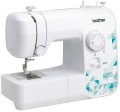 |  |
|---|---|---|
| Brother X17S | Veritas Janis | |
from $327.45 | Outdated Product | |
| TOP sellers | ||
| Type of sewing machine | electromechanical | electromechanical |
| Shuttle | horizontal rotary | oscillating |
| Loop formation | semi-automatic | semi-automatic |
Technical specs | ||
| Number of stitches | 16 | 9 |
| Number of loops | 1 | 1 |
| Max. stitch length | 4 mm | 4 mm |
| Max. stitch width | 5 mm | 5 mm |
| Sewing speed | 750 st/min | 750 st/min |
Features | ||
| Features | reverse stitching free arm twin needle sewing | reverse stitching free arm twin needle sewing |
Adjustment options | ||
| Adjustments | thread tension | thread tension |
Included presser feet | ||
| Presser foots | universal foot zipper foot buttonhole foot | universal foot zipper foot buttonhole foot |
More specs | ||
| Led lighting |  | |
| Power source | power through mount | power through mount |
| Power consumption | 80 W | 70 W |
| Weight | 5.3 kg | |
| Added to E-Catalog | july 2022 | february 2022 |


Compare Brother X17S and Veritas Janis
You may be interested in
Brother X17S often compared

Glossary
Shuttle
The type of shuttle provided in the design of the sewing machine.
The shuttle is a device for feeding the lower thread; This is where the bobbin and thread is inserted. The following types of shuttles are found in modern machines:
- Rocking. Swinging shuttles have only a vertical layout. This is a simple, inexpensive and at the same time reliable mechanism, which also makes the device almost “omnivorous”: many models with swinging shuttles are able to cope with thick, coarse fabrics that are “too tough” for other types of machines. In addition, in such a shuttle it is very easy to adjust the method of thread tension. Among the disadvantages of this option, it is worth noting the increased level of vibration and noise, relatively low speed, as well as a more complex threading procedure than in horizontal shuttles.
— Vertical rotational. In a number of features, such shuttles are similar to swinging shuttles (see the corresponding paragraph): in particular, they are relatively simple to adjust the thread tension, but to thread the bobbin you must every time reach into the mechanism and remove the bobbin case from the shuttle. The key difference is that the shuttle does not swing during operation, but rotates. Because of this, such mechanisms are somewhat more complex and more expensive than swinging ones, but they provide higher sewing speeds with lower levels of vibration and noise....This option is used in professional and semi-professional machines, as well as industrial equipment.
— Horizontal rotational. Shuttles of this type are easy to use: to thread the bobbin thread, you do not need to remove the bobbin case; just open the cover and install the bobbin directly into the shuttle. In addition, the top cover is often made transparent, which allows you to monitor the remainder of the lower thread. Moreover, due to the rotational principle of operation, such a shuttle provides good speed and a minimum level of vibration and noise. Among the disadvantages of this option, one can note the difficulty in adjusting the thread tension: to do this, as a rule, you have to unscrew several bolts and remove the entire shuttle (whereas in vertical mechanisms the regulator is located on a quickly removable bobbin head). In addition, horizontal shuttles are not suitable for constant sewing with coarse threads - such a thread can rub a groove in the body, after which the mechanism will have to be changed.
The shuttle is a device for feeding the lower thread; This is where the bobbin and thread is inserted. The following types of shuttles are found in modern machines:
- Rocking. Swinging shuttles have only a vertical layout. This is a simple, inexpensive and at the same time reliable mechanism, which also makes the device almost “omnivorous”: many models with swinging shuttles are able to cope with thick, coarse fabrics that are “too tough” for other types of machines. In addition, in such a shuttle it is very easy to adjust the method of thread tension. Among the disadvantages of this option, it is worth noting the increased level of vibration and noise, relatively low speed, as well as a more complex threading procedure than in horizontal shuttles.
— Vertical rotational. In a number of features, such shuttles are similar to swinging shuttles (see the corresponding paragraph): in particular, they are relatively simple to adjust the thread tension, but to thread the bobbin you must every time reach into the mechanism and remove the bobbin case from the shuttle. The key difference is that the shuttle does not swing during operation, but rotates. Because of this, such mechanisms are somewhat more complex and more expensive than swinging ones, but they provide higher sewing speeds with lower levels of vibration and noise....This option is used in professional and semi-professional machines, as well as industrial equipment.
— Horizontal rotational. Shuttles of this type are easy to use: to thread the bobbin thread, you do not need to remove the bobbin case; just open the cover and install the bobbin directly into the shuttle. In addition, the top cover is often made transparent, which allows you to monitor the remainder of the lower thread. Moreover, due to the rotational principle of operation, such a shuttle provides good speed and a minimum level of vibration and noise. Among the disadvantages of this option, one can note the difficulty in adjusting the thread tension: to do this, as a rule, you have to unscrew several bolts and remove the entire shuttle (whereas in vertical mechanisms the regulator is located on a quickly removable bobbin head). In addition, horizontal shuttles are not suitable for constant sewing with coarse threads - such a thread can rub a groove in the body, after which the mechanism will have to be changed.
Number of stitches
The number of stitches that a sewing machine can sew. The larger this number, the more extensive the capabilities of this model, the wider the choice the user has; however, it wouldn’t hurt to clarify the specific range of supported stitches separately.
The fewest options - mostly up to 25 - are provided in electromechanical machines, as well as specialized devices such as overlockers and carpet lockers (see “Type”). In computer-controlled devices, the number of lines can be in the dozens, and some also allow you to download additional options from the computer.
The fewest options - mostly up to 25 - are provided in electromechanical machines, as well as specialized devices such as overlockers and carpet lockers (see “Type”). In computer-controlled devices, the number of lines can be in the dozens, and some also allow you to download additional options from the computer.
Power consumption
The power consumed by the machine during operation. Usually, the maximum power value is indicated in the characteristics.
Most of the electricity supplied to the machine is consumed by the engine, so this indicator primarily describes the power of the engine. The higher this power, the faster the machine can work and the better it is suitable for working with dense fabrics. However, there is no strict dependence here, much also depends on the general specialization of the unit.
Most of the electricity supplied to the machine is consumed by the engine, so this indicator primarily describes the power of the engine. The higher this power, the faster the machine can work and the better it is suitable for working with dense fabrics. However, there is no strict dependence here, much also depends on the general specialization of the unit.