
Comparison Vinga CS216B black vs Vinga Gladius black
Add to comparison |  | 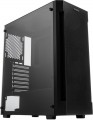 |
|---|---|---|
| Vinga CS216B black | Vinga Gladius black | |
| Outdated Product | Outdated Product | |
| User reviews | ||
| TOP sellers | ||
| Features | gaming | gaming |
| Form factor | Midi Tower | Midi Tower |
| Mount | vertical | vertical |
| Motherboard support | ATX | ATX |
| Board placement | vertical | vertical |
| PSU form factor | ATX (regular) | ATX (regular) |
Computer case | ||
| Dimensions (HxWxD) | 445x193x335 mm | 447x195x385 mm |
| PSU max lenght | 160 mm | |
| Graphics card max lenght | 280 mm | 340 mm |
| Fan max height | 155 mm | 165 mm |
| Material | steel | steel |
| Sidewall thickness | 0.5 mm | |
| Rubber feet |  |  |
| Side panel | removable | removable |
Storage | ||
| PSU | | |
| PSU mount | bottom | bottom |
| 3.5" bays | 2 | 2 |
| internal 2.5" compartments | 2 | 2 |
| Expansion slots | 7 | 7 |
Cooling | ||
| Fans (back) | 1x120mm | 1x120mm |
| Fans (front) | 3x120mm | 3x120mm |
| Fans (top) | 2x120mm | 2x140mm |
| Fans (bottom) | 2x120mm | |
| Fan mounts total | 6 | 8 |
| Dust filter | bottom | top and bottom |
| Liquid cooling system support | | |
Liquid cooling system | ||
| Liquid cooling (rear) | 120 mm | |
| Liquid cooling (front) | 240mm | 360 mm |
| Liquid cooling mounts | 2 | 1 |
Connectors and functions | ||
| Placement | on top of the case | on top of the case |
| USB-A 2.0 | 2 pcs | 2 pcs |
| USB-A 5Gbps | 1 pcs | 1 pcs |
| Audio (microphone/headphones) | | |
More features | ||
| Front panel | lattice | lattice |
| Side panel window | tempered glass | tempered glass |
| More features | hidden wiring CPU cooling mount window | hidden wiring CPU cooling mount window |
| Color | ||
| Added to E-Catalog | november 2023 | november 2023 |


Compare Vinga CS216B and Gladius
You may be interested in
My comparisons
Vinga CS216B often compared

Vinga Gladius often compared


Glossary
PSU max lenght
Possible length of the PSU that can be installed in the case.
Graphics card max lenght
The maximum length of a graphics card that can be installed in this case.
Modern mid-range and top-end video cards with high performance often differ in considerable length, which is why such a card can not fit into any case. So before collecting components, it is worth evaluating the length of the proposed graphics card and choosing a case in which it is guaranteed to fit. This forethought is useful anyway, but it's especially true if you're building a system that requires a powerful graphics adapter, such as a high-end gaming PC or 3D design workstation.
Modern mid-range and top-end video cards with high performance often differ in considerable length, which is why such a card can not fit into any case. So before collecting components, it is worth evaluating the length of the proposed graphics card and choosing a case in which it is guaranteed to fit. This forethought is useful anyway, but it's especially true if you're building a system that requires a powerful graphics adapter, such as a high-end gaming PC or 3D design workstation.
Fan max height
The highest cooler height allowed for this case.
In this case, we mean a cooler used to cool the processor — such a component is found in the vast majority of modern PCs. Height is measured relative to the motherboard.
In this case, we mean a cooler used to cool the processor — such a component is found in the vast majority of modern PCs. Height is measured relative to the motherboard.
Sidewall thickness
The thickness of the side walls used in the case. When choosing a thickness, manufacturers have to compromise between several points at once. On the one hand, thin walls are inexpensive and heat dissipates faster through them, which has a positive effect on cooling efficiency. On the other hand, powerful systems inevitably require thick walls, otherwise the case may simply not withstand the weight of advanced high-performance components. Thirdly, steel is a fairly durable material even with a relatively small thickness. In light of all this, in most models this indicator does not exceed 0.7 — 0.8 mm, and more often it is about 0.5 – 0.6 mm.
Rubber feet
The presence of rubberized legs in the design of the case.
These feet absorb vibrations generated during operation of the computer (mainly due to the operation of fans and optical drives), thereby reducing noise levels and providing additional comfort. Rubberized feet are especially desirable if the computer is placed on a table (on a tabletop or in a dedicated compartment on a table) or on a hard floor.
These feet absorb vibrations generated during operation of the computer (mainly due to the operation of fans and optical drives), thereby reducing noise levels and providing additional comfort. Rubberized feet are especially desirable if the computer is placed on a table (on a tabletop or in a dedicated compartment on a table) or on a hard floor.
Fans (top)
The number of fan slots on the top side of the case, and the size of the fans these slots are designed for. The presence of the fans themselves in the kit should be specified separately.
The larger the fan, the more advanced it is considered: a large diameter allows you to work efficiently at relatively low speeds, which reduces the noise level and energy consumption. Case fans are available in several standard diameters, and the seats under them can be designed for both one and several sizes — for example, 120 / 140 mm. At the same time, in some models, the available number of seats also depends on the chosen size: for example, there are gaming cases where you can install either one 180 mm fan or four 120 mm fans at once.
The larger the fan, the more advanced it is considered: a large diameter allows you to work efficiently at relatively low speeds, which reduces the noise level and energy consumption. Case fans are available in several standard diameters, and the seats under them can be designed for both one and several sizes — for example, 120 / 140 mm. At the same time, in some models, the available number of seats also depends on the chosen size: for example, there are gaming cases where you can install either one 180 mm fan or four 120 mm fans at once.
Fans (bottom)
The number of fan slots on the underside of the case, as well as the size of the fans that these slots are designed for. The presence of the fans themselves in the kit should be specified separately.
The larger the fan, the more advanced it is considered: a large diameter allows you to work efficiently at relatively low speeds, which reduces the noise level and energy consumption. Case fans are available in several standard diameters, and the seats under them can be designed for both one and several sizes — for example, 120 / 140 mm. At the same time, in some models, the available number of seats also depends on the selected size: for example, it may be possible to install either one 180 mm fan or two 140 mm fans.
The larger the fan, the more advanced it is considered: a large diameter allows you to work efficiently at relatively low speeds, which reduces the noise level and energy consumption. Case fans are available in several standard diameters, and the seats under them can be designed for both one and several sizes — for example, 120 / 140 mm. At the same time, in some models, the available number of seats also depends on the selected size: for example, it may be possible to install either one 180 mm fan or two 140 mm fans.
Fan mounts total
The total number of places for installing fans provided in the chassis design.
The more performant the system, the more components it includes — the more powerful cooling it will need; therefore, the number of places for fans, usually, is directly related to the size and purpose of the case. It is also worth considering that with the same number, the installation location of individual fans may be different — behind, on the side, on top, etc.
The more performant the system, the more components it includes — the more powerful cooling it will need; therefore, the number of places for fans, usually, is directly related to the size and purpose of the case. It is also worth considering that with the same number, the installation location of individual fans may be different — behind, on the side, on top, etc.
Dust filter
The presence of a special filter in the housing to prevent dust from entering. Without such a filter, dust settles on the system elements; Radiators are especially susceptible to this; they also lose their efficiency by becoming clogged with dust. If you have a dust filter, you have to clean not the “filling” of the PC, but the filter element itself, which is much simpler and more convenient.
Compartments for dust filters can be located on the front panel of the case, back, bottom, top, or in the side walls. There are also case models with several technological niches for installing dust filters - the combined version assumes the presence of such compartments on several sides of the case at once.
Compartments for dust filters can be located on the front panel of the case, back, bottom, top, or in the side walls. There are also case models with several technological niches for installing dust filters - the combined version assumes the presence of such compartments on several sides of the case at once.