
Comparison CyberPower CP1600EPFCLCD 1600 VA vs CyberPower CP900EPFCLCD 900 VA
Add to comparison |  | 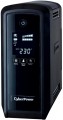 |
|---|---|---|
| CyberPower CP1600EPFCLCD 1600 VA | CyberPower CP900EPFCLCD 900 VA | |
from $631.00 | from $419.00 | |
| User reviews | ||
| TOP sellers | ||
Interactive UPS. 6 sockets. Correct sinusoid. Cold start. Quiet work. | ||
| Type | smart | smart |
| Form factor | standard (Tower) | standard (Tower) |
| Operating time (100% load) | 2.6 min | 1 min |
| Operating time (50% load) | 9.7 min | 7 min |
| Switching to battery | 8 ms | 4 ms |
Input | ||
| Input voltage | 1 phase (230V) | 1 phase (230V) |
| Input voltage range | 169 – 271 В | 170 – 270 В |
| Max. current | 10 А | 10 А |
| Bypass (direct connection) | auto | auto |
Output | ||
| Output voltage | 1 phase (230V) | 1 phase (230V) |
| Peak output power | 1600 VA | 900 VA |
| Rated output power | 1000 W | 540 W |
| Output voltage accuracy | 10 % | |
| Output waveform | pure sine wave (PSW) | pure sine wave (PSW) |
| Output frequency | 50/60 Hz | 50/60 Hz |
| Redundant sockets | 6 | 6 |
| Socket type | type F (Schuko) | type F (Schuko) |
| USB-A for charging | 1 pcs | |
| USB-C for charging | 1 pcs | |
Battery | ||
| Number of batteries | 1 | |
| Total battery capacity | 8.5 Ah | |
| Battery type | GEL ( filled with gel) | |
| Full charge time | 480 min | 480 min |
Protection | ||
| Protection | short circuit protection overload protection noise filtering data line protection sound alarm | overload protection noise filtering data line protection sound alarm |
| Fuse | auto | auto |
| Surge protection | 405 J | 405 J |
| Control interfaces | RS-232 USB type B SmartSlot "dry contact" | USB type B |
General | ||
| Screen |  | |
| Operating temperature | 0 – 40 °C | 0 – 40 °C |
| Noise level | 40 dB | |
| Dimensions (HxWxD) | 280x100x355 mm | 230x100x275 mm |
| Weight | 11 kg | 7.1 kg |
| Added to E-Catalog | march 2024 | june 2015 |


Compare CyberPower CP1600EPFCLCD and CP900EPFCLCD
You may be interested in
CyberPower CP1600EPFCLCD often compared

CyberPower CP900EPFCLCD often compared


Glossary
Operating time (100% load)
UPS continuous operation time from a fully charged battery when connected to a load with a power equal to the UPS output power (maximum or effective, depending on the type of load, see the relevant paragraphs for details). For a UPS designed to work with a home or office PC, a time of about 10-15 minutes is considered sufficient, this is enough to save data and complete work. To power servers, it is worth using devices with an operating time of 20 minutes or more.
Operating time (50% load)
UPS continuous operation time from a fully charged battery when connected to a load with a power equal to half the output power of the UPS (maximum or effective, depending on the type of load, see below for details). The operating time with such a load is much longer than for a full load, and even in the simplest models it can reach 20-30 minutes.
Switching to battery
The time required to transfer the load from mains power to battery power. In standby and interactive UPSs (see Type), a short-term power failure occurs at this moment — accordingly, the shorter the time to switch to the battery, the more uniform the power supply is provided by the source during a power failure. Ideally, the switching time for the traditional 50 Hz AC frequency should be less than 5 ms (a quarter of one cycle of the sine wave). With inverter UPSs, the transfer time is, by definition, zero.
Input voltage range
In this case, the input voltage range is implied, in which the UPS is able to supply a stable voltage to the load only due to its own regulators, without switching to the battery. For redundant UPSs (see "Type") this range is quite small, approximately 190 to 260 V; for interactive and especially inverter ones, it is much wider. Some UPS models allow you to manually set the input voltage range.
Peak output power
The maximum output power supplied by the UPS, in other words, the highest apparent load power allowed for this model.
This indicator is measured in volt-amperes (the general meaning of this unit is the same as that of the watt, and different names are used to separate different types of power). The total power consumption of the load, implied in this case, is the sum of two powers — active and reactive. Active power is actually effective power (it is indicated in watts in the characteristics of electrical appliances). Reactive power is the power wasted by coils and capacitors in AC devices; with numerous coils and/or capacitors, this power can be a fairly significant part of the total energy consumption. Note that for simple tasks, you can use data on effective power (it is often given for UPS — see below); but for accurate electrical calculations it is worth using the full one.
The simplest selection rule for this indicator is: the maximum output power of the UPS in volt-amperes should be at least 1.7 times higher than the total load power in watts. There are also more detailed calculation formulas that take into account the characteristics of different types of load; they can be found in special sources. As for specific values, the most modest modern UPSs give out 700 – 1000 VA, or even less — this is enough to power a PC of average performance; and in the most "heavyweight" models, th...is figure can be 8 – 10 kVA and higher.
This indicator is measured in volt-amperes (the general meaning of this unit is the same as that of the watt, and different names are used to separate different types of power). The total power consumption of the load, implied in this case, is the sum of two powers — active and reactive. Active power is actually effective power (it is indicated in watts in the characteristics of electrical appliances). Reactive power is the power wasted by coils and capacitors in AC devices; with numerous coils and/or capacitors, this power can be a fairly significant part of the total energy consumption. Note that for simple tasks, you can use data on effective power (it is often given for UPS — see below); but for accurate electrical calculations it is worth using the full one.
The simplest selection rule for this indicator is: the maximum output power of the UPS in volt-amperes should be at least 1.7 times higher than the total load power in watts. There are also more detailed calculation formulas that take into account the characteristics of different types of load; they can be found in special sources. As for specific values, the most modest modern UPSs give out 700 – 1000 VA, or even less — this is enough to power a PC of average performance; and in the most "heavyweight" models, th...is figure can be 8 – 10 kVA and higher.
Rated output power
The effective output power of the UPS is, in fact, the maximum active power of the load that can be connected to the device.
Active power is consumed directly for the operation of the device; it is expressed in watts. In addition to it, most AC devices also consume reactive power, which is "wasted" (relatively speaking) is spent by coils and capacitors. Apparent power (denoted in volt-amperes) is precisely the sum of active and reactive power; it is this characteristic that should be used in accurate electrical calculations. See "Maximum output power" for details; here we note that when selecting a UPS for a relatively simple application, it is quite possible to use only effective power. This is at least easier than converting the watts claimed in the characteristics of the connected devices into full power volt-amps.
The most modest modern "uninterruptibles" give out less than 500 watts. 501 – 1000 W can be considered an average value, 1.1 – 2 kW is above average, and in the most powerful models this figure exceeds 2 kW and can reach very impressive values (up to 1000 kW or more in some industrial class UPS).
Active power is consumed directly for the operation of the device; it is expressed in watts. In addition to it, most AC devices also consume reactive power, which is "wasted" (relatively speaking) is spent by coils and capacitors. Apparent power (denoted in volt-amperes) is precisely the sum of active and reactive power; it is this characteristic that should be used in accurate electrical calculations. See "Maximum output power" for details; here we note that when selecting a UPS for a relatively simple application, it is quite possible to use only effective power. This is at least easier than converting the watts claimed in the characteristics of the connected devices into full power volt-amps.
The most modest modern "uninterruptibles" give out less than 500 watts. 501 – 1000 W can be considered an average value, 1.1 – 2 kW is above average, and in the most powerful models this figure exceeds 2 kW and can reach very impressive values (up to 1000 kW or more in some industrial class UPS).
Output voltage accuracy
This parameter characterizes the degree of difference between the AC voltage at the output of the UPS and the perfect voltage, the graph of which has the shape of a regular sinusoid. The perfect voltage is so named because it is the most uniform and creates the least unnecessary load on the connected devices. Thus, the distortion of the output voltage is one of the most important parameters that determine the quality of the power received by the load. A distortion level of 0% means that the UPS produces a perfect sine wave, up to 5% — slight sine wave distortion, up to 18% — strong distortion, from 18% to 40% — a trapezoidal signal, more than 40% — a square wave.
USB-A for charging
The number of USB-A type ports provided in the UPS intended for charging external devices, such as smartphones or tablets.
This number corresponds to the number of gadgets that can be charged simultaneously. However, it's worth noting that not every UPS with this function is capable of charging USB devices from its own battery without external power supply — it's better to verify this possibility before purchasing.
This number corresponds to the number of gadgets that can be charged simultaneously. However, it's worth noting that not every UPS with this function is capable of charging USB devices from its own battery without external power supply — it's better to verify this possibility before purchasing.
USB-C for charging
The number of symmetrical USB-C ports in the UPS design, which are used for charging gadgets. Often, a UPS with such an interface is equipped with one USB-C output, less often with two.