
Comparison VST 863 vs VST 862
Add to comparison |  | 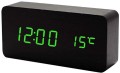 |
|---|---|---|
| VST 863 | VST 862 | |
| Outdated Product | Outdated Product | |
| TOP sellers | ||
There is also a version that shows not only the temperature but also the air humidity: VST 862S | ||
| Device type | desk clock | desk clock |
| Dial type | digital | digital |
| Dial shape | rectangular | rectangular |
Specs | ||
| Time format | 24-hour | 12/24 hour |
| Features | alarm calendar thermometer | alarm calendar thermometer |
General | ||
| Power source | 4xAAA mains | 4xAAA mains |
| Size | 100x60x42 mm | 150x70x41 mm |
| Added to E-Catalog | february 2025 | november 2024 |


Compare VST 863 and 862
You may be interested in
Glossary
Time format
The format in which the time is displayed on the clock face.
— 12 hours. A format that enumerates individual hours (time intervals) from 1 to 12. Since there are 24 hours in a day, this numbering covers only half of the day. This option is traditional for hand dials (see "Dial type") — historically, the full circle of the hour hand corresponds exactly to 12 o'clock, and it is from this principle that both watchmakers and watch users around the world today proceed. However, it can also be found in other types of dials. Theoretically, this option may require clarification — roughly speaking, "7 o'clock — in the morning or in the evening?" — however, in the vast majority of cases, the answer to such a question is clear immediately, from the context of the situation. But when using an alarm clock (see "Functions / Capabilities") in such a watch, you have to be especially careful: if, for example, at 6 pm you set the signal time to 8 am, the alarm clock will go off at 8 pm, because the clock itself "does not distinguish" between morning and evening.
— 24 hour. A full 24-hour format, provides numbering of hours from 1 to 24 (more precisely, from 0 to 23, because exactly 24 hours are considered zero of the next day). Thus, when looking at the clock, in principle, there is no question whether we are talking about the time of "morning" or "evening": for example, 7.00 will unambiguously correspond to morning, and "7 pm" will be designated as 19.00. At th...e same time, we note that such clarification can be provided in other ways — namely, the 12-hour scale, which has additional indicators AM (ante meridiem, "before noon") and PM (post meridiem, "after noon"). Therefore, models with such modified 12-hour scales are also classified as 24-hour models in our catalog. This format is used in all types of dials, except for arrows.
— 12/24 hour. This category includes watches that have the ability to switch between a full 24-hour clock and a 12-hour clock with "AM/PM" qualifiers. Formally, both of these types of scales are 24-hour scales (and are described in detail in the relevant paragraph above); the same designation is used to emphasize the possibility of switching formats.
— 12 hours. A format that enumerates individual hours (time intervals) from 1 to 12. Since there are 24 hours in a day, this numbering covers only half of the day. This option is traditional for hand dials (see "Dial type") — historically, the full circle of the hour hand corresponds exactly to 12 o'clock, and it is from this principle that both watchmakers and watch users around the world today proceed. However, it can also be found in other types of dials. Theoretically, this option may require clarification — roughly speaking, "7 o'clock — in the morning or in the evening?" — however, in the vast majority of cases, the answer to such a question is clear immediately, from the context of the situation. But when using an alarm clock (see "Functions / Capabilities") in such a watch, you have to be especially careful: if, for example, at 6 pm you set the signal time to 8 am, the alarm clock will go off at 8 pm, because the clock itself "does not distinguish" between morning and evening.
— 24 hour. A full 24-hour format, provides numbering of hours from 1 to 24 (more precisely, from 0 to 23, because exactly 24 hours are considered zero of the next day). Thus, when looking at the clock, in principle, there is no question whether we are talking about the time of "morning" or "evening": for example, 7.00 will unambiguously correspond to morning, and "7 pm" will be designated as 19.00. At th...e same time, we note that such clarification can be provided in other ways — namely, the 12-hour scale, which has additional indicators AM (ante meridiem, "before noon") and PM (post meridiem, "after noon"). Therefore, models with such modified 12-hour scales are also classified as 24-hour models in our catalog. This format is used in all types of dials, except for arrows.
— 12/24 hour. This category includes watches that have the ability to switch between a full 24-hour clock and a 12-hour clock with "AM/PM" qualifiers. Formally, both of these types of scales are 24-hour scales (and are described in detail in the relevant paragraph above); the same designation is used to emphasize the possibility of switching formats.