
Comparison REAL-EL X-525 vs REAL-EL X-510
Add to comparison | 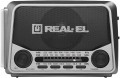 |  |
|---|---|---|
| REAL-EL X-525 | REAL-EL X-510 | |
| Outdated Product | Outdated Product | |
| TOP sellers | ||
| Device type | radio | radio |
Specs | ||
| Tuner type | analogue | analogue |
| Radio | FM AM SW | FM AM SW |
| Playback | USB-A card reader | USB-A card reader line input |
| Speaker power | 3 W | 3 W |
| Features | flashlight | flashlight |
General | ||
| Power source | 2xD mains cordless | 2xD mains cordless |
| Battery capacity | 800 mAh | 800 mAh |
| Material | plastic | plastic |
| Size | 182x120x80 mm | 182x120x80 mm |
| Weight | 650 g | 650 g |
| Color | ||
| Added to E-Catalog | april 2023 | april 2023 |


Compare REAL-EL X-525 and X-510
You may be interested in
My comparisons
REAL-EL X-525 often compared

REAL-EL X-510 often compared


Glossary
Playback
— Bluetooth. Wireless technology for transmitting sound from mobile phones, tablets, etc. Allows you to connect a device wirelessly at a short distance from the signal source. The quality and overall capabilities of Bluetooth depend on its version:
— Bluetooth 4. Each version brings improvements over the previous one. In version 4.0, three standards were effectively combined: traditional Bluetooth, high-speed channel, and energy-saving mode for small amounts of data. This allowed for optimized channel use and battery consumption. Version 4.1 enhanced resistance to interference when working near 4G LTE modules. Version 4.2 mainly introduced general improvements in speed and security.
— Bluetooth 5.0. One of the most important innovations of the Bluetooth 5.0 standard was the expansion of BLE ("Bluetooth Low Energy") capabilities: if necessary, the device can increase range by reducing speed, or speed up transmission by reducing range. Moreover, several improvements related to simultaneous operation with multiple connected devices were introduced.
— Bluetooth 5.1. A significant upgrade in version 5.1 was the ability to precisely position the signal transmitter (receiver). Whereas previous versions could only determine distance, version 5.1 can also determine direction. This improved navigation function, which enhanced the operation of smart home systems, connected device search, etc. Additionally, improvements a...gain touched on energy consumption savings and simultaneous operation with multiple connected devices.
— Bluetooth 5.2. The next update after 5.1 in the Bluetooth 5 generation. The main innovations in this version were several security improvements, additional energy consumption optimization in LE mode, and a new audio signal format for synchronizing parallel playback on multiple devices.
— Bluetooth 5.3. The Bluetooth v 5.3 wireless communication protocol was introduced at the beginning of 2022. Innovations sped up the channel negotiation process between the controller and the device, implemented a quick switch function between low-duty cycle and high-speed mode, improved bandwidth and connection stability by reducing susceptibility to interference. In the event of unexpected interference in Low Energy mode, the channel selection procedure for switching was accelerated. The 5.3 protocol does not present fundamental innovations, but a number of qualitative improvements are apparent.
— Bluetooth 5.4. Introduced at the start of 2023, this version increased the range and data exchange speed. Also, improvements were made to the BLE energy-saving mode in Bluetooth v 5.4. This protocol uses new security features to protect data from unauthorized access, offers increased connection reliability by selecting the best communication channel, and prevents connection losses due to interference.
— USB-A. The presence of a USB-A port allows connecting USB drives, mobile phones, MP3 players, and other similar peripherals. Accordingly, such models have a built-in player and allow connected gadgets to be used solely as storage devices.
— Card Reader. Like the above-mentioned USB-A, this item implies the presence of a built-in player. And a card reader allows using memory cards as storage on which songs will be recorded.
— Line Input. An input for transmitting sound in analog format. Through such an input, you can connect an external signal source — for example, an MP3 player — to a radio receiver and listen to music through the receiver's speakers. Despite the development of digital standards, the line input remains one of the most popular connection interfaces.
— Bluetooth 4. Each version brings improvements over the previous one. In version 4.0, three standards were effectively combined: traditional Bluetooth, high-speed channel, and energy-saving mode for small amounts of data. This allowed for optimized channel use and battery consumption. Version 4.1 enhanced resistance to interference when working near 4G LTE modules. Version 4.2 mainly introduced general improvements in speed and security.
— Bluetooth 5.0. One of the most important innovations of the Bluetooth 5.0 standard was the expansion of BLE ("Bluetooth Low Energy") capabilities: if necessary, the device can increase range by reducing speed, or speed up transmission by reducing range. Moreover, several improvements related to simultaneous operation with multiple connected devices were introduced.
— Bluetooth 5.1. A significant upgrade in version 5.1 was the ability to precisely position the signal transmitter (receiver). Whereas previous versions could only determine distance, version 5.1 can also determine direction. This improved navigation function, which enhanced the operation of smart home systems, connected device search, etc. Additionally, improvements a...gain touched on energy consumption savings and simultaneous operation with multiple connected devices.
— Bluetooth 5.2. The next update after 5.1 in the Bluetooth 5 generation. The main innovations in this version were several security improvements, additional energy consumption optimization in LE mode, and a new audio signal format for synchronizing parallel playback on multiple devices.
— Bluetooth 5.3. The Bluetooth v 5.3 wireless communication protocol was introduced at the beginning of 2022. Innovations sped up the channel negotiation process between the controller and the device, implemented a quick switch function between low-duty cycle and high-speed mode, improved bandwidth and connection stability by reducing susceptibility to interference. In the event of unexpected interference in Low Energy mode, the channel selection procedure for switching was accelerated. The 5.3 protocol does not present fundamental innovations, but a number of qualitative improvements are apparent.
— Bluetooth 5.4. Introduced at the start of 2023, this version increased the range and data exchange speed. Also, improvements were made to the BLE energy-saving mode in Bluetooth v 5.4. This protocol uses new security features to protect data from unauthorized access, offers increased connection reliability by selecting the best communication channel, and prevents connection losses due to interference.
— USB-A. The presence of a USB-A port allows connecting USB drives, mobile phones, MP3 players, and other similar peripherals. Accordingly, such models have a built-in player and allow connected gadgets to be used solely as storage devices.
— Card Reader. Like the above-mentioned USB-A, this item implies the presence of a built-in player. And a card reader allows using memory cards as storage on which songs will be recorded.
— Line Input. An input for transmitting sound in analog format. Through such an input, you can connect an external signal source — for example, an MP3 player — to a radio receiver and listen to music through the receiver's speakers. Despite the development of digital standards, the line input remains one of the most popular connection interfaces.