
Comparison AZIMUT Tornado 26 vs AZIMUT Fusion 26
Add to comparison | 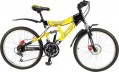 | 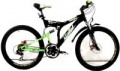 |
|---|---|---|
| AZIMUT Tornado 26 | AZIMUT Fusion 26 | |
from $120.00 up to $132.00 | from $120.00 up to $124.20 | |
| TOP sellers | ||
| Type | mountain (MTB) | mountain (MTB) |
Frame and suspension | ||
| Frame material | steel | steel |
| Suspension | full suspension | full suspension |
| Suspension type (fork) | spring-elastomer | spring-elastomer |
| Fork material | steel | |
| Suspension type (rear suspension) | spring-elastomer | spring-elastomer |
Wheels and brakes | ||
| Wheel size | 26 " | 26 " |
| Rim material | aluminium | aluminium |
| Rim | double wall | double wall |
| Front brake | mechanical disc | mechanical disc |
| Rear brake | mechanical disc | mechanical disc |
Handlebar and transmission | ||
| Speeds | 21 | 21 |
| Chainrings | 3 | 3 |
| Freewheel cogs | 7 | 7 |
| Bottom bracket model | Taiwan | Taiwan MTB |
| Rear derailleur | Shimano Tourney TX35 | Shimano RD-TX35 |
| Shifter type | grip shift | grip shift |
| Shifter model | Shimano Tourney RS35 | Shimano SL-RS35 |
| Chain model | KMC Z33 | KMC Z33 |
| Handlebar type | straight | straight |
General | ||
| Equipment | mudguards chain guard kickstand | mudguards chain guard kickstand |
| Weight | 16.5 kg | 16 kg |
| Color | ||
| Added to E-Catalog | june 2014 | june 2014 |


Compare AZIMUT Tornado 26 and Fusion 26
You may be interested in
My comparisons
AZIMUT Tornado 26 often compared


AZIMUT Fusion 26 often compared

Glossary
Fork material
— Aluminium. In this case, aluminium is the simplest and most unpretentious option. Its advantages include light weight; on the other hand, in the absence of shock absorption, the steering wheel with such a fork is highly susceptible to vibrations, and in terms of durability, aluminium is somewhat inferior to steel.
— Steel. Another relatively simple option, which at the same time is considered more advanced than the aluminium described above, and is found even in fairly expensive pro-level bikes. This is due to the fact that steel is noticeably stronger and more durable, as it is not as susceptible to "metal fatigue". However such forks weigh a little more than aluminium ones.
— Chromium molybdenum steel. A type of steel that is more advanced than more traditional grades. Among the main advantages of such alloys are high strength and reliability; at the same time, due to such properties, individual elements of the forks can be made thinner, and the forks themselves can be made lighter than ordinary steel ones. The main disadvantage of Cro-Mo steel is the rather high cost.
— Carbon. Lightweight and high-strength carbon fibre forks effectively dampen small bumps in the road under the wheels of the bike and slightly spring on small potholes, thereby providing cushioning on bumpy roads. The carbon fork facilitates the design of the front of the bike. Most often it is found on board "highways" and "gravel roads", less often it is installed in o...ff-road fatbikes. Vulnerable point — carbon forks break under the influence of strong point impacts.
— Steel. Another relatively simple option, which at the same time is considered more advanced than the aluminium described above, and is found even in fairly expensive pro-level bikes. This is due to the fact that steel is noticeably stronger and more durable, as it is not as susceptible to "metal fatigue". However such forks weigh a little more than aluminium ones.
— Chromium molybdenum steel. A type of steel that is more advanced than more traditional grades. Among the main advantages of such alloys are high strength and reliability; at the same time, due to such properties, individual elements of the forks can be made thinner, and the forks themselves can be made lighter than ordinary steel ones. The main disadvantage of Cro-Mo steel is the rather high cost.
— Carbon. Lightweight and high-strength carbon fibre forks effectively dampen small bumps in the road under the wheels of the bike and slightly spring on small potholes, thereby providing cushioning on bumpy roads. The carbon fork facilitates the design of the front of the bike. Most often it is found on board "highways" and "gravel roads", less often it is installed in o...ff-road fatbikes. Vulnerable point — carbon forks break under the influence of strong point impacts.
Bottom bracket model
Model of the carriage installed on the bike as standard. The bottom bracket is the part that connects the system (front sprockets with pedals) and the frame; roughly speaking — an axle with bearings.
For details on the meaning of the model of a particular part, see "Cassette Model".
For details on the meaning of the model of a particular part, see "Cassette Model".
Rear derailleur
Model of the derailleur (derailer) installed on the rear wheel cassette as standard on the bike. For more information on why you need to know the model of a particular bicycle component, see paragraph "Cassette Model".
Shifter model
The model of the shifters (see “Shifter type”) that are fitted to the bike as standard. For more information on why you need to know the model of a particular bicycle component, see paragraph "Cassette Model".