
Comparison Ergo M126 vs ZTE U10 Pro
Add to comparison |  | 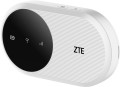 |
|---|---|---|
| Ergo M126 | ZTE U10 Pro | |
| Outdated Product | Outdated Product | |
| TOP sellers | ||
VPN support. Support for 3G UMTS 2100 and 4G LTE-FDD 900/1800/2600 MHz bands. | ||
| Device type | portable router | portable router |
| Wi-Fi | Wi-Fi 3 (802.11g) Wi-Fi 4 (802.11n) Wi-Fi 6 (802.11ax) | Wi-Fi 3 (802.11g) Wi-Fi 4 (802.11n) Wi-Fi 6 (802.11ax) |
| Max speed at 2.4 GHz | 287 Mbit/s | 287 Mbit/s |
| Connected devices, up to | 10 | 32 |
Connection | ||
| Communication generation | 3G 4G (LTE) | 2G 3G 4G (LTE) |
| 4G (LTE) | Cat.4 (150/50 Mbps) | Cat.4 (150/50 Mbps) |
| Transmission technology | LTE | LTE |
| Ports | USB-C | USB-C |
Features | ||
| SIM card slot |  | |
General | ||
| Built-in battery | | |
| Battery capacity | 3000 mAh | 3000 mAh |
| Operating time (internet browsing) | 10 h | |
| Dimensions | 101x64x17 mm | 108x60x17 mm |
| Weight | 100 g | 119 g |
| Added to E-Catalog | september 2025 | december 2024 |


Compare Ergo M126 and ZTE U10 Pro
You may be interested in
My comparisons
Ergo M126 often compared

ZTE U10 Pro often compared


Glossary
Connected devices, up to
The largest number of devices that can be simultaneously connected to the modem via Wi-Fi (see "Connection").
The presence of this limitation is due to the fact that processing network requests from several devices at once requires a fairly large amount of computing resources, and there are not so many of them in miniature electronics like wireless modems. However, even inexpensive models can support about 5 – 6 devices, which is more than enough for most cases; and in more advanced modems, this number can reach 10.
The presence of this limitation is due to the fact that processing network requests from several devices at once requires a fairly large amount of computing resources, and there are not so many of them in miniature electronics like wireless modems. However, even inexpensive models can support about 5 – 6 devices, which is more than enough for most cases; and in more advanced modems, this number can reach 10.
Communication generation
The generation(s) of mobile networks supported by the modem.
Note that this spec is rather conditional and generalized, since one generation usually includes several data transmission technologies (see below), and the set of these technologies may vary in different mobile networks and in different modems. Therefore, it is possible to evaluate the compatibility of a device with a specific cellular network using this parameter only approximately. Nevertheless, generation data may well come in handy at the preliminary selection stage: they allow you to at least select the generation you are interested in and then search further among models that are compatible with it.
As for specific generations, today they are as follows:
— 2g. Communication standards of the second generation implemented through mobile networks of the GSM standard. Support GPRS and EDGE transmission technologies. Due to low bandwidth, today they are considered obsolete and are gradually being replaced by the next generations of communication. However, this process is uneven, and in some countries 2G is still the main mobile standard (although everything is moving towards changing this situation). Also note that even the introduction of newer standards does not mean the replacement of GSM — many operators keep this technology as a spare and intended for the simplest mobile phone models. Actually, the second generation in its pure form is pract...ically never found in cellular modems — it complements more advanced standards.
— 3G. Communication technologies of the third generation. Includes W-CDMA, HSUPA, HSDPA, and HSPA+ technologies, and in CDMA networks, EV-DO Rev.A and Rev.B. Significantly outperforms second-generation standards in terms of both pure throughput and additional features. And the data transfer speed itself can be comparable to that of a fixed wired Internet connection, which allows you not only to comfortably browse the web, but also use video calls, listen to streaming audio, etc. However, in fact, the quality of communication depends both on the specific technologies used, on the signal level, and the workload of base stations, etc.
— 4G. The fourth generation of communication, the most advanced to date. It includes WiMAX and LTE technologies, which significantly exceed not only 3G standards in terms of data transfer speed, but also the usual fixed wired Internet connection via Ethernet. However such a connection is not cheap.
Note that this spec is rather conditional and generalized, since one generation usually includes several data transmission technologies (see below), and the set of these technologies may vary in different mobile networks and in different modems. Therefore, it is possible to evaluate the compatibility of a device with a specific cellular network using this parameter only approximately. Nevertheless, generation data may well come in handy at the preliminary selection stage: they allow you to at least select the generation you are interested in and then search further among models that are compatible with it.
As for specific generations, today they are as follows:
— 2g. Communication standards of the second generation implemented through mobile networks of the GSM standard. Support GPRS and EDGE transmission technologies. Due to low bandwidth, today they are considered obsolete and are gradually being replaced by the next generations of communication. However, this process is uneven, and in some countries 2G is still the main mobile standard (although everything is moving towards changing this situation). Also note that even the introduction of newer standards does not mean the replacement of GSM — many operators keep this technology as a spare and intended for the simplest mobile phone models. Actually, the second generation in its pure form is pract...ically never found in cellular modems — it complements more advanced standards.
— 3G. Communication technologies of the third generation. Includes W-CDMA, HSUPA, HSDPA, and HSPA+ technologies, and in CDMA networks, EV-DO Rev.A and Rev.B. Significantly outperforms second-generation standards in terms of both pure throughput and additional features. And the data transfer speed itself can be comparable to that of a fixed wired Internet connection, which allows you not only to comfortably browse the web, but also use video calls, listen to streaming audio, etc. However, in fact, the quality of communication depends both on the specific technologies used, on the signal level, and the workload of base stations, etc.
— 4G. The fourth generation of communication, the most advanced to date. It includes WiMAX and LTE technologies, which significantly exceed not only 3G standards in terms of data transfer speed, but also the usual fixed wired Internet connection via Ethernet. However such a connection is not cheap.
Operating time (internet browsing)
The maximum operating time of the modem with battery power (see "Power") on a single charge in Internet browsing mode. Such power is typical for Wi-Fi routers, therefore, usually, Internet browsing is supposed to provide access to the World Wide Web for an external Wi-Fi device.
This spec is the main indicator of battery life for any battery-powered modem, because it describes the time of using it for its main purpose without recharging. At the same time, you should know that this indicator is measured under certain "perfect" conditions; the actual operating time depends on a number of factors, including the intensity of browsing, the amount of data transferred, the number of connected devices and the distance to them, the cellular network signal strength, etc. Therefore, in fact, the battery life of the modem may be somewhat lower. Nevertheless, it is quite possible to compare different models with each other according to the operating time stated in the specs.
This spec is the main indicator of battery life for any battery-powered modem, because it describes the time of using it for its main purpose without recharging. At the same time, you should know that this indicator is measured under certain "perfect" conditions; the actual operating time depends on a number of factors, including the intensity of browsing, the amount of data transferred, the number of connected devices and the distance to them, the cellular network signal strength, etc. Therefore, in fact, the battery life of the modem may be somewhat lower. Nevertheless, it is quite possible to compare different models with each other according to the operating time stated in the specs.