
Comparison Zoom H4 Essential vs Zoom H4n Pro
Add to comparison | 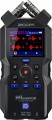 | 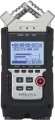 |
|---|---|---|
| Zoom H4 Essential | Zoom H4n Pro | |
| Compare prices 34 | from $45.61 | |
| TOP sellers | ||
Supports 48 kHz/32-bit float. Color screen. | 2x XLR/Jack inputs. Professional rotary microphones. Eliminating the effect of phasing. High sensitivity microphones. Can be used as a sound card for a computer. Built-in effects. | |
| Type | recorder | recorder |
| Memory card slot |  | |
| Memory card type | SDXC | SDHC |
| Max. memory card size | 1024 GB | 32 GB |
Recording | ||
| Microphone type | stereo (X/Y) | stereo (X/Y) |
| Microphone | built-in/external | built-in/external |
| External microphone connector | x2 XLR/Jack | x2 XLR/Jack |
| Recording format | MP3/WAV | MP3/WAV |
| Max. recording quality (MP3) | 320 kbps | 320 kbps |
| Max. recording quality (WAV) | 24bit/96kHz | |
| Maximum recording time | 380 h | |
| Features | microphone sensitivity change record quality change record labels recording timer | microphone sensitivity change record quality change record labels |
More features | ||
| Additional features | computer connect button lock built-in speaker headphone output | computer connect button lock built-in speaker headphone output |
General | ||
| LCD display | | |
| Display backlight | | |
| Power source | 2xAA | 2xAA |
| Battery indicator | | |
| Dimensions (HxWxT) | 67x156x38 mm | 157x73x37 mm |
| Weight | 243 g | 294 g |
| Added to E-Catalog | february 2024 | december 2018 |





Compare Zoom H4 Essential and H4n Pro
Price comparison
You may be interested in
Zoom H4 Essential often compared


Zoom H4n Pro often compared


Glossary
Memory card type
— SD. One of the formats used in audio, video, computer technology, etc.; Almost every modern laptop has an SD card reader. However, the dimensions of such cards (32x24 mm) are relatively large for portable equipment, and therefore they are used relatively rarely in voice recorders. And they are often represented by more modern SDHC or SDXC cards with increased memory capacity and support for the high-speed UHS bus. Accordingly, SDXC support guarantees comfortable work with SDHC and SD, and SDHC support will not fail when connecting SD cards.
— miniSD. A slightly reduced (up to 22x20 mm) variation of the SD standard, otherwise completely identical to it (up to compatibility with SD-card readers when using simple adapters). It is rare due to the widespread use of even smaller microSDs.
— microSD. The most compact version of SD memory cards to date, have a size of 15x11 mm and a capacity of up to 4 GB. Due to their small size, they are widely used in portable electronics: in fact, they are the standard for mobile phones, and are also widely used in voice recorders. Like miniSD, they can be read by original SD card readers using an adapter.
— microSD HC. The second generation of the microSD standard; characterized by increased capacity, reaching 32 GB. In a voice recorder (and in general any card reader), ordinary microSD cards can also be used for microSD HC cards, but it is impossible to do the opposite — the card will not be read.
...— CompactFlash (hereinafter referred to as CF). One of the first memory card standards, it is still used due to its decent data transfer speed and impressive volumes (up to 128 GB). However, the dimensions of these cards are no less impressive — 42x36 mm. As a result, they are poorly suited for pocket format equipment and are rarely used in voice recorders — mainly in advanced models, where the priority is functionality and recording quality, rather than compactness. If the recorder is designed for CF Type II cards, it can work with all types of CF, and devices under Type I are only compatible with this type.
— memorystick. A proprietary standard developed by Sony and used primarily in its devices. It has a number of variations that differ in dimensions, volume and compatibility, and therefore, when buying a card for such a voice recorder, it is worth clarifying the specific MemoryStick specification used. The standard is rather poorly spread: firstly, because of its closeness (that's why, by the way, full compliance with it is guaranteed only in original Sony cards), and secondly, because of the high price of the cards themselves.
xD-Picture. Cards originally made by Olympus and Fujifilm for their digital cameras. The advantages of such cards are high reliability and compactness (20x25 mm), the disadvantages are high cost and relatively small volumes (up to 2 GB). As a result, dictaphones for xD-Picture are very rare.
— miniSD. A slightly reduced (up to 22x20 mm) variation of the SD standard, otherwise completely identical to it (up to compatibility with SD-card readers when using simple adapters). It is rare due to the widespread use of even smaller microSDs.
— microSD. The most compact version of SD memory cards to date, have a size of 15x11 mm and a capacity of up to 4 GB. Due to their small size, they are widely used in portable electronics: in fact, they are the standard for mobile phones, and are also widely used in voice recorders. Like miniSD, they can be read by original SD card readers using an adapter.
— microSD HC. The second generation of the microSD standard; characterized by increased capacity, reaching 32 GB. In a voice recorder (and in general any card reader), ordinary microSD cards can also be used for microSD HC cards, but it is impossible to do the opposite — the card will not be read.
...— CompactFlash (hereinafter referred to as CF). One of the first memory card standards, it is still used due to its decent data transfer speed and impressive volumes (up to 128 GB). However, the dimensions of these cards are no less impressive — 42x36 mm. As a result, they are poorly suited for pocket format equipment and are rarely used in voice recorders — mainly in advanced models, where the priority is functionality and recording quality, rather than compactness. If the recorder is designed for CF Type II cards, it can work with all types of CF, and devices under Type I are only compatible with this type.
— memorystick. A proprietary standard developed by Sony and used primarily in its devices. It has a number of variations that differ in dimensions, volume and compatibility, and therefore, when buying a card for such a voice recorder, it is worth clarifying the specific MemoryStick specification used. The standard is rather poorly spread: firstly, because of its closeness (that's why, by the way, full compliance with it is guaranteed only in original Sony cards), and secondly, because of the high price of the cards themselves.
xD-Picture. Cards originally made by Olympus and Fujifilm for their digital cameras. The advantages of such cards are high reliability and compactness (20x25 mm), the disadvantages are high cost and relatively small volumes (up to 2 GB). As a result, dictaphones for xD-Picture are very rare.
Max. recording quality (WAV)
Uncompressed WAV provides the best sound quality among common Hi-Res audio formats. Its sampling rate is usually 96 or 192 kHz with a bit depth of 24 bits. The format is used for "clean" sound recording with maximum detail of the scene.
Maximum recording time
The maximum continuous recording time for the voice recorder. It depends primarily on the amount of memory (see "Built-in memory", "Memory card slot"), it is also directly related to the recording quality: the higher the quality, the more space the material occupies and the shorter the maximum recording time. In this regard, manufacturers usually indicate in the specifications the maximum possible recording time, that is, the recording time with minimum quality; with higher quality and time will be less.
Features
— Change microphone sensitivity. The ability to change the sensitivity of the microphone allows you to optimally adjust it to the surrounding conditions. So, with a low level of extraneous noise (for example, at a lecture or a press conference), sensitivity can be set to the maximum in order to guarantee that everything that is needed is recorded, and in a noisy environment (for example, an interview in a cafe), on the contrary, it can be reduced in order to reduce outsiders noise to a minimum.
— Change the quality of the recording. Possibility to change the recording quality (usually the bitrate of recorded materials). The volume of the file is directly related to the quality: the higher the quality, the more space the recording takes up. Thus, this function allows you to achieve the optimal balance between sound and memory occupied: for example, for loud intelligible speech without extraneous noise, you can use low quality, in a noisy environment, on the contrary, increase it in order to achieve maximum intelligibility; if there is not much memory left, and nothing can be deleted, lower the quality of the recording, etc.
— Voice activated recording. When using this function, the recorder only records when its microphone captures a significant level of sound — in principle, this can be any source, but since human speech is most often recorded, the name of t...his function refers specifically to the voice. With such a recording, the recorder does not record long pauses, which saves both the occupied memory and time (and sometimes nerves) when listening to the recording. The disadvantage of this feature is that activation takes some time and the first sounds may not be recorded on the recording.
— Setting record labels. Ability to assign a unique label to each file. This can be either a number or a time and date, or both. Tags organize entries and make them easier to access, making it much easier to find the right file.
— Recording timer. The timer allows you to set the start time of the recording; when it occurs, the recorder will turn on automatically. Thus, you will be able to record the material you need (for example, a speech or a lecture) from the very beginning, even if you will not be there by the time you start.
— Ring record. The name of this function comes from its resemblance to recording on a magnetic tape closed in a ring. In this mode, the recorder can record regardless of the amount of free memory: new materials are simply recorded instead of the oldest ones. This eliminates the need to clear memory manually and can come in handy if your records quickly become out of date — for example, if you have to take surveys by phone and process the results on the same day. At the same time, this function requires caution, as increases the likelihood of accidentally erasing necessary, but old records.
— Change the quality of the recording. Possibility to change the recording quality (usually the bitrate of recorded materials). The volume of the file is directly related to the quality: the higher the quality, the more space the recording takes up. Thus, this function allows you to achieve the optimal balance between sound and memory occupied: for example, for loud intelligible speech without extraneous noise, you can use low quality, in a noisy environment, on the contrary, increase it in order to achieve maximum intelligibility; if there is not much memory left, and nothing can be deleted, lower the quality of the recording, etc.
— Voice activated recording. When using this function, the recorder only records when its microphone captures a significant level of sound — in principle, this can be any source, but since human speech is most often recorded, the name of t...his function refers specifically to the voice. With such a recording, the recorder does not record long pauses, which saves both the occupied memory and time (and sometimes nerves) when listening to the recording. The disadvantage of this feature is that activation takes some time and the first sounds may not be recorded on the recording.
— Setting record labels. Ability to assign a unique label to each file. This can be either a number or a time and date, or both. Tags organize entries and make them easier to access, making it much easier to find the right file.
— Recording timer. The timer allows you to set the start time of the recording; when it occurs, the recorder will turn on automatically. Thus, you will be able to record the material you need (for example, a speech or a lecture) from the very beginning, even if you will not be there by the time you start.
— Ring record. The name of this function comes from its resemblance to recording on a magnetic tape closed in a ring. In this mode, the recorder can record regardless of the amount of free memory: new materials are simply recorded instead of the oldest ones. This eliminates the need to clear memory manually and can come in handy if your records quickly become out of date — for example, if you have to take surveys by phone and process the results on the same day. At the same time, this function requires caution, as increases the likelihood of accidentally erasing necessary, but old records.