
Comparison Edifier S300 vs Klipsch The Three Plus
Add to comparison |  | 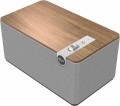 |
|---|---|---|
| Edifier S300 | Klipsch The Three Plus | |
| Compare prices 3 | Compare prices 3 | |
| TOP sellers | ||
Retro design, connection to a computer via the included USB cable. | Control and configuration using a proprietary application, the ability to synchronize up to 10 speakers using Klipsch Broadcast Mode. | |
| Features | minisystem | minisystem |
| Number of channels | 1.0 | 2.1 |
Playback | ||
| Media | USB port | USB port |
Tech specs | ||
| Hi-Res Audio |  |  |
| System power | 80 W | 120 W |
| Number of bands | 2 | 1 |
| Sensitivity | 106 dB | |
| Frequency range | 45 – 20000 Hz | |
| Phase inverter | | |
| Passive emitter | | |
| Equalizer | | |
Interfaces and features | ||
| Interfaces | AirPlay 2 Wi-Fi 6 (802.11ax) Bluetooth v5.4 AAC LDAC | Bluetooth v5.3 |
| Speaker synchronization | Klipsch Broadcast Mode | |
| More features | omnidirectional sound Multiroom | mobile app |
Connectors | ||
| Inputs | mini-Jack (3.5 mm) | RCA mini-Jack (3.5 mm) optical |
General | ||
| Remote control | | |
| Dimensions (HxWxD) | 204x351x231 mm | 213x355x178 mm |
| Weight | 6.23 kg | 4.8 kg |
| Color | ||
| Added to E-Catalog | december 2025 | april 2024 |






Compare Edifier S300 and Klipsch The Three Plus
Price comparison
You may be interested in
My comparisons
Edifier S300 often compared

Klipsch The Three Plus often compared


Glossary
Number of channels
The maximum number of audio channels that the audio system can reproduce through its own acoustics.
— 1.0. One channel of audio allows only monophonic sound — enough to hear the sound, but not providing a surround effect. The advantage of this option is compactness, because For normal operation, it is enough to equip the device with one speaker. The single-channel format is found mainly in inexpensive models, as well as in the most compact audio systems, where small size is more important than "fancy" sound.
— 2.0. Two channels is the minimum required to play stereo sound. This format already allows you to achieve a sense of spaciousness without requiring too many speakers and complicating the entire system. Therefore, he is very popular.
— 2.1. Modification of the 2.0 format described above, supplemented by a subwoofer — a specialized speaker for low frequencies. The use of a subwoofer improves sound quality by delivering rich bass sound.
— 2.2. A further extension of the 2.1 format described above, providing for the presence of two subwoofers — this improves the reliability of the transmission of low frequencies.
— 3.1. An extended version of the 2.1 standard, in which two classic stereo speakers are complemented not only by a subwoofer, but also by a thi...rd, centre speaker. This allows you to improve the sound quality — in particular, due to a richer surround sound.
Note that 2.0 models that do not have their own subwoofer may be equipped with a subwoofer output (see below).
— 1.0. One channel of audio allows only monophonic sound — enough to hear the sound, but not providing a surround effect. The advantage of this option is compactness, because For normal operation, it is enough to equip the device with one speaker. The single-channel format is found mainly in inexpensive models, as well as in the most compact audio systems, where small size is more important than "fancy" sound.
— 2.0. Two channels is the minimum required to play stereo sound. This format already allows you to achieve a sense of spaciousness without requiring too many speakers and complicating the entire system. Therefore, he is very popular.
— 2.1. Modification of the 2.0 format described above, supplemented by a subwoofer — a specialized speaker for low frequencies. The use of a subwoofer improves sound quality by delivering rich bass sound.
— 2.2. A further extension of the 2.1 format described above, providing for the presence of two subwoofers — this improves the reliability of the transmission of low frequencies.
— 3.1. An extended version of the 2.1 standard, in which two classic stereo speakers are complemented not only by a subwoofer, but also by a thi...rd, centre speaker. This allows you to improve the sound quality — in particular, due to a richer surround sound.
Note that 2.0 models that do not have their own subwoofer may be equipped with a subwoofer output (see below).
Hi-Res Audio
The speaker supports high-resolution audio Hi-Res Audio. The corresponding format is designed to provide sound close to that recorded in the studio. Hi-Res Audio refers to a digital signal with parameters starting from 96 kHz/24 bits, and for analogue equipment there is a requirement for an extended frequency response - from 40 kHz. Audio tracks in this format sound as close as possible to the original ideas of the authors of the compositions. The Hi-Res license marks premium solutions for avid audiophiles.
System power
The total sound power provided by the audio system at maximum volume, in other words, the total power of all the speakers provided by the device (including the subwoofer).
The higher the power, the louder the system will sound and the larger the area it can cover. On the other hand, high power significantly affects the price, dimensions, weight and power consumption of the device. In addition, when evaluating and comparing according to this indicator, it is worth considering some nuances. Firstly, some manufacturers go to the trick and give in the characteristics not the average, but the peak sound power; such numbers can be quite impressive, but they have very little to do with real loudness. So if it seems to you that the claimed power is too high, it's ok to clarify what exactly is meant in this case. Secondly, when comparing, it is worth considering the presence of a subwoofer — it plays an auxiliary role, but it can account for more than half of the total system power. Because of this, for equal total power, a device with a subwoofer may be quieter than a model without a subwoofer: for example, a 2.0 40W system will have 20W per main channel, while a 2.1 40W model may have 20W per subwoofer, and only 10 watts for the main speakers.
The higher the power, the louder the system will sound and the larger the area it can cover. On the other hand, high power significantly affects the price, dimensions, weight and power consumption of the device. In addition, when evaluating and comparing according to this indicator, it is worth considering some nuances. Firstly, some manufacturers go to the trick and give in the characteristics not the average, but the peak sound power; such numbers can be quite impressive, but they have very little to do with real loudness. So if it seems to you that the claimed power is too high, it's ok to clarify what exactly is meant in this case. Secondly, when comparing, it is worth considering the presence of a subwoofer — it plays an auxiliary role, but it can account for more than half of the total system power. Because of this, for equal total power, a device with a subwoofer may be quieter than a model without a subwoofer: for example, a 2.0 40W system will have 20W per main channel, while a 2.1 40W model may have 20W per subwoofer, and only 10 watts for the main speakers.
Number of bands
The number of distinct frequency ranges (bands) into which sound is divided when played through the acoustics of an audio system. For each such band, a separate speaker is provided, and sometimes several.
The simplest option provides 1 lane; it is very popular in modern audio systems, because. requires a minimum number of speakers, and the sound quality can be quite good. More advanced options provide 2-3 bands (low and high frequencies, or bass, treble and medium), and in high-end models, the number of bands can be up to five. Note that, in addition to integers, models are also produced with a fractional number of stripes — for example, 2.5 or 3.5. This marking indicates the presence in the design of a speaker responsible for two bands at once: for example, model 2.5 has separate speakers for bass and treble plus a combined bass + midrange (similar in design to bass, but also loaded with mid frequencies).
Anyway, the abundance of bands, usually, indicates a high class of acoustics: the more separate frequency ranges, the narrower the specialization of each speaker, the more accurately it is able to reproduce its part of the signal, and the more complex the system is.
The simplest option provides 1 lane; it is very popular in modern audio systems, because. requires a minimum number of speakers, and the sound quality can be quite good. More advanced options provide 2-3 bands (low and high frequencies, or bass, treble and medium), and in high-end models, the number of bands can be up to five. Note that, in addition to integers, models are also produced with a fractional number of stripes — for example, 2.5 or 3.5. This marking indicates the presence in the design of a speaker responsible for two bands at once: for example, model 2.5 has separate speakers for bass and treble plus a combined bass + midrange (similar in design to bass, but also loaded with mid frequencies).
Anyway, the abundance of bands, usually, indicates a high class of acoustics: the more separate frequency ranges, the narrower the specialization of each speaker, the more accurately it is able to reproduce its part of the signal, and the more complex the system is.
Sensitivity
Sensitivity determines the intensity of the acoustics response to a signal of a certain level; Simply put, the higher this figure, the higher the volume of the speaker system will be at the same signal level. Note that in the case of audio systems, this parameter plays a secondary role: it is important for selecting acoustics for an amplifier, and here both of these components are in most cases optimally matched by the manufacturer to each other.
Frequency range
The total frequency range reproduced by the acoustics of an audio system. Measured from the lower threshold of the lowest frequency speaker to the upper threshold of the highest frequency: for example, in a 2.1 system with main speakers at 100 – 22000 Hz and a subwoofer at 20 – 150 Hz, the total value will be 20 – 22000 Hz.
In general, the wider the frequency range, the fuller the reproduced sound will be, the less low and high frequencies will be lost due to insufficient acoustic capabilities. On the other hand, do not forget that the actual sound quality also depends on a number of other parameters — primarily the frequency response. In addition, human audible frequencies range from 16 Hz to 22 kHz; deviations from these values are very small, and the upper limit also decreases with age. Therefore, from a practical point of view, it does not make sense to provide too large a frequency range; and impressive performances like 10 – 50000 Hz, found in top-class models, are usually more of a kind of "side effect" of high-quality speakers (and at the same time — a marketing ploy) than a really significant moment.
In general, the wider the frequency range, the fuller the reproduced sound will be, the less low and high frequencies will be lost due to insufficient acoustic capabilities. On the other hand, do not forget that the actual sound quality also depends on a number of other parameters — primarily the frequency response. In addition, human audible frequencies range from 16 Hz to 22 kHz; deviations from these values are very small, and the upper limit also decreases with age. Therefore, from a practical point of view, it does not make sense to provide too large a frequency range; and impressive performances like 10 – 50000 Hz, found in top-class models, are usually more of a kind of "side effect" of high-quality speakers (and at the same time — a marketing ploy) than a really significant moment.
Phase inverter
The phase inverter is a tube installed in the column housing and having an outlet to the surrounding space. The length of the tube is chosen so that a signal comes out of the outlet, inverted in phase relative to the signal from the front of the diffuser. This enhances the sound pressure and improves the sound of the speakers, including at low frequencies. Note that such audio systems should be placed at a certain distance from walls, furniture, etc. — otherwise, a hum may occur due to the movement of air through the phase inverter tube.
A similar function in some models is performed by a passive radiator (see below).
A similar function in some models is performed by a passive radiator (see below).
Passive emitter
A passive radiator can be simply described as a low-frequency speaker that does not have its own reproducing system (coil with magnet). It is driven by pressure fluctuations created by active drivers and acts as a resonator to deliver deep, rich bass—especially useful for systems that do not include a subwoofer. At the same time, unlike phase inverters, passive radiators do not generate additional noise.
Equalizer
The presence of an equalizer function in the audio system.
Equalizer allows you to change the timbre of the sound by adjusting the volume for individual frequency bands. The simplest version of this adjustment provides 2 bands (high and low frequencies), but most often there are more bands. Anyway, the equalizer can be useful both for fine-tuning the sound to your own preferences, and for compensating for the shortcomings of external or standard acoustics, connected headphones, etc. - for example, if the speakers "fail" certain frequency bands. In addition, many audio systems have a set of equalizer presets (presets), usually designed for different styles of music - "Classic", "Rock", "Pop", etc. You may also be able to create and edit your own presets.
Equalizer allows you to change the timbre of the sound by adjusting the volume for individual frequency bands. The simplest version of this adjustment provides 2 bands (high and low frequencies), but most often there are more bands. Anyway, the equalizer can be useful both for fine-tuning the sound to your own preferences, and for compensating for the shortcomings of external or standard acoustics, connected headphones, etc. - for example, if the speakers "fail" certain frequency bands. In addition, many audio systems have a set of equalizer presets (presets), usually designed for different styles of music - "Classic", "Rock", "Pop", etc. You may also be able to create and edit your own presets.