
Comparison Sven PS-950 vs Sven PS-800
Add to comparison |  | 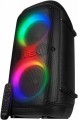 |
|---|---|---|
| Sven PS-950 | Sven PS-800 | |
| Outdated Product | Outdated Product | |
| TOP sellers | ||
| Features | party | party |
| Number of channels | 2.0 | 2.0 |
Playback | ||
| Media | USB port card reader | USB port card reader |
Radio | ||
| Tuner bands | FM | FM |
Tech specs | ||
| System power | 160 W | 100 W |
| Number of bands | 2 | 2 |
| Frequency range | 35 – 20000 Hz | 40 – 22000 Hz |
| Phase inverter |  | |
| Equalizer | | |
| Bass Boost | | |
Interfaces and features | ||
| Interfaces | Bluetooth NFC | Bluetooth NFC |
| Speaker synchronization | TWS | TWS |
| More features | karaoke | karaoke |
Connectors | ||
| Inputs | mini-Jack (3.5 mm) for microphone | mini-Jack (3.5 mm) for microphone |
General | ||
| LCD display | | |
| Lighting effects | | |
| Remote control | | |
| Autonomous power supply | battery | battery |
| Operating hours | 10 h | |
| Battery capacity | 8800 mAh | 4400 mAh |
| Dimensions (HxWxD) | 1018x265x265 mm | 568x325x312 mm |
| Weight | 9.2 kg | 5.2 kg |
| Color | ||
| Added to E-Catalog | september 2024 | november 2023 |


Compare Sven PS-950 and PS-800
You may be interested in
Sven PS-950 often compared


Sven PS-800 often compared

Glossary
System power
The total sound power provided by the audio system at maximum volume, in other words, the total power of all the speakers provided by the device (including the subwoofer).
The higher the power, the louder the system will sound and the larger the area it can cover. On the other hand, high power significantly affects the price, dimensions, weight and power consumption of the device. In addition, when evaluating and comparing according to this indicator, it is worth considering some nuances. Firstly, some manufacturers go to the trick and give in the characteristics not the average, but the peak sound power; such numbers can be quite impressive, but they have very little to do with real loudness. So if it seems to you that the claimed power is too high, it's ok to clarify what exactly is meant in this case. Secondly, when comparing, it is worth considering the presence of a subwoofer — it plays an auxiliary role, but it can account for more than half of the total system power. Because of this, for equal total power, a device with a subwoofer may be quieter than a model without a subwoofer: for example, a 2.0 40W system will have 20W per main channel, while a 2.1 40W model may have 20W per subwoofer, and only 10 watts for the main speakers.
The higher the power, the louder the system will sound and the larger the area it can cover. On the other hand, high power significantly affects the price, dimensions, weight and power consumption of the device. In addition, when evaluating and comparing according to this indicator, it is worth considering some nuances. Firstly, some manufacturers go to the trick and give in the characteristics not the average, but the peak sound power; such numbers can be quite impressive, but they have very little to do with real loudness. So if it seems to you that the claimed power is too high, it's ok to clarify what exactly is meant in this case. Secondly, when comparing, it is worth considering the presence of a subwoofer — it plays an auxiliary role, but it can account for more than half of the total system power. Because of this, for equal total power, a device with a subwoofer may be quieter than a model without a subwoofer: for example, a 2.0 40W system will have 20W per main channel, while a 2.1 40W model may have 20W per subwoofer, and only 10 watts for the main speakers.
Frequency range
The total frequency range reproduced by the acoustics of an audio system. Measured from the lower threshold of the lowest frequency speaker to the upper threshold of the highest frequency: for example, in a 2.1 system with main speakers at 100 – 22000 Hz and a subwoofer at 20 – 150 Hz, the total value will be 20 – 22000 Hz.
In general, the wider the frequency range, the fuller the reproduced sound will be, the less low and high frequencies will be lost due to insufficient acoustic capabilities. On the other hand, do not forget that the actual sound quality also depends on a number of other parameters — primarily the frequency response. In addition, human audible frequencies range from 16 Hz to 22 kHz; deviations from these values are very small, and the upper limit also decreases with age. Therefore, from a practical point of view, it does not make sense to provide too large a frequency range; and impressive performances like 10 – 50000 Hz, found in top-class models, are usually more of a kind of "side effect" of high-quality speakers (and at the same time — a marketing ploy) than a really significant moment.
In general, the wider the frequency range, the fuller the reproduced sound will be, the less low and high frequencies will be lost due to insufficient acoustic capabilities. On the other hand, do not forget that the actual sound quality also depends on a number of other parameters — primarily the frequency response. In addition, human audible frequencies range from 16 Hz to 22 kHz; deviations from these values are very small, and the upper limit also decreases with age. Therefore, from a practical point of view, it does not make sense to provide too large a frequency range; and impressive performances like 10 – 50000 Hz, found in top-class models, are usually more of a kind of "side effect" of high-quality speakers (and at the same time — a marketing ploy) than a really significant moment.
Operating hours
Audio system operating time without connection to an external power source (network or USB port, depending on the capabilities). Note that manufacturers tend to indicate battery life in their specifications under optimal conditions for energy saving: at low volume, without using additional functions, etc. Therefore, in fact, this indicator may be noticeably lower than the claimed one, and speakers with a long operating time will not sound at full volume for the specified hours.