
Comparison Dynaudio Emit 20 vs Dynaudio Evoke 20
Add to comparison | 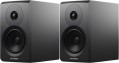 |  |
|---|---|---|
| Dynaudio Emit 20 | Dynaudio Evoke 20 | |
| Compare prices 3 | from $2,399.00 | |
| User reviews | ||
| TOP sellers | ||
| Features | homemade | homemade |
| Mount | shelf | shelf |
Specs | ||
| Type | passive | passive |
| Number of channels | 2.0 system | 2.0 system |
| Number of speakers | 2 | 2 |
| Number of bands | 2 | 2 |
| Sensitivity | 86 dB | 86 dB |
| Impedance | 6 Ohm | 6 Ohm |
| Crossover frequency | 3.8 kHz | |
Power / frequency | ||
| Maximum amplifier power | 180 W | |
| Overall frequency range | 53 – 25000 Hz | 40 – 23000 Hz |
Design | ||
| Design features | phase inverter back | phase inverter back |
General | ||
| Tweeter size | 28 mm | |
| Woofer size (LF/MF) | 180 mm | 180 mm |
| Finishing material | MDF | MDF |
| Front speaker dimensions (HxWxD) | 37x21x31 cm | 38x21.5x31.7 cm |
| Weight | 20 kg | 19.8 kg |
| Color | ||
| Added to E-Catalog | july 2021 | december 2018 |



Compare Dynaudio Emit 20 and Evoke 20
Price comparison
You may be interested in
My comparisons
Dynaudio Emit 20 often compared


Dynaudio Evoke 20 often compared

Glossary
Crossover frequency
The crossover frequency provided in the speaker design.
A crossover is installed exclusively in a multi-band model (see "Number of Bands"). This is an electronic filter that ensures the division of the incoming audio signal into separate frequency ranges and directs each range to "its" set of speakers. And the crossover frequency shows where the boundary between these ranges lies. If there are more than two bands, there will be several such boundaries: for example, for a four-band system it may be specified "0.15 / 0.8 / 2.8 kHz" or "0.12 / 1 / 3.8".
In most cases, this parameter has mainly a reference value: the frequencies of the built-in crossover are selected to match the operating characteristics of the speakers installed in the speaker system.
A crossover is installed exclusively in a multi-band model (see "Number of Bands"). This is an electronic filter that ensures the division of the incoming audio signal into separate frequency ranges and directs each range to "its" set of speakers. And the crossover frequency shows where the boundary between these ranges lies. If there are more than two bands, there will be several such boundaries: for example, for a four-band system it may be specified "0.15 / 0.8 / 2.8 kHz" or "0.12 / 1 / 3.8".
In most cases, this parameter has mainly a reference value: the frequencies of the built-in crossover are selected to match the operating characteristics of the speakers installed in the speaker system.
Maximum amplifier power
The highest power rating of an amplifier that the loudspeakers can handle safely. Too much input power can damage the speakers, so when connecting, make sure that the amplifier's characteristics do not exceed the capabilities of the speakers. It is worth noting that this parameter may be slightly higher than the total nominal power of the acoustics (see below), since in this case we are only talking about the safety of the equipment, and not about the absence of distortion in the sound.
Overall frequency range
The total frequency range that the speaker is capable of reproducing. Specified from the bottom of the range in the lowest frequency component to the top of the range in the highest frequency: for example, in a 2.1 system with main speakers at 100 – 22000 Hz and a subwoofer at 20 – 150 Hz, the total value will be 20 – 22000 Hz.
The wider the frequency range — the fuller the reproduced sound, the lower the likelihood that some part of the low or high frequencies will be "cut off". It is worth noting here that the human ear perceives frequencies on average from 16 Hz to 22 kHz, and from a practical point of view, it makes no sense to provide a wider frequency range in speakers. However, quite a few models go beyond this range, sometimes quite significantly (for example, there are speakers with a range of about 10 – 50,000 Hz). Such characteristics are a kind of "side effect" of high-end acoustics, and they are usually given for advertising purposes.
Thus, the lower limit of the range in modern speakers can be within frequencies up to 20 Hz, however, higher values \u200b\u200bare more common — 30 – 40 Hz, 40 – 50 Hz, or even more than 70 Hz. In turn, the upper limit in most modern speakers lies in the range 19 – 22 kHz, although there are deviations both upwards (see above) and downwards....
The wider the frequency range — the fuller the reproduced sound, the lower the likelihood that some part of the low or high frequencies will be "cut off". It is worth noting here that the human ear perceives frequencies on average from 16 Hz to 22 kHz, and from a practical point of view, it makes no sense to provide a wider frequency range in speakers. However, quite a few models go beyond this range, sometimes quite significantly (for example, there are speakers with a range of about 10 – 50,000 Hz). Such characteristics are a kind of "side effect" of high-end acoustics, and they are usually given for advertising purposes.
Thus, the lower limit of the range in modern speakers can be within frequencies up to 20 Hz, however, higher values \u200b\u200bare more common — 30 – 40 Hz, 40 – 50 Hz, or even more than 70 Hz. In turn, the upper limit in most modern speakers lies in the range 19 – 22 kHz, although there are deviations both upwards (see above) and downwards....
Tweeter size
The diameter of the tweeter (speakers) speakers. Since size primarily affects the range of the speaker (as the diameter increases, the operating frequencies decrease), in HF components it can be quite small. More detailed information can be found in special sources.
Weight
The total weight of all components of the speaker system.