
Comparison M-AUDIO BX4 vs PreSonus Eris E3.5
Add to comparison | 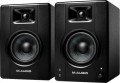 |  |
|---|---|---|
| M-AUDIO BX4 | PreSonus Eris E3.5 | |
| Compare prices 3 | from $99.99 | |
| TOP sellers | ||
| Features | monitor | monitor |
| Near field monitoring |  |  |
| Mount | shelf | shelf |
Specs | ||
| Type | active | active |
| Number of channels | 2.0 system | 2.0 system |
| Number of speakers | 2 | 2 |
| Number of bands | 2 | 2 |
| Crossover frequency | 2.8 kHz | |
Power / frequency | ||
| Front | 25 W/channel | 25 W/channel |
| Total rated power | 50 W | 50 W |
| Overall frequency range | 69 – 22000 Hz | 80 – 20000 Hz |
Design | ||
| Design features | phase inverter back treble adjustment bass control | phase inverter back treble adjustment bass control |
Connectors | ||
| Inputs | RCA mini-Jack (3.5 mm) Jack (6.35 mm) | RCA mini-Jack (3.5 mm) Jack (6.35 mm) |
| Outputs | on headphones | |
General | ||
| Tweeter size | 25 mm | 25 mm |
| Woofer size (LF/MF) | 114 mm | 89 mm |
| Finishing material | MDF | MDF |
| Front speaker dimensions (HxWxD) | 23x16x18 cm | 21x14x16 cm |
| Weight | 9 kg | 2.9 kg |
| Color | ||
| Added to E-Catalog | june 2021 | november 2017 |



Compare M-AUDIO BX4 and PreSonus Eris E3.5
Price comparison
You may be interested in
My comparisons
M-AUDIO BX4 often compared


PreSonus Eris E3.5 often compared


Glossary
Near field monitoring
Possibility of using an acoustic system for monitoring the near field. Monitoring is called sound quality control - for example, during recording in a studio; for this, columns of the corresponding purpose are used (see above). The term "near field" means that acoustics are designed for use at a short distance - up to 1.5 m from the listener; such speakers have a relatively low power and are best suited for small rooms (as well as other conditions where there is no extensive space or it is not required) - in particular, amateur and even home studios.
Crossover frequency
The crossover frequency provided in the speaker design.
A crossover is installed exclusively in a multi-band model (see "Number of Bands"). This is an electronic filter that ensures the division of the incoming audio signal into separate frequency ranges and directs each range to "its" set of speakers. And the crossover frequency shows where the boundary between these ranges lies. If there are more than two bands, there will be several such boundaries: for example, for a four-band system it may be specified "0.15 / 0.8 / 2.8 kHz" or "0.12 / 1 / 3.8".
In most cases, this parameter has mainly a reference value: the frequencies of the built-in crossover are selected to match the operating characteristics of the speakers installed in the speaker system.
A crossover is installed exclusively in a multi-band model (see "Number of Bands"). This is an electronic filter that ensures the division of the incoming audio signal into separate frequency ranges and directs each range to "its" set of speakers. And the crossover frequency shows where the boundary between these ranges lies. If there are more than two bands, there will be several such boundaries: for example, for a four-band system it may be specified "0.15 / 0.8 / 2.8 kHz" or "0.12 / 1 / 3.8".
In most cases, this parameter has mainly a reference value: the frequencies of the built-in crossover are selected to match the operating characteristics of the speakers installed in the speaker system.
Overall frequency range
The total frequency range that the speaker is capable of reproducing. Specified from the bottom of the range in the lowest frequency component to the top of the range in the highest frequency: for example, in a 2.1 system with main speakers at 100 – 22000 Hz and a subwoofer at 20 – 150 Hz, the total value will be 20 – 22000 Hz.
The wider the frequency range — the fuller the reproduced sound, the lower the likelihood that some part of the low or high frequencies will be "cut off". It is worth noting here that the human ear perceives frequencies on average from 16 Hz to 22 kHz, and from a practical point of view, it makes no sense to provide a wider frequency range in speakers. However, quite a few models go beyond this range, sometimes quite significantly (for example, there are speakers with a range of about 10 – 50,000 Hz). Such characteristics are a kind of "side effect" of high-end acoustics, and they are usually given for advertising purposes.
Thus, the lower limit of the range in modern speakers can be within frequencies up to 20 Hz, however, higher values \u200b\u200bare more common — 30 – 40 Hz, 40 – 50 Hz, or even more than 70 Hz. In turn, the upper limit in most modern speakers lies in the range 19 – 22 kHz, although there are deviations both upwards (see above) and downwards....
The wider the frequency range — the fuller the reproduced sound, the lower the likelihood that some part of the low or high frequencies will be "cut off". It is worth noting here that the human ear perceives frequencies on average from 16 Hz to 22 kHz, and from a practical point of view, it makes no sense to provide a wider frequency range in speakers. However, quite a few models go beyond this range, sometimes quite significantly (for example, there are speakers with a range of about 10 – 50,000 Hz). Such characteristics are a kind of "side effect" of high-end acoustics, and they are usually given for advertising purposes.
Thus, the lower limit of the range in modern speakers can be within frequencies up to 20 Hz, however, higher values \u200b\u200bare more common — 30 – 40 Hz, 40 – 50 Hz, or even more than 70 Hz. In turn, the upper limit in most modern speakers lies in the range 19 – 22 kHz, although there are deviations both upwards (see above) and downwards....
Outputs
Types of outputs provided in the design of the speaker system.
Outputs in modern speakers are mainly used to switch the signal coming from an external source. However, other applications are also possible: for example, a speaker with a USB port (see "Inputs") and a built-in player may have connectors for connecting additional acoustics. The most common types of exits are:
— RCA. In this case, we mean an output for working with an analogue audio signal, usually a line level (an RCA connector can also be used in other interfaces, but they have their own names). In general, this interface does not differ in noise immunity, but its capabilities are quite enough at least for home acoustics, including quite advanced ones. Note that with this connection, each audio channel requires its own connector; therefore, RCA jacks are usually installed in pairs — stereo left and right. The exception is the subwoofer outputs, which can also be performed in this format — one connector is enough for them.
— mini-Jack (3.5 mm). Standard mini-jack socket. Most often used in the same way as RCA described above — for line-level analogue audio, including connecting subwoofers. At the same time, one 3.5 mm jack can be responsible for two stereo channels at once, however, the noise immunity of such an interface is even lower than that of RCA. Therefore, such a connector among the speakers is much less common.
Separately, we emph...asize that the headphone output (see below) is indicated separately, even if it also uses the mini-Jack jack.
— Jack (6.35 mm). A connector similar in shape to the mini-jack described above, but having a larger size; as a result, it is found mainly in stationary audio equipment, and is also used in musical instruments. 6.35 mm Jack is considered more durable and reliable than 3.5 mm mini-jack, besides technically it is able to provide the so-called balanced connection (see below), although in fact this possibility is relatively rare. One of the most popular uses for this output is connecting an additional speaker to a live speaker. Along with its younger brother, the 6.35 mm Jack connector can be used as a headphone output, but headphone jacks are not included in this category and are listed separately (see below).
— Headphones. Dedicated headphone output. Most modern "ears" have mini-Jack plugs (see above) — respectively, and this output is equipped with just such a connector. Occasionally there are speakers with Jack jacks, but this point is not important — a 3.5 mm plug can be connected to a 6.35 mm jack using a simple adapter (such adapters are even supplied with many headphones). Headphones can be useful, for example, at a later time of the day when loud music is undesirable — or vice versa, in a noisy environment, in order to hear the sound better; at the same time, the speaker is often closer to the listener than the player or other signal source, and it is most convenient to connect the “ears” to the speaker.
— Balanced XLR. XLR connectors have three pins, according to the number of cable strands. They can be used to transmit a different type of signal, however, in this case, an analogue balanced connection is implied. With this connection, one channel of audio is transmitted per connector, and a fairly large part of the interference that occurs during transmission is extinguished by the cable itself. The latter ensures the purity of the transmitted sound even at fairly large distances (of the order of several metres). Balanced XLR refers to professional interfaces and is found mainly in speakers of the corresponding class.
— Balanced digital AES/EBU. A variation of the XLR interface, designed to transmit a signal in digital format. It also belongs to professional ones, uses the same connectors and cables and the same balanced transmission method, which ensures the damping of most interference; however, due to differences in the type of signal, it has a large bandwidth and allows even multi-channel audio to be transmitted through one connector.
— Optical. One of the varieties of the S / P-DIF standard — along with the coaxial described below. In this case, the signal is transmitted via a TOSLINK fiber optic cable. The main advantage of this interface is its complete insensitivity to electrical interference, while its capabilities are sufficient even to work with multi-channel audio. Among the shortcomings, it is worth noting the high price of connecting cables, as well as the need for careful handling of them.
— Coaxial. An electrical version of the S / P-DIF standard, using a coaxial cable with a “tulip” connector for signal transmission. Do not confuse this interface with the analogue RCA described above — despite the identity of the connectors, these standards are fundamentally different: "coaxial" works in digital format and even multi-channel audio can be transmitted over a single cable. Compared to optical S/PDIF, this interface is less resistant to interference, but more reliable because electrical cables are not as delicate.
— Speakon. A professional interface used to work with the signal coming from the power amplifier. It is used in the equipment of the corresponding class, in particular, concert systems (see "Purpose") — in this case, we are talking about connecting additional passive speakers to such a speaker. Thanks to the features of the connectors (presence of latches, high degree of isolation), the Speakon interface can be used even with the most powerful amplifiers.
Outputs in modern speakers are mainly used to switch the signal coming from an external source. However, other applications are also possible: for example, a speaker with a USB port (see "Inputs") and a built-in player may have connectors for connecting additional acoustics. The most common types of exits are:
— RCA. In this case, we mean an output for working with an analogue audio signal, usually a line level (an RCA connector can also be used in other interfaces, but they have their own names). In general, this interface does not differ in noise immunity, but its capabilities are quite enough at least for home acoustics, including quite advanced ones. Note that with this connection, each audio channel requires its own connector; therefore, RCA jacks are usually installed in pairs — stereo left and right. The exception is the subwoofer outputs, which can also be performed in this format — one connector is enough for them.
— mini-Jack (3.5 mm). Standard mini-jack socket. Most often used in the same way as RCA described above — for line-level analogue audio, including connecting subwoofers. At the same time, one 3.5 mm jack can be responsible for two stereo channels at once, however, the noise immunity of such an interface is even lower than that of RCA. Therefore, such a connector among the speakers is much less common.
Separately, we emph...asize that the headphone output (see below) is indicated separately, even if it also uses the mini-Jack jack.
— Jack (6.35 mm). A connector similar in shape to the mini-jack described above, but having a larger size; as a result, it is found mainly in stationary audio equipment, and is also used in musical instruments. 6.35 mm Jack is considered more durable and reliable than 3.5 mm mini-jack, besides technically it is able to provide the so-called balanced connection (see below), although in fact this possibility is relatively rare. One of the most popular uses for this output is connecting an additional speaker to a live speaker. Along with its younger brother, the 6.35 mm Jack connector can be used as a headphone output, but headphone jacks are not included in this category and are listed separately (see below).
— Headphones. Dedicated headphone output. Most modern "ears" have mini-Jack plugs (see above) — respectively, and this output is equipped with just such a connector. Occasionally there are speakers with Jack jacks, but this point is not important — a 3.5 mm plug can be connected to a 6.35 mm jack using a simple adapter (such adapters are even supplied with many headphones). Headphones can be useful, for example, at a later time of the day when loud music is undesirable — or vice versa, in a noisy environment, in order to hear the sound better; at the same time, the speaker is often closer to the listener than the player or other signal source, and it is most convenient to connect the “ears” to the speaker.
— Balanced XLR. XLR connectors have three pins, according to the number of cable strands. They can be used to transmit a different type of signal, however, in this case, an analogue balanced connection is implied. With this connection, one channel of audio is transmitted per connector, and a fairly large part of the interference that occurs during transmission is extinguished by the cable itself. The latter ensures the purity of the transmitted sound even at fairly large distances (of the order of several metres). Balanced XLR refers to professional interfaces and is found mainly in speakers of the corresponding class.
— Balanced digital AES/EBU. A variation of the XLR interface, designed to transmit a signal in digital format. It also belongs to professional ones, uses the same connectors and cables and the same balanced transmission method, which ensures the damping of most interference; however, due to differences in the type of signal, it has a large bandwidth and allows even multi-channel audio to be transmitted through one connector.
— Optical. One of the varieties of the S / P-DIF standard — along with the coaxial described below. In this case, the signal is transmitted via a TOSLINK fiber optic cable. The main advantage of this interface is its complete insensitivity to electrical interference, while its capabilities are sufficient even to work with multi-channel audio. Among the shortcomings, it is worth noting the high price of connecting cables, as well as the need for careful handling of them.
— Coaxial. An electrical version of the S / P-DIF standard, using a coaxial cable with a “tulip” connector for signal transmission. Do not confuse this interface with the analogue RCA described above — despite the identity of the connectors, these standards are fundamentally different: "coaxial" works in digital format and even multi-channel audio can be transmitted over a single cable. Compared to optical S/PDIF, this interface is less resistant to interference, but more reliable because electrical cables are not as delicate.
— Speakon. A professional interface used to work with the signal coming from the power amplifier. It is used in the equipment of the corresponding class, in particular, concert systems (see "Purpose") — in this case, we are talking about connecting additional passive speakers to such a speaker. Thanks to the features of the connectors (presence of latches, high degree of isolation), the Speakon interface can be used even with the most powerful amplifiers.
Woofer size (LF/MF)
The diameter of the woofer or combined woofer/midrange speaker(s). The larger the speaker, the lower its operating frequencies and the more sound power it can provide. Therefore, you should pay special attention to this parameter if you want to get high-quality rich bass - especially if we are talking about an audio system without a subwoofer. More detailed information about speaker sizes can be found in special sources.
Weight
The total weight of all components of the speaker system.