
Comparison JBL Stage3 507CF vs JBL Stage3 527
Add to comparison |  | 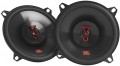 |
|---|---|---|
| JBL Stage3 507CF | JBL Stage3 527 | |
| Expecting restock | Compare prices 2 | |
| TOP sellers | ||
This model does not include protective grilles. | This model does not include protective grilles. | |
| Application area | car | car |
| Type | component | coaxial |
| Size | 5.25" (13 cm) | 5.25" (13 cm) |
| Number of bands | 2 | 2 |
Specs | ||
| Rated power | 45 W | 40 W |
| Max. power | 135 W | 120 W |
| Frequency range | 75 – 20000 Hz | 75 – 20000 Hz |
| Impedance | 3 Ohm | 3 Ohm |
| Sensitivity | 91 dB | 91 dB |
Size | ||
| Woofer size | 114 mm | 130 mm |
| Mounting depth | 45 mm | 45 mm |
| Added to E-Catalog | october 2025 | september 2021 |




Compare JBL Stage3 507CF and Stage3 527
Price comparison
You may be interested in
My comparisons
JBL Stage3 527 often compared


Glossary
Type
— Broadband speakers. The simplest type of acoustics: one speaker is used to reproduce the entire frequency range. The advantages of such speakers are simplicity of design (as a result, low cost) and ease of installation. On the other hand, the sound quality of full range speakers is significantly lower than that of dedicated speakers (see below).
— Component speakers. The most advanced type of car speaker: it has separate speakers for each frequency band (see "Number of bands"), which allows you to customize the sound of each speaker as you wish and provide high sound quality. If the latter is the main factor for you when choosing car audio, you should pay attention to component speakers. However such systems are not cheap, and their installation can be quite complicated due to the large number of speakers.
— Coaxial speakers. A kind of compromise between component and full-range speakers: in such systems, small-sized tweeters and mid-range speakers are placed directly in front of the larger woofer cone, on the same axis with it. This design simplifies installation, reduces cost, and delivers better sound quality than full-range speakers. However this quality is still lower than that of component systems, and therefore “coaxials” are usually used either as rear speakers, or when for some reason (for example, due to cramped conditions) it is impossible to install a...component speaker.
— Cabinet speaker. The speakers of such acoustic systems are housed in a separate cabinet(s). This greatly simplifies installation — you do not have to find speakers to fit existing niches or even cut these niches on purpose, as in other types of speakers. On the other hand, such acoustics take up more space in the cabin.
— Midrange speakers. As the name implies, such a speaker reproduces only the middle frequency band, "cutting off" the highest and lowest. Technically, it can be used as a separate speaker, but this is usually not justified. Therefore, in fact, mid-frequency acoustics are usually installed as part of a more advanced component-type system (see above).
— Twitter. A speaker designed to reproduce high frequencies. Due to specialization, it is not used separately, it is used in combination with a mid-frequency speaker to build component-type systems (see above).
— Component speakers. The most advanced type of car speaker: it has separate speakers for each frequency band (see "Number of bands"), which allows you to customize the sound of each speaker as you wish and provide high sound quality. If the latter is the main factor for you when choosing car audio, you should pay attention to component speakers. However such systems are not cheap, and their installation can be quite complicated due to the large number of speakers.
— Coaxial speakers. A kind of compromise between component and full-range speakers: in such systems, small-sized tweeters and mid-range speakers are placed directly in front of the larger woofer cone, on the same axis with it. This design simplifies installation, reduces cost, and delivers better sound quality than full-range speakers. However this quality is still lower than that of component systems, and therefore “coaxials” are usually used either as rear speakers, or when for some reason (for example, due to cramped conditions) it is impossible to install a...component speaker.
— Cabinet speaker. The speakers of such acoustic systems are housed in a separate cabinet(s). This greatly simplifies installation — you do not have to find speakers to fit existing niches or even cut these niches on purpose, as in other types of speakers. On the other hand, such acoustics take up more space in the cabin.
— Midrange speakers. As the name implies, such a speaker reproduces only the middle frequency band, "cutting off" the highest and lowest. Technically, it can be used as a separate speaker, but this is usually not justified. Therefore, in fact, mid-frequency acoustics are usually installed as part of a more advanced component-type system (see above).
— Twitter. A speaker designed to reproduce high frequencies. Due to specialization, it is not used separately, it is used in combination with a mid-frequency speaker to build component-type systems (see above).
Rated power
Rated power of the acoustic system. Most often, the average (root mean square) sound power is indicated as rated.
The most obvious point related to this characteristic is the volume of sound: the more powerful the sound system, the louder the sound it can produce, all other things being equal. In addition, compatibility with an external amplifier depends on this indicator: its power should not exceed the power of the sound system, otherwise overloads and damage to the speakers are possible.
The most obvious point related to this characteristic is the volume of sound: the more powerful the sound system, the louder the sound it can produce, all other things being equal. In addition, compatibility with an external amplifier depends on this indicator: its power should not exceed the power of the sound system, otherwise overloads and damage to the speakers are possible.
Max. power
The maximum power of a short-term (up to several seconds) incoming signal that the speaker can withstand without physical damage. Just like the nominal power, it matters for the selection of acoustics for an amplifier (or vice versa): it is believed that the maximum power of the speakers should be at least 2 times higher than the maximum power of the signal source.
Woofer size
Size of the low-frequency speaker(s) provided in the speaker system.
This size is specified only for models with separate bass speakers. In such acoustics, it is the LF emitter that is the largest (this is due to the physical characteristics of the bass range). Accordingly, the space occupied by the entire system is determined mainly by the diameter of the LF speaker. And since the power and richness of the bass also directly depends on the size of the emitter, then when choosing, you have to proceed from a compromise between the capabilities of the acoustics and the available space in the car.
This size is specified only for models with separate bass speakers. In such acoustics, it is the LF emitter that is the largest (this is due to the physical characteristics of the bass range). Accordingly, the space occupied by the entire system is determined mainly by the diameter of the LF speaker. And since the power and richness of the bass also directly depends on the size of the emitter, then when choosing, you have to proceed from a compromise between the capabilities of the acoustics and the available space in the car.