
Comparison Videx VCH-UT201 vs Nitecore UMS2
Add to comparison | 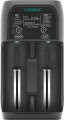 | 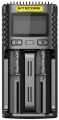 |
|---|---|---|
| Videx VCH-UT201 | Nitecore UMS2 | |
| Outdated Product | Compare prices 4 | |
| TOP sellers | ||
USB-C port to power the device. | Supports Quick Charge technology version 2.0. Ability to manually select charging current and voltage. | |
Batteries charging | ||
| Charging slots | 2 шт | 2 шт |
| Supported types | Ni-Cd Ni-Mh Li-Ion LiFePO4 IMR | Ni-Cd Ni-Mh Li-Ion LiFePO4 IMR |
| Size | AAAA AAA AA C D 10440 14500 16340 (CR123) 17500 17650 17670 18490 18500 18650 20700 21700 22650 26500 26650 36250 | AAAA AAA AA C D 10440 14500 16340 (CR123) 16500 17500 17650 17670 18350 18490 18500 18650 22650 25500 26500 26650 26700 |
Specs | ||
| Operation indicator | display | display |
| Independent charge channels | 2 шт | 2 шт |
| Min. charge current | 1000 mA | 100 mA |
| Max. charge current | 2000 mA | 3000 mA |
| Charge current (all channels) | 1000 mA | 4000 mA |
| Number of settings | 2 pcs | |
Features | ||
| Capacity measurement |  | |
| Overcharge protection | | |
| Preliminary discharge | |  |
| Capacity recovery | | |
| Residual capacity check | | |
| Polarity test | | |
| Fault detection | | |
| USB output charging gadgets | | |
| Overheat protection | | |
| Short circuit protection | | |
General | ||
| Movable negative contact | | |
| USB charging power | USB C | microUSB |
| Dimensions (HxWxD) | 146x75x40 mm | 40x73x152 mm |
| Weight | 100 g | 157 g |
| Added to E-Catalog | june 2021 | july 2020 |



Compare Videx VCH-UT201 and Nitecore UMS2
Price comparison
You may be interested in
My comparisons
Videx VCH-UT201 often compared


Nitecore UMS2 often compared


Glossary
Size
The battery sizes that the charger is compatible with. In this case, the adapters supplied in the kit (see below) are not taken into account in this paragraph, we are talking only about the memory as such.
The standard dimensions describes the shape, dimensions, connector design and operating voltage of the battery; thus, it is one of the most important parameters for determining compatibility with a particular charger.
The most popular sizes for which modern “chargers” are made can be divided into 1.5-volt (marked in Latin letters AA, AAA, C, D) and 3.7-volt (have digital markings 14500, 17500, 18650, 22650, 26650, etc. .P.). More about them:
— AAAA. The smallest version of the "finger" dimensions: batteries of the same cylindrical shape as the well-known AA and AAA, but with a size of only about 8 mm and a length of about 43 mm. Similar in application to AAA, but very poorly distributed.
— AAA. Size, colloquially known as "mini finger" or "little finger batteries": cylindrical batteries with a size of 10.5 mm and a length of 44.5 mm. They are mainly used in miniature devices for which there are not enough “tablet” bat...teries, and larger elements are too bulky.
— AA. Classic "finger" batteries with a size of 14 mm and a length of 50 mm, one of the most popular modern standard sizes (if not the most popular). They are used in a wide variety of types and price categories of devices, including even external battery packs for SLR cameras.
- C. Batteries in the form of a characteristic "barrel". They are similar in height to finger-type AAs, but almost twice as thick - 50 mm and 26 mm, respectively - due to which they have a higher capacity.
- D. The largest dimensions of consumer grade 1.5V batteries, 34mm in size and 61mm in length. It is mainly used in high-power flashlights and devices with high energy consumption.
3.7-V batteries are indicated by a five-digit number. In it, the first two digits indicate the size (in millimeters), the remaining three indicate the length (in tenths of a millimeter). For example, the popular dimensions 18650 corresponds to a battery with a size of 18 mm and a length of 65.0 mm. It is worth noting here that there are 3.7-volt cells that are the same dimensions as the 1.5-volt ones described above (for example, the 14500 dimensions is similar to AA finger-type), but both types are not interchangeable due to the difference in voltage.
A separate category is 9-volt R22 batteries, also known as PP3: these are rectangular elements in which a pair of contacts is located on one of the ends.
The standard dimensions describes the shape, dimensions, connector design and operating voltage of the battery; thus, it is one of the most important parameters for determining compatibility with a particular charger.
The most popular sizes for which modern “chargers” are made can be divided into 1.5-volt (marked in Latin letters AA, AAA, C, D) and 3.7-volt (have digital markings 14500, 17500, 18650, 22650, 26650, etc. .P.). More about them:
— AAAA. The smallest version of the "finger" dimensions: batteries of the same cylindrical shape as the well-known AA and AAA, but with a size of only about 8 mm and a length of about 43 mm. Similar in application to AAA, but very poorly distributed.
— AAA. Size, colloquially known as "mini finger" or "little finger batteries": cylindrical batteries with a size of 10.5 mm and a length of 44.5 mm. They are mainly used in miniature devices for which there are not enough “tablet” bat...teries, and larger elements are too bulky.
— AA. Classic "finger" batteries with a size of 14 mm and a length of 50 mm, one of the most popular modern standard sizes (if not the most popular). They are used in a wide variety of types and price categories of devices, including even external battery packs for SLR cameras.
- C. Batteries in the form of a characteristic "barrel". They are similar in height to finger-type AAs, but almost twice as thick - 50 mm and 26 mm, respectively - due to which they have a higher capacity.
- D. The largest dimensions of consumer grade 1.5V batteries, 34mm in size and 61mm in length. It is mainly used in high-power flashlights and devices with high energy consumption.
3.7-V batteries are indicated by a five-digit number. In it, the first two digits indicate the size (in millimeters), the remaining three indicate the length (in tenths of a millimeter). For example, the popular dimensions 18650 corresponds to a battery with a size of 18 mm and a length of 65.0 mm. It is worth noting here that there are 3.7-volt cells that are the same dimensions as the 1.5-volt ones described above (for example, the 14500 dimensions is similar to AA finger-type), but both types are not interchangeable due to the difference in voltage.
A separate category is 9-volt R22 batteries, also known as PP3: these are rectangular elements in which a pair of contacts is located on one of the ends.
Min. charge current
The smallest current that the device can provide in charge mode. If this parameter is specified in the specifications, this means that this model has the ability to adjust the charge current (otherwise, only the maximum current is indicated).
Charging current is one of the most important parameters for any charger: see “Maximum charge current. And the general range of current adjustment depends on this indicator: the lower the minimum value (with the same maximum) — the more extensive the possibilities for setting up the "charger" for the specific specifics of work.
Charging current is one of the most important parameters for any charger: see “Maximum charge current. And the general range of current adjustment depends on this indicator: the lower the minimum value (with the same maximum) — the more extensive the possibilities for setting up the "charger" for the specific specifics of work.
Max. charge current
The highest current that the device can provide when charging the battery (or the nominal value of the charging current, if it is not adjustable).
Charging current is one of the most important parameters for any charger: it determines the speed of the process and compatibility with certain batteries. In general, the higher the current, the faster the process, the less time it takes to charge. At the same time, some batteries may have recommendations for the optimal current strength and restrictions on its maximum values. Therefore, mindlessly chasing a powerful charger is not worth it: at first it's ok to clarify how justified such power will be.
Note that in multi-channel devices (see "Independent channels"), the maximum current strength can be achieved when only part of the channels are operating. The indicators provided when all channels are operating simultaneously are indicated separately for such models (see "Charge current (all channels)").
Charging current is one of the most important parameters for any charger: it determines the speed of the process and compatibility with certain batteries. In general, the higher the current, the faster the process, the less time it takes to charge. At the same time, some batteries may have recommendations for the optimal current strength and restrictions on its maximum values. Therefore, mindlessly chasing a powerful charger is not worth it: at first it's ok to clarify how justified such power will be.
Note that in multi-channel devices (see "Independent channels"), the maximum current strength can be achieved when only part of the channels are operating. The indicators provided when all channels are operating simultaneously are indicated separately for such models (see "Charge current (all channels)").
Charge current (all channels)
The highest current provided by a multi-channel charger (see "Independent channels") at full load, with all slots (and, accordingly, channels) operating. In fact, a guaranteed maximum current provided by a multi-channel charger, regardless of the number of channels involved.
For the total charge current, see “Maximum charge current. Here we note that the full load is a rather complex mode in which the current strength can decrease. Therefore, this parameter is specified separately.
For the total charge current, see “Maximum charge current. Here we note that the full load is a rather complex mode in which the current strength can decrease. Therefore, this parameter is specified separately.
Number of settings
The number of separate charge current settings (see above) provided in the design of the charger. For example, a device with 4 settings may provide options for 200, 400, 800 and 1000 mAh. In general, the larger this number, the more accurately you can choose the charging current for a particular situation.
Preliminary discharge
Pre-discharge is useful for batteries that are prone to memory effect - they need to be charged only after the charge is completely depleted. In accordance with the name, a charger with this function is capable, if necessary, of discharging the installed battery “to zero” before starting charging. At the same time, some models are able to automatically detect the presence of residual energy and turn on a preliminary discharge, in others it must be turned on manually.
Residual capacity check
A procedure to determine the actual capacity of the installed battery. When measuring capacity, the charger charges and discharges the battery (in some models - several times, for greater accuracy), measuring the actual amount of stored and released energy. Checking the remaining capacity takes much longer than the “capacity measurement” item described above, but it is much more accurate and can be used not only to determine the characteristics of the battery, but also to diagnose its condition and degree of wear.
Fault detection
A diagnostic system capable of detecting faulty batteries, disconnecting them from power and notifying the user. The fault detection function is useful not only for checking the performance as such: a battery malfunction that is not detected in time is fraught with equipment damage, and in some cases even fires.
USB output charging gadgets
The ability to use the charger to charge portable electronics - smartphones, tablets, players, etc. As a rule, for this, a USB port is provided in the design, for connection to which an appropriate cable is required; in fact, you can charge from such a device not only mobile gadgets, but also any equipment that can be powered from USB. True, it is worth noting that some manufacturers do not recommend using third-party devices for their equipment if they are not officially approved.