
Comparison Oukitel P2001 Plus vs Choetech BS008
Add to comparison | 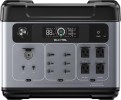 |  |
|---|---|---|
| Oukitel P2001 Plus | Choetech BS008 | |
| Compare prices 1 | Outdated Product | |
| TOP sellers | ||
Flashlight. New models (from 2026) have a smartphone control feature (check with the store before purchasing). | ||
| In box | charging station | charging station |
| Rated power | 2400 W | 2400 W |
| Peak power | 4800 W | 4800 W |
| Output waveform | sinusoid (PSW) | sinusoid (PSW) |
| UPS function |  | |
| Switchover time to battery | 10 ms | 10 ms |
Outputs | ||
| Sockets (230 V) | 4 | 3 |
| USB-A (quick charge) | 2x QC3.0 5В/3A, 9В/2A, 12В/1.5A 18 W | 2x QC3.0 5В/3A, 9В/2A, 12В/1.5A 18 W |
| USB-C | 4 pcs 3 A, 5 A 100 W | 4 pcs 3 A, 5 A 100 W |
| Car cigarette lighter | | |
Inputs (station charging) | ||
| From solar panels | | |
| Input port XT60 | | |
| Anderson port | 11.5 – 50 H / 500 W | |
Battery and charging time | ||
| Battery type | LiFePO4 | LiFePO4 |
| Battery capacity | 2048 Wh | 2048 Wh |
| Charging cycles | 3500 | |
| Charging time (socket) ≈ | 60 min | |
| Charging time (solar panel) ≈ | 165 min | |
| Charging power (socket) | 1800 W | 1100 W |
| Charging power (solar panel) | 500 W | 500 W |
| Charging power (cigarette lighter) | 120 W | |
General | ||
| Smartphone synchronization | Bluetooth and WiFi | Bluetooth and WiFi |
| PSU | built into the body | built into the body |
| Display | | |
| Backlight | | |
| Carrying handle | | |
| Operating temperature | 0 °C ~ +40 °C | -10 °C ~ +40 °C |
| Dimensions (LxWxH) | 399x286x320 mm | 392x279x323 mm |
| Weight | 22 kg | 22.5 kg |
| Warranty | 3 years | 2 years |
| Added to E-Catalog | september 2024 | september 2024 |



Compare Oukitel P2001 Plus and Choetech BS008
The Oukitel P2001 Plus and Choetech BS008 charging stations have similar features, but differences in functionality and performance may impact a user's choice. The Oukitel P2001 Plus offers 4 outlets (230 V) and 2 USB A ports, while the Choetech BS008 has 3 outlets (230 V) and also 2 USB A ports. Both models have a peak power of 4800 W and use LiFePO4 batteries, however, Oukitel has a larger battery capacity (2048 Wh versus 40 Ah for Choetech). The charging time for Oukitel from an outlet is about 60 minutes, which is faster compared to Choetech, which charges at 1100 W. Additionally, it is worth noting that Oukitel supports synchronization with a smartphone via Bluetooth and Wi-Fi, a feature not available in Choetech. Overall, the Oukitel P2001 Plus may be preferable for users looking for a more powerful and functional charging station.
Price comparison
You may be interested in
Oukitel P2001 Plus often compared


Choetech BS008 often compared


Glossary
Sockets (230 V)
Total number of outlets with output voltage. This is, in fact, the number of devices that can be simultaneously connected to the charging station without the use of splitters, extension cords and carriers. Accordingly, weaker charging stations have one or two sockets in their submission. Powerful charging stations already have three or more sockets “on board”.
Anderson port
A large two-pole connector for connecting batteries, chargers and all kinds of equipment where reliable contact is required for the sake of ensuring stable operation of the equipment. Anderson Port is resistant to moisture changes, can be used both for indoor and outdoor mechanisms. Thanks to identical mating parts, a pair is formed by two identical connectors, which are rotated 180 ° relative to each other. Most often, Anderson port is used in mobile homes on wheels.
Charging cycles
The number of charge-discharge cycles that the battery can withstand without significant loss of performance.
In the process of operation, the batteries wear out, which causes their performance to suffer (in the first place, the capacity decreases). Battery life is usually measured in charge-discharge cycles. However, models with the same declared resource are not always equally durable in practice. Different manufacturers may interpret “significant loss of performance” in different ways: for example, one brand indicates the resource up to a 20% decrease in capacity (DOD > 80%), another - up to a 60% decrease (DOD > 40%) Behind the abbreviation DOD worth decoding Depth of Discharge, i.e. discharge depth. Therefore, when choosing, it makes sense to focus not only on pure numbers, but also on other sources - test results, reviews, etc. Also note that battery life can be noticeably reduced if the operating conditions are violated (for example, in case of overheating or hypothermia).
In the process of operation, the batteries wear out, which causes their performance to suffer (in the first place, the capacity decreases). Battery life is usually measured in charge-discharge cycles. However, models with the same declared resource are not always equally durable in practice. Different manufacturers may interpret “significant loss of performance” in different ways: for example, one brand indicates the resource up to a 20% decrease in capacity (DOD > 80%), another - up to a 60% decrease (DOD > 40%) Behind the abbreviation DOD worth decoding Depth of Discharge, i.e. discharge depth. Therefore, when choosing, it makes sense to focus not only on pure numbers, but also on other sources - test results, reviews, etc. Also note that battery life can be noticeably reduced if the operating conditions are violated (for example, in case of overheating or hypothermia).
Charging time (socket) ≈
Time to charge the portable power station from a fully discharged state to 100% charge when using the power adapter from a household outlet. This refers to the original battery and standard charger.
Charging time (solar panel) ≈
Time spent on a full charge when using the original panel in bright sunlight. In cloudy weather, the charging time of the device from the solar panel can be strikingly different downwards.
Charging power (socket)
The power at which, in normal mode, the portable power station is charged from a household outlet when using the original power supply.
Charging power (cigarette lighter)
The power normally received by the charging station when connected from the car's cigarette lighter socket (12 V).
Operating temperature
The temperature range in which the charging station normally operates in normal mode. Exceeding the specified norms in any direction leads to a rapid discharge of the battery, its accelerated degradation and other unpleasant consequences.
Warranty
Warranties for charging stations usually provide users with protection against manufacturing defects and malfunctions for a certain period, which may vary depending on the manufacturer. Warranty service includes free repair or replacement of components if the problem is not the user's fault. The warranty period can be from one year to several years, and it is important to consider conditions such as correct installation, use of the station for its intended purpose, and compliance with technical requirements.