
Comparison Creality Ender-3 V3 Plus vs Creality Ender-3 V3
Add to comparison | 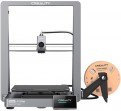 | 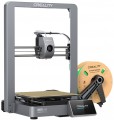 |
|---|---|---|
| Creality Ender-3 V3 Plus | Creality Ender-3 V3 | |
| Compare prices 2 | from $399.00 | |
| User reviews | ||
| TOP sellers | ||
| Print technology | deposition modeling (FDM/FFF) | deposition modeling (FDM/FFF) |
| Filament material | ABS PETG PLA TPU | ABS PETG PLA TPU |
| 3D model file format | .stl , .obj, .gcode | .stl , .obj, .gcode |
| Compatible software | Creality Print | Creality Print |
| Object dimensions (HxWxD) | 330x300x300 mm | 250x220x220 mm |
| Object volume | 29.7 L | 12 L |
Printing process | ||
| Kinematics | Bed Slinger (Core XZ) | Bed Slinger (Core XZ) |
| Min layer thickness | 100 µm | 100 µm |
| Print speed | 600 mm/s | 600 mm/s |
| Nozzle diameter | 0.4 mm | 0.4 mm |
| Min thread diameter | 1.75 mm | 1.75 mm |
| Heating bed temperature | 100 °C | 110 °C |
| Extruder (nozzle) temperature | 300 °C | 300 °C |
| Number of extruders | 1 | 1 |
More features | ||
| Features | heated bed resume print filament sensor plastic feed tube | heated bed resume print filament sensor plastic feed tube |
| Data transfer | USB-A Wi-Fi | USB-A Wi-Fi |
General | ||
| LCD display | 4.3" touch screen | 4.3" touch screen |
| Power | 350 W | 350 W |
| Dimensions | 41x44.5x58 cm | 36x37x50 cm |
| Weight | 11.5 kg | 7.83 kg |
| Added to E-Catalog | may 2024 | april 2024 |



Compare Creality Ender-3 V3 Plus and Ender-3 V3
Price comparison
You may be interested in
My comparisons
Creality Ender-3 V3 Plus often compared


Creality Ender-3 V3 often compared


Glossary
Object dimensions (HxWxD)
The maximum dimensions of a product that can be printed on a 3D printer in one cycle.
The larger the dimensions of the model, the wider the choice for the user, the greater the variety of sizes available for printing. On the other hand, "large-sized" printers take a lot of space, and this parameter significantly affects the cost of the device. In addition, while printing a large model with FDM/FFF (see "Printing Technology"), larger nozzles and higher print speeds are desirable — and these features negatively affect detailing and the print quality of tiny objects. Therefore, while choosing, you should not aim the utmost maximum sizes — you should realistically assess the dimensions of the objects that you're going to print, and proceed from these data (plus a small margin in case of unexpected moments). In addition, we note that a large product can be printed in parts, and then piece these parts together.
The larger the dimensions of the model, the wider the choice for the user, the greater the variety of sizes available for printing. On the other hand, "large-sized" printers take a lot of space, and this parameter significantly affects the cost of the device. In addition, while printing a large model with FDM/FFF (see "Printing Technology"), larger nozzles and higher print speeds are desirable — and these features negatively affect detailing and the print quality of tiny objects. Therefore, while choosing, you should not aim the utmost maximum sizes — you should realistically assess the dimensions of the objects that you're going to print, and proceed from these data (plus a small margin in case of unexpected moments). In addition, we note that a large product can be printed in parts, and then piece these parts together.
Object volume
The largest volume of an object that can be printed on a printer. This indicator directly depends on the maximum dimensions (see above) — usually, it corresponds to these dimensions multiplied by each other. For example, dimensions of 230x240x270 mm will correspond to a volume of 23*24*27 = 14,904 cm³, that is, 14.9 litres.
The exact meaning of this indicator depends on the printing technology used (see above). These data are fundamental for photopolymer technologies SLA and DLP, as well as for powder SHS: the volume of the model corresponds to the amount of photopolymer/powder that needs to be loaded into the printer to print the product to the maximum height. If the size is smaller, this amount may decrease proportionally (for example, printing a model at half the maximum height will require half the volume), however, some printers require a full load regardless of the size of the product. In turn, for FDM/FFF and other similar technologies, the volume of the model is more of a reference value: the actual material consumption there will depend on the configuration of the printed product.
As for specific figures, the volume up to 5 litres can be considered as small, from 5 to 10 litres — medium, more than 10 litres — large.
The exact meaning of this indicator depends on the printing technology used (see above). These data are fundamental for photopolymer technologies SLA and DLP, as well as for powder SHS: the volume of the model corresponds to the amount of photopolymer/powder that needs to be loaded into the printer to print the product to the maximum height. If the size is smaller, this amount may decrease proportionally (for example, printing a model at half the maximum height will require half the volume), however, some printers require a full load regardless of the size of the product. In turn, for FDM/FFF and other similar technologies, the volume of the model is more of a reference value: the actual material consumption there will depend on the configuration of the printed product.
As for specific figures, the volume up to 5 litres can be considered as small, from 5 to 10 litres — medium, more than 10 litres — large.
Heating bed temperature
Maximum heating temperature in 3D printers with heated bed (for more details, see the relevant paragraph). The higher the limit, the more varieties of plastic can be used for printing. So, models with heating up to 100 °C are suitable for 3D printing with PLA plastic, with a bed temperature of 100 to 120 °C — for working with ABS plastic and nylon, high-temperature ones — allow the use of polycarbonate and refractory varieties of plastic.