
Comparison Darex Professional Precision Adjust vs Darex Precision Adjust
Add to comparison |  | 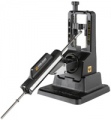 |
|---|---|---|
| Darex Professional Precision Adjust | Darex Precision Adjust | |
from $277.90 | from $249.95 | |
| TOP sellers | ||
| Type | professional sharpening machine | professional sharpening machine |
Specs | ||
| Abrasive material | diamond and ceramic | diamond and ceramic |
| Min. grain | 220 grit | 320 grit |
| Max. grain | 800 grit | 600 grit |
| Sharpening angle | 15° / 30° | 15° / 30° |
| Serrated sharpening |  |  |
| Added to E-Catalog | november 2023 | june 2023 |


Compare Darex Professional Precision Adjust and Precision Adjust
You may be interested in
My comparisons
Darex Precision Adjust often compared

Glossary
Min. grain
The smallest grit provided in the design of the sharpener or among the complete replacement whetstones. It also indicates the standard grain size for models that have only one type of abrasive surface.
The universal unit for grit is GRIT. Simplified, GRIT grit can be described as the smallest number of holes per square inch of a sieve, at which individual abrasive grains can no longer wake up through this sieve. Accordingly, the higher the GRIT number, the finer the grain will be and the lower the granularity will be.
The purity and intensity of sharpening directly depends on this indicator. The finer the grit, the finer the finish and the lower the abrasive performance, and vice versa, coarser surfaces are well suited for initial sharpening, roughing and/or removing large amounts of material.
Here is a rough table of recommendations for optimal GRIT grit for different applications:
80 – 600 — peeling work (for example, correcting the thickness or geometry of the cutting edge or the entire blade).
600 – 3000 – preparatory work (elimination of traces of peeling), initial sharpening.
3000 – 6000 – semi-finish and fine sharpening.
More than 6000 – final finishing, polishing, straightening of the cutting edge.
At the same time, it is worth remembering that the processing features also depend on the material of the abrasive (see above). For example, ceramic surfaces with...the same grain size work more delicately and more slowly than diamond ones. More detailed recommendations on optimal grit values and the specifics of various materials can be found in special sources.
The universal unit for grit is GRIT. Simplified, GRIT grit can be described as the smallest number of holes per square inch of a sieve, at which individual abrasive grains can no longer wake up through this sieve. Accordingly, the higher the GRIT number, the finer the grain will be and the lower the granularity will be.
The purity and intensity of sharpening directly depends on this indicator. The finer the grit, the finer the finish and the lower the abrasive performance, and vice versa, coarser surfaces are well suited for initial sharpening, roughing and/or removing large amounts of material.
Here is a rough table of recommendations for optimal GRIT grit for different applications:
80 – 600 — peeling work (for example, correcting the thickness or geometry of the cutting edge or the entire blade).
600 – 3000 – preparatory work (elimination of traces of peeling), initial sharpening.
3000 – 6000 – semi-finish and fine sharpening.
More than 6000 – final finishing, polishing, straightening of the cutting edge.
At the same time, it is worth remembering that the processing features also depend on the material of the abrasive (see above). For example, ceramic surfaces with...the same grain size work more delicately and more slowly than diamond ones. More detailed recommendations on optimal grit values and the specifics of various materials can be found in special sources.
Max. grain
The largest grain size of the abrasive surface provided in the design of the sharpener (or among the replaceable whetstones supplied as standard).
See “Min. graininess" above. This parameter is indicated only if the sharpener has several abrasive surfaces with different grain sizes. The greater the difference between the minimum and maximum graininess, the more universal this model is, usually, the more options it offers in terms of processing intensity. On the other hand, a wide variety of abrasive surfaces has a corresponding effect on the cost.
See “Min. graininess" above. This parameter is indicated only if the sharpener has several abrasive surfaces with different grain sizes. The greater the difference between the minimum and maximum graininess, the more universal this model is, usually, the more options it offers in terms of processing intensity. On the other hand, a wide variety of abrasive surfaces has a corresponding effect on the cost.
Serrated sharpening
Possibility of using a sharpener for sharpening serrated blades.
Such blades have a serrated cutting edge, for which the classical method of sharpening, on a flat surface, is unsuitable: such a procedure will simply erase the teeth and, at best, turn the serrated blade into a classic smooth one. Therefore, for sharpening in this case, special devices are used: thin rods made of abrasive material, somewhat tapering towards the end. With such a rod, each individual tooth is sharpened separately; this work can be quite laborious, but it allows you to restore the full performance of the serrated blade. At the same time, note that for blades with fine teeth, even such a specialized sharpener may be too large.
Such blades have a serrated cutting edge, for which the classical method of sharpening, on a flat surface, is unsuitable: such a procedure will simply erase the teeth and, at best, turn the serrated blade into a classic smooth one. Therefore, for sharpening in this case, special devices are used: thin rods made of abrasive material, somewhat tapering towards the end. With such a rod, each individual tooth is sharpened separately; this work can be quite laborious, but it allows you to restore the full performance of the serrated blade. At the same time, note that for blades with fine teeth, even such a specialized sharpener may be too large.