
Comparison WorkMan BD1600VS 150 mm / 710 W 230 В vs Scheppach BTS 700 125 mm / 370 W 230 В
Add to comparison | 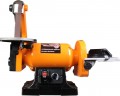 | 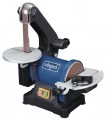 |
|---|---|---|
| WorkMan BD1600VS 150 mm / 710 W 230 В | Scheppach BTS 700 125 mm / 370 W 230 В | |
| Outdated Product | Outdated Product | |
| TOP sellers | ||
| Machine | grinder | grinder |
Specs | ||
| Rotation modules | 2 | 2 |
| Location of rotation modules | coaxially | coaxially |
| Work part | disk / belt | disk / belt |
| Voltage | 230 В | 230 В |
| Motor power | 710 W | 370 W |
| Sharpening | universal | universal |
Dry processing | ||
| Disc diameter | 150 mm | 125 mm |
| Disc speed | 2976 rpm | 2850 rpm |
| Belt length | 762 mm | 762 mm |
| Belt width | 25 mm | 25 mm |
| Belt rotation speed | 820 m/min | |
General | ||
| hook-and-loop fastening system |  | |
| Speed controller | |  |
| Work table size | 200x130 mm | 184x98 mm |
| Dimensions | 380x300x370 mm | |
| Weight | 13.5 kg | 7.42 kg |
| Added to E-Catalog | january 2021 | may 2017 |


Compare WorkMan BD1600VS and Scheppach BTS 700
You may be interested in
WorkMan BD1600VS often compared

Scheppach BTS 700 often compared
Glossary
Motor power
Rated power of the electric motor of the machine. The more powerful the engine, the higher the speed and intensity of processing can be, the larger discs can be used with the machine and the better it is suitable for working with hard, stubborn materials. On the other hand, a powerful motor consumes a lot of energy (which may require special connection — see "Power") and significantly affects the dimensions, weight and price of the entire unit. Therefore, manufacturers choose this parameter based on the type (see "Machine") and the desired characteristics of speed, productivity, etc. In fact, this means that engine power is rather a secondary parameter, and when choosing, it makes sense to pay attention to more practical points — disk diameter, rotation / movement speed, etc.
Disc diameter
Regular diameter of the disk (see "Working element") used by the machine for dry processing (see above). When grinding and polishing, usually, we are talking about the maximum diameter of the disk that can be installed on the tool — a larger nozzle will either be ineffective or not fit into the dimensions of the seat at all, but a smaller diameter disk, usually, is installed without problems (of course, if the hole diameter matches — see below). For grinding machines, the diameter of the disc corresponds to the diameter of the sanding pad, which is necessary for the full use of the disc.
The larger the regular disk — the heavier and more powerful the machine, usually, the better it can cope with complex work of a large volume. At the same time, for small everyday tasks like periodically sharpening knives or chisels, a small disc is quite enough.
The larger the regular disk — the heavier and more powerful the machine, usually, the better it can cope with complex work of a large volume. At the same time, for small everyday tasks like periodically sharpening knives or chisels, a small disc is quite enough.
Disc speed
The nominal speed of rotation of the disk for dry processing (see above), provided by the machine; for models with adjustable rotation (see below), the maximum rotation speed.
For the same disc diameter and material, a higher speed provides more intensive processing, and a slower rotation contributes to accuracy and precision. In addition, optimal speeds depend on the composition of the disc and the material being processed; detailed recommendations with specific figures for a particular situation can be found in special sources.
A separate category is grinding machines with disk-shaped working elements: in such units, the actual speed of movement of the disk surface relative to the workpiece depends on how close the contact point is to the centre of the disk.
For the same disc diameter and material, a higher speed provides more intensive processing, and a slower rotation contributes to accuracy and precision. In addition, optimal speeds depend on the composition of the disc and the material being processed; detailed recommendations with specific figures for a particular situation can be found in special sources.
A separate category is grinding machines with disk-shaped working elements: in such units, the actual speed of movement of the disk surface relative to the workpiece depends on how close the contact point is to the centre of the disk.
Belt rotation speed
The nominal belt speed provided by the machine with the grinding function (see "Machine"). Other things being equal, a higher speed is useful for ensuring intensity and productivity, a lower speed allows for more precise control of the process. Detailed recommendations with specific figures for a particular situation can be found in special sources.
Speed controller
The ability to change the speed of movement of the working element of the machine. The speed controller may have its own characteristics: in some models it is smooth, in others it is stepped, the number of steps may be different, etc. Anyway, speed control greatly expands the capabilities of the machine, allowing you to adjust the mode of operation to the specific situation.
Work table size
The dimensions of the desktop provided in the design of the machine.
The working table is called the plane on which the workpiece is placed during processing. In general, the larger this plane, the larger the part can be machined without problems. At the same time, individual nuances may vary depending on the design features: for example, grinding machines for a sleeve (see "Working item") allow you to work with parts that are larger than the desktop without much difficulty, and in tape models, the length of the table actually corresponds to the working length sanding belt (and the maximum length of the surface that can be processed at one time).
The working table is called the plane on which the workpiece is placed during processing. In general, the larger this plane, the larger the part can be machined without problems. At the same time, individual nuances may vary depending on the design features: for example, grinding machines for a sleeve (see "Working item") allow you to work with parts that are larger than the desktop without much difficulty, and in tape models, the length of the table actually corresponds to the working length sanding belt (and the maximum length of the surface that can be processed at one time).