
Comparison VENTS PS 102 vs VENTS PS 100
Add to comparison | 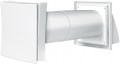 |  |
|---|---|---|
| VENTS PS 102 | VENTS PS 100 | |
| Compare prices 1 | Compare prices 2 | |
| TOP sellers | ||
| System type | decentralized | decentralized |
| Ventilation type | supply and exhaust | supply and exhaust |
| Mounting | wall | wall |
| Mounting diameter | 103 mm | 103 mm |
Specs | ||
| Air filters | G3 | G3 |
| Maximum air flow (ventilation) | 35 m³/h | 35 m³/h |
| Number of fan speeds | 1 | 1 |
| External static pressure | 20 Pa | 20 Pa |
General specs | ||
| Remote control |  | |
| Mains voltage | 230 В | |
| Minimum wall thickness | 215 mm | 215 mm |
| Maximum wall thickness | 384 mm | 384 mm |
| Country of origin | Ukraine | Ukraine |
| Added to E-Catalog | december 2018 | december 2018 |

Compare VENTS PS 102 and PS 100
Price comparison
You may be interested in
My comparisons
VENTS PS 102 often compared

Glossary
Mains voltage
It is the voltage for which the air handling unit is designed..
- 230 V. Powered by a single-phase household mains 230 V. The main advantage of such a power supply is that it is available almost everywhere where there is electricity. This is the power supply provided by conventional wall outlets. True, such sockets are not suitable for powerful (3500 W or more) devices — such equipment will have to be connected directly to the distribution board. However, the ventilation units, even powerful and heavy ones, consume relatively little energy, so a special connection may be required only if the unit has an additional electric heater.
- 400 V. Power supply from a three-phase 400 V mains. Such power supply is considered the prerogative of powerful and high-consumption units (including models with electric heaters), for which 230 V is not enough. However, relatively low-power ventilation units can also require 400 V. This is because connecting to a three-phase network allows you to achieve higher efficiency, reduce power surges in 230 V mains nearby, and also more accurately calculate the energy consumed. On the other hand, direct access to the 400 V mains is far from being available everywhere: for example, in a residential area, it can be difficult.
- 12 V. This option, as a rule, means that the unit is powered by an external power supply that is plugged into a regular outlet a...nd lowers the operating voltage from 230 V to 12 V. This power supply in some cases — for example, in conditions of high humidity — is highly desirable from a safety point of view: lower voltage reduces the likelihood of a serious electric shock. However, such a need arises extremely rarely, and therefore 12 V devices have not received much distribution.
- 120 V. Mains with a voltage of about 120 V (110–127 V) are rarely used in Eurasia but are the standard for North America and Japan.
- 230 V. Powered by a single-phase household mains 230 V. The main advantage of such a power supply is that it is available almost everywhere where there is electricity. This is the power supply provided by conventional wall outlets. True, such sockets are not suitable for powerful (3500 W or more) devices — such equipment will have to be connected directly to the distribution board. However, the ventilation units, even powerful and heavy ones, consume relatively little energy, so a special connection may be required only if the unit has an additional electric heater.
- 400 V. Power supply from a three-phase 400 V mains. Such power supply is considered the prerogative of powerful and high-consumption units (including models with electric heaters), for which 230 V is not enough. However, relatively low-power ventilation units can also require 400 V. This is because connecting to a three-phase network allows you to achieve higher efficiency, reduce power surges in 230 V mains nearby, and also more accurately calculate the energy consumed. On the other hand, direct access to the 400 V mains is far from being available everywhere: for example, in a residential area, it can be difficult.
- 12 V. This option, as a rule, means that the unit is powered by an external power supply that is plugged into a regular outlet a...nd lowers the operating voltage from 230 V to 12 V. This power supply in some cases — for example, in conditions of high humidity — is highly desirable from a safety point of view: lower voltage reduces the likelihood of a serious electric shock. However, such a need arises extremely rarely, and therefore 12 V devices have not received much distribution.
- 120 V. Mains with a voltage of about 120 V (110–127 V) are rarely used in Eurasia but are the standard for North America and Japan.