
Comparison Covax EPH37700E vs Forte FG 3800
Add to comparison | 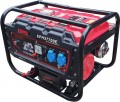 | 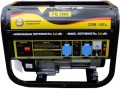 |
|---|---|---|
| Covax EPH37700E | Forte FG 3800 | |
| Outdated Product | from $215.08 up to $259.08 | |
| User reviews | ||
| TOP sellers | ||
Automatic voltage regulator (AVR). Output 12 V. | ||
| Fuel | petrol | petrol |
| Output voltage | 230 B | 230 B |
| Rated power | 2.8 kW | 2.8 kW |
| Max. power | 3 kW | 3 kW |
| Alternator | synchronous | synchronous |
| Alternator winding | copper | copper |
Engine | ||
| ICE type | 4-stroke | 4-stroke |
| Engine size | 196 cm³ | |
| Power | 7.5 hp | 7 hp |
| Fuel tank volume | 15 L | 15 L |
| Fuel level indicator |  | |
| Starter type | electric starter (key) | manual |
| Motor cooling | air | air |
Connection (sockets) | ||
| Total number of sockets | 2 | 2 |
| Sockets 230 V | 16 A x2 | 16 A x2 |
| Output 12 V | terminals | terminals |
Features | ||
| Features | automatic voltage regulator (AVR) voltmeter | automatic voltage regulator (AVR) voltmeter |
General | ||
| Protection level | IP 23 | IP 23 |
| Sound level (7 m) | 65 dB | |
| Dimensions | 605x445x435 mm | 605x435x450 mm |
| Weight | 42 kg | 50 kg |
| Added to E-Catalog | march 2023 | september 2014 |


Compare Covax EPH37700E and Forte FG 3800
You may be interested in
My comparisons
Covax EPH37700E often compared


Forte FG 3800 often compared


Glossary
Engine size
The working volume of the engine in a gasoline or diesel generator (see "Fuel"). Theoretically, more volume usually means more power, but in fact, everything is not so clear. Firstly, the specific power strongly depends on the type of fuel, and in gasoline units, also on the type of internal combustion engine (see above). Secondly, similar engines of the same power can have different volumes, and there is a practical point here: with the same power, a larger engine consumes more fuel, but by itself it can cost less.
Power
The operating power of the engine installed in the generator. Traditionally stated in horsepower; 1 HP approximately equal to 735 watts.
First of all, the rated power of the generator directly depends on this indicator (see above): in principle, it cannot be higher than the engine power, moreover, part of the engine power is spent on heat, friction and other losses. And the smaller the difference between these capacities, the higher the efficiency of the generator and the more economical it is. However high efficiency affects the cost, but this difference can pay off with regular use due to fuel savings.
First of all, the rated power of the generator directly depends on this indicator (see above): in principle, it cannot be higher than the engine power, moreover, part of the engine power is spent on heat, friction and other losses. And the smaller the difference between these capacities, the higher the efficiency of the generator and the more economical it is. However high efficiency affects the cost, but this difference can pay off with regular use due to fuel savings.
Starter type
Method of starting the electric generator engine. To start the internal combustion engine (petrol or diesel, see "Fuel"), it is necessary to turn the engine shaft in any case; this can be done in two ways:
— Manual. With this method of starting, the initial impulse is transmitted to the engine manually - usually the user needs to pull hard on the cable that spins a special flywheel. The simplest in design and cheapest method of starting, from additional equipment it requires only the cable itself with a flywheel. On the other hand, it may require the user to apply significant muscular effort and is poorly suited for high-power units.
— Electric starter. With this type of start, the engine shaft is rotated by a special electric motor, which is called a starter; the starter is powered by its own battery. This option for starting the generator power unit is the easiest for the user and requires a minimum of effort. Depending on the implementation of the electric starter, it is usually enough to turn the key in the ignition switch, press a button, turn the handle or rotate a special drum, etc. The power of modern starters is sufficient even for heavy engines, where manual starting is difficult or impossible. Also note that an electric starter is required by definition to use the ATS autostart (see "Features"). On the other hand, additional equipment affects the weight and cost of the unit,...and sometimes quite noticeably. Therefore, such starting systems are used mainly where they cannot be avoided - in the aforementioned heavy equipment, as well as generators with ATS.
— Manual. With this method of starting, the initial impulse is transmitted to the engine manually - usually the user needs to pull hard on the cable that spins a special flywheel. The simplest in design and cheapest method of starting, from additional equipment it requires only the cable itself with a flywheel. On the other hand, it may require the user to apply significant muscular effort and is poorly suited for high-power units.
— Electric starter. With this type of start, the engine shaft is rotated by a special electric motor, which is called a starter; the starter is powered by its own battery. This option for starting the generator power unit is the easiest for the user and requires a minimum of effort. Depending on the implementation of the electric starter, it is usually enough to turn the key in the ignition switch, press a button, turn the handle or rotate a special drum, etc. The power of modern starters is sufficient even for heavy engines, where manual starting is difficult or impossible. Also note that an electric starter is required by definition to use the ATS autostart (see "Features"). On the other hand, additional equipment affects the weight and cost of the unit,...and sometimes quite noticeably. Therefore, such starting systems are used mainly where they cannot be avoided - in the aforementioned heavy equipment, as well as generators with ATS.
Sound level (7 m)
Sound pressure level in decibels at a distance of 7 m between the noise source and the ear of the equipment operator. Since people do not work in the immediate vicinity of the generator, the parameter will be useful for estimating the noise level at a distance. For example, current European Union regulations require that the sound power of generating sets with a power of more than 2 kW does not exceed 97 dB — at a distance of 7 m, the noise from the generator engine will correspond to a sound pressure of about 72 dB.
Weight
The total weight of the unit - usually excluding fuel; the weight on full tank can be easily determined knowing the tank capacity.
In general, more powerful generators are inevitably heavier, but models with similar characteristics can differ significantly in weight. When assessing these differences and generally choosing an option based on weight, it is worth considering the specifics of the generator's use. So, if the device is often to be moved from place to place - for example, when used "on the road" - it may be worth paying attention to lighter units that are more convenient to transport. However, it is worth considering that the downside of a lightweight design is often an increased cost or a reduced degree of protection. But for stationary use, you can not pay special attention to this parameter - or even the opposite: choose a heavier (and, as a rule, more advanced and functional) option.
Regarding specific figures, it is worth noting that modern generators are generally quite massive. Thus, a small weight for such equipment is considered not only < 20 kg, but even 20-30 kg ; many units weigh 150-200 kg, or even more, and the weight of stationary industrial models is measured in tons.
In general, more powerful generators are inevitably heavier, but models with similar characteristics can differ significantly in weight. When assessing these differences and generally choosing an option based on weight, it is worth considering the specifics of the generator's use. So, if the device is often to be moved from place to place - for example, when used "on the road" - it may be worth paying attention to lighter units that are more convenient to transport. However, it is worth considering that the downside of a lightweight design is often an increased cost or a reduced degree of protection. But for stationary use, you can not pay special attention to this parameter - or even the opposite: choose a heavier (and, as a rule, more advanced and functional) option.
Regarding specific figures, it is worth noting that modern generators are generally quite massive. Thus, a small weight for such equipment is considered not only < 20 kg, but even 20-30 kg ; many units weigh 150-200 kg, or even more, and the weight of stationary industrial models is measured in tons.