
Comparison Sturm PG8735N vs DENZEL PS 33
Add to comparison | 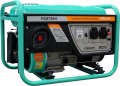 |  |
|---|---|---|
| Sturm PG8735N | DENZEL PS 33 | |
| Outdated Product | Outdated Product | |
| TOP sellers | ||
| Fuel | petrol | petrol |
| Output voltage | 230 B | 230 B |
| Rated power | 3 kW | 3 kW |
| Max. power | 3.5 kW | 3.3 kW |
| Alternator | synchronous | synchronous |
| Alternator winding | copper | copper |
Engine | ||
| ICE type | 4-stroke | 4-stroke |
| Motor type | KM170F | |
| Engine size | 212 cm³ | |
| Power | 7 hp | 7 hp |
| Fuel consumption (50% load) | 1.15 l/h | |
| Fuel tank volume | 15 L | 15 L |
| Fuel level indicator |  | |
| Starter type | manual | manual |
| Motor cooling | air | air |
Connection (sockets) | ||
| Total number of sockets | 2 | 2 |
| Sockets 230 V | 16 A x2 | 16 A x2 |
| Output 12 V | terminals | terminals |
Features | ||
| Features | automatic voltage regulator (AVR) voltmeter | automatic voltage regulator (AVR) voltmeter |
General | ||
| Protection level | IP 23 | IP 23 |
| Noise level | 85 dB | |
| Weight | 43 kg | 43 kg |
| Added to E-Catalog | january 2022 | september 2019 |


Compare Sturm PG8735N and DENZEL PS 33
You may be interested in
Sturm PG8735N often compared

Glossary
Max. power
The maximum power output that the generator can provide.
This power is slightly higher than the nominal (see above), but the maximum performance mode can only be maintained for a very short time - otherwise an overload occurs. Therefore, the practical meaning of this characteristic is mainly to describe the efficiency of the generator when working with increased starting currents.
Let us recall that some types of electrical appliances consume several times more power (and, accordingly, power) at the moment of starting than in the normal mode; this is typical mainly for devices with electric motors, such as power tools, refrigerators, etc. However, increased power for such equipment is needed only for a short time, normal operation is restored in literally a few seconds. And you can estimate the starting characteristics by multiplying the nominal power by the so-called starting coefficient. For equipment of the same type, it is more or less the same (1.2 - 1.3 for most power tools, 2 for a microwave oven, 3.5 for an air conditioner, etc.); more detailed data is available in special sources.
Ideally, the maximum power of the generator should be no less than the total peak power of the connected load - that is, the starting power of equipment with a starting factor greater than 1 plus the rated power of all other equipment. This will minimize the likelihood of overloads.
This power is slightly higher than the nominal (see above), but the maximum performance mode can only be maintained for a very short time - otherwise an overload occurs. Therefore, the practical meaning of this characteristic is mainly to describe the efficiency of the generator when working with increased starting currents.
Let us recall that some types of electrical appliances consume several times more power (and, accordingly, power) at the moment of starting than in the normal mode; this is typical mainly for devices with electric motors, such as power tools, refrigerators, etc. However, increased power for such equipment is needed only for a short time, normal operation is restored in literally a few seconds. And you can estimate the starting characteristics by multiplying the nominal power by the so-called starting coefficient. For equipment of the same type, it is more or less the same (1.2 - 1.3 for most power tools, 2 for a microwave oven, 3.5 for an air conditioner, etc.); more detailed data is available in special sources.
Ideally, the maximum power of the generator should be no less than the total peak power of the connected load - that is, the starting power of equipment with a starting factor greater than 1 plus the rated power of all other equipment. This will minimize the likelihood of overloads.
Motor type
Model name of the engine installed in the generator. Knowing this name, you can, if necessary, find detailed data on the engine and clarify how it meets your requirements. In addition, model data may be needed for some specific tasks, including maintenance and repair.
Note that modern generators are often equipped with branded engines from famous manufacturers: Honda, John Deere, Mitsubishi, Volvo, etc. Such engines are more expensive than similar units from little-known brands, but this is offset by higher quality and/or solid warranty conditions , and in many cases, the ease of finding spare parts and additional documentation (such as manuals for special maintenance and minor repairs).
Note that modern generators are often equipped with branded engines from famous manufacturers: Honda, John Deere, Mitsubishi, Volvo, etc. Such engines are more expensive than similar units from little-known brands, but this is offset by higher quality and/or solid warranty conditions , and in many cases, the ease of finding spare parts and additional documentation (such as manuals for special maintenance and minor repairs).
Engine size
The working volume of the engine in a gasoline or diesel generator (see "Fuel"). Theoretically, more volume usually means more power, but in fact, everything is not so clear. Firstly, the specific power strongly depends on the type of fuel, and in gasoline units, also on the type of internal combustion engine (see above). Secondly, similar engines of the same power can have different volumes, and there is a practical point here: with the same power, a larger engine consumes more fuel, but by itself it can cost less.
Fuel consumption (50% load)
Fuel consumption of a petrol or diesel generator when operating at half power, and for combined models when using petrol (see “Fuel”).
Fuel consumption usually increases with load. However, generator efficiency is not always linear - fuel consumption may vary disproportionately with different loads. In this case, the approximate amount of fuel consumed by the generator when operating at half power (50% of the rated power) is given. Knowing the fuel consumption and tank capacity, you can at least estimate how long one fill-up will last.
Fuel consumption usually increases with load. However, generator efficiency is not always linear - fuel consumption may vary disproportionately with different loads. In this case, the approximate amount of fuel consumed by the generator when operating at half power (50% of the rated power) is given. Knowing the fuel consumption and tank capacity, you can at least estimate how long one fill-up will last.
Noise level
The noise level produced by the generator when operating in normal mode. The less noise the unit makes, the more comfortable it is to use, the closer it can be placed to people, but the higher its price, all other things being equal.
It is also worth considering that generators with internal combustion engines are, in principle, quite noisy equipment. Thus, even the "quietest" units produce < 70 dB - this is the volume of a conversation in tones from medium to high. Accordingly, it is recommended to install the device remotely from the place of use. At the same time, we note that the noise level is not directly related to the power: for example, among units of 80 dB and more, there are both heavy and relatively low-power models.
It is also worth considering that generators with internal combustion engines are, in principle, quite noisy equipment. Thus, even the "quietest" units produce < 70 dB - this is the volume of a conversation in tones from medium to high. Accordingly, it is recommended to install the device remotely from the place of use. At the same time, we note that the noise level is not directly related to the power: for example, among units of 80 dB and more, there are both heavy and relatively low-power models.