
Comparison Fogo F 2001 iS vs Forte FG2000i
Add to comparison | 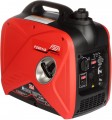 | 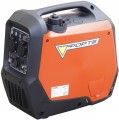 |
|---|---|---|
| Fogo F 2001 iS | Forte FG2000i | |
| Outdated Product | Outdated Product | |
| TOP sellers | ||
Inverter alternator. Output 12 V. Parallel connection. | There is a possibility of parallel connection with another generator. Connectors for parallel connection. Two 230 V sockets. 12 V cigarette lighter socket. Low noise level. | |
| Fuel | petrol | petrol |
| Output voltage | 230 B | 230 B |
| Rated power | 1.8 kW | 1.8 kW |
| Max. power | 2 kW | 2 kW |
| Alternator | inverter | inverter |
Engine | ||
| ICE type | 4-stroke | 4-stroke |
| Motor type | Rato R80I | |
| Engine size | 80 cm³ | 79 cm³ |
| Fuel consumption (50% load) | 0.67 l/h | |
| Fuel consumption (100% load) | 1.1 l/h | 1 l/h |
| Fuel tank volume | 4 L | 4 L |
| Fuel level indicator |  |  |
| Starter type | manual | manual |
| Motor cooling | air | air |
Connection (sockets) | ||
| Total number of sockets | 1 | 2 |
| Sockets 230 V | 16 A x1 | 16 A x2 |
| Output 12 V | socket | cigarette lighter |
Features | ||
| Features | parallel connection | parallel connection |
General | ||
| Sound insulation cover | | |
| Protection level | IP 23 | IP 23 |
| Noise level | 87 dB | |
| Sound level (7 m) | 62 dB | |
| Dimensions | 498x290x459 mm | 440x530x280 mm |
| Weight | 22 kg | 21 kg |
| Added to E-Catalog | april 2021 | october 2020 |


Compare Fogo F 2001 iS and Forte FG2000i
You may be interested in
My comparisons
Fogo F 2001 iS often compared


Forte FG2000i often compared

Glossary
Motor type
Model name of the engine installed in the generator. Knowing this name, you can, if necessary, find detailed data on the engine and clarify how it meets your requirements. In addition, model data may be needed for some specific tasks, including maintenance and repair.
Note that modern generators are often equipped with branded engines from famous manufacturers: Honda, John Deere, Mitsubishi, Volvo, etc. Such engines are more expensive than similar units from little-known brands, but this is offset by higher quality and/or solid warranty conditions , and in many cases, the ease of finding spare parts and additional documentation (such as manuals for special maintenance and minor repairs).
Note that modern generators are often equipped with branded engines from famous manufacturers: Honda, John Deere, Mitsubishi, Volvo, etc. Such engines are more expensive than similar units from little-known brands, but this is offset by higher quality and/or solid warranty conditions , and in many cases, the ease of finding spare parts and additional documentation (such as manuals for special maintenance and minor repairs).
Engine size
The working volume of the engine in a gasoline or diesel generator (see "Fuel"). Theoretically, more volume usually means more power, but in fact, everything is not so clear. Firstly, the specific power strongly depends on the type of fuel, and in gasoline units, also on the type of internal combustion engine (see above). Secondly, similar engines of the same power can have different volumes, and there is a practical point here: with the same power, a larger engine consumes more fuel, but by itself it can cost less.
Fuel consumption (50% load)
Fuel consumption of a petrol or diesel generator when operating at half power, and for combined models when using petrol (see “Fuel”).
Fuel consumption usually increases with load. However, generator efficiency is not always linear - fuel consumption may vary disproportionately with different loads. In this case, the approximate amount of fuel consumed by the generator when operating at half power (50% of the rated power) is given. Knowing the fuel consumption and tank capacity, you can at least estimate how long one fill-up will last.
Fuel consumption usually increases with load. However, generator efficiency is not always linear - fuel consumption may vary disproportionately with different loads. In this case, the approximate amount of fuel consumed by the generator when operating at half power (50% of the rated power) is given. Knowing the fuel consumption and tank capacity, you can at least estimate how long one fill-up will last.
Fuel consumption (100% load)
The amount of fuel consumed by the generator when operating at full power. The parameter is specified for petrol and diesel units (and for models on combined fuel - when using petrol).
In full power mode, the generator consumes maximum fuel. However, such long-term operation is fraught with accelerated wear of the unit components, so generators are rarely loaded to 100%. Nevertheless, the parameter gives an approximate understanding of the expected fuel consumption when used "at full capacity".
In full power mode, the generator consumes maximum fuel. However, such long-term operation is fraught with accelerated wear of the unit components, so generators are rarely loaded to 100%. Nevertheless, the parameter gives an approximate understanding of the expected fuel consumption when used "at full capacity".
Fuel level indicator
A pointer that allows you to monitor the remaining fuel in the generator tank. The simplest such indicators work only with a critical decrease in the level of fuel, warning of the need for refueling; more advanced ones constantly display the remainder. However, anyway, this feature makes it easier to keep track of the fuel supply and reduces the risk of a generator shutdown due to a forgotten refueling.
Total number of sockets
The total number of sockets for 230 and/or 400 V provided in the design of the generator.
This number corresponds to the number of devices that can be simultaneously connected to the generator without using splitters, extension cords, etc. If it is a three-phase model (see "Output voltage") with different types of sockets, it is worth specifying the quantity of each type separately, as different models may have varying configurations. For example, a unit specified as having 3 sockets might have 1 three-phase socket and 2 single-phase ones, or 2 three-phase and 1 single-phase socket. Generally, the most basic modern generators have only 1 socket, though models with 2 sockets are more common; and the most powerful models can have 4 or more sockets.
It is also important to remember that the ability to connect various devices is limited not only by the number of sockets but also by the generator's rated power (see above for more details).
This number corresponds to the number of devices that can be simultaneously connected to the generator without using splitters, extension cords, etc. If it is a three-phase model (see "Output voltage") with different types of sockets, it is worth specifying the quantity of each type separately, as different models may have varying configurations. For example, a unit specified as having 3 sockets might have 1 three-phase socket and 2 single-phase ones, or 2 three-phase and 1 single-phase socket. Generally, the most basic modern generators have only 1 socket, though models with 2 sockets are more common; and the most powerful models can have 4 or more sockets.
It is also important to remember that the ability to connect various devices is limited not only by the number of sockets but also by the generator's rated power (see above for more details).
Sockets 230 V
The number of 230 V sockets provided in the design of the generator, as well as the type of connectors used in such sockets.
The type of connector in this case is indicated by the maximum power that is allowed for the outlet - for example, “2 pieces for 16 A”. The most popular options for 230-volt outlets are 16 A, 32 A, and 63 A. We emphasize that amperes in this designation are not the actual power that the generator can produce, but the outlet’s own limitation; the actual power value is usually noticeably lower. Simply put, if, for example, the generator has a 32 A socket, the output power on it will not reach 32 A; and the specific number of amperes will depend on the rated and maximum power of the unit (see above). So, if for our example we take a rated power of 5 kW and a maximum of 6 kW, then to a 230 V outlet such a generator will be able to produce no more than 5 kW / 230 V = 22.7 A standard and 6 kW / 230 V = 27, 3 A at its peak. And if the power has to be divided between several outlets, then it will accordingly be even less.
As for specific types of connectors, the higher the power permissible for the outlet, the higher the requirements for its reliability and quality of protection. In light of this, as a rule, higher power outlets can be connected to lower power plugs (directly or through an adapter), but not vice versa. And if there are several sockets, by their type it i...s possible to estimate with some certainty the distribution of the entire power of the generator between them: between two identical sockets such power is usually divided equally, and more power is allocated to an socket with a larger number of amperes and power. However, specific details on this matter should be clarified separately in each case; It's also worth considering 400V outlets, if available (see below).
The type of connector in this case is indicated by the maximum power that is allowed for the outlet - for example, “2 pieces for 16 A”. The most popular options for 230-volt outlets are 16 A, 32 A, and 63 A. We emphasize that amperes in this designation are not the actual power that the generator can produce, but the outlet’s own limitation; the actual power value is usually noticeably lower. Simply put, if, for example, the generator has a 32 A socket, the output power on it will not reach 32 A; and the specific number of amperes will depend on the rated and maximum power of the unit (see above). So, if for our example we take a rated power of 5 kW and a maximum of 6 kW, then to a 230 V outlet such a generator will be able to produce no more than 5 kW / 230 V = 22.7 A standard and 6 kW / 230 V = 27, 3 A at its peak. And if the power has to be divided between several outlets, then it will accordingly be even less.
As for specific types of connectors, the higher the power permissible for the outlet, the higher the requirements for its reliability and quality of protection. In light of this, as a rule, higher power outlets can be connected to lower power plugs (directly or through an adapter), but not vice versa. And if there are several sockets, by their type it i...s possible to estimate with some certainty the distribution of the entire power of the generator between them: between two identical sockets such power is usually divided equally, and more power is allocated to an socket with a larger number of amperes and power. However, specific details on this matter should be clarified separately in each case; It's also worth considering 400V outlets, if available (see below).
Output 12 V
Existence in the generator of an output with a direct current and voltage of 12 V. The main function of this output is to charge car batteries, as well as power devices originally intended for cars (recall, 12 V is the standard voltage of on-board networks in cars).
The following types of 12-volt outputs are found in generators:
- Terminals. Terminals are used to connect wires directly without using any plugs. This connection is the most reliable.
- Socket. Socket outlet for a plug with two flat pins, designed to connect 12-volt consumers. Holes in sockets come in different layouts, which you need to pay attention to.
- Cigarette lighter. The so-called "car socket", which in many cars is combined with a cigarette lighter socket (hence the name). Such connectors are used to power various automotive devices and accessories.
The following types of 12-volt outputs are found in generators:
- Terminals. Terminals are used to connect wires directly without using any plugs. This connection is the most reliable.
- Socket. Socket outlet for a plug with two flat pins, designed to connect 12-volt consumers. Holes in sockets come in different layouts, which you need to pay attention to.
- Cigarette lighter. The so-called "car socket", which in many cars is combined with a cigarette lighter socket (hence the name). Such connectors are used to power various automotive devices and accessories.
Noise level
The noise level produced by the generator when operating in normal mode. The less noise the unit makes, the more comfortable it is to use, the closer it can be placed to people, but the higher its price, all other things being equal.
It is also worth considering that generators with internal combustion engines are, in principle, quite noisy equipment. Thus, even the "quietest" units produce < 70 dB - this is the volume of a conversation in tones from medium to high. Accordingly, it is recommended to install the device remotely from the place of use. At the same time, we note that the noise level is not directly related to the power: for example, among units of 80 dB and more, there are both heavy and relatively low-power models.
It is also worth considering that generators with internal combustion engines are, in principle, quite noisy equipment. Thus, even the "quietest" units produce < 70 dB - this is the volume of a conversation in tones from medium to high. Accordingly, it is recommended to install the device remotely from the place of use. At the same time, we note that the noise level is not directly related to the power: for example, among units of 80 dB and more, there are both heavy and relatively low-power models.