
Comparison Procraft PKA60 vs Procraft PKA38
Add to comparison | 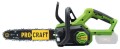 |  |
|---|---|---|
| Procraft PKA60 | Procraft PKA38 | |
| Outdated Product | Outdated Product | |
| TOP sellers | ||
| Product type | chainsaw | chainsaw |
| Type | portable | portable |
| Power source | battery | battery |
Motor | ||
| Brushless motor |  | |
| Engine location | longitudinally | transversely |
| No load speed | 4500 rpm | |
Cutting equipment | ||
| Bar/blade size | 350 mm | 350 mm |
| Chain pitch | 3/8 " | 3/8 " |
| Chain speed | 8 m/s | 8 m/s |
Protective functions | ||
| Soft start | | |
| Chain brake | |  |
| Motor brake | | |
Features | ||
| Features | keyless chain tension keyless blade replacement | keyless chain tension keyless blade replacement |
| In box | chain without charger | chain without charger |
Battery | ||
| Battery in set | no | no |
| Battery platform | Proсraft 20V | Proсraft 20V |
| Battery voltage | 20 В | 20 В |
| Compatible batteries | Procraft Battery20 | Procraft Battery20 |
General | ||
| Noise level | 93 dB | 98 dB |
| Added to E-Catalog | december 2024 | september 2024 |


Compare Procraft PKA60 and PKA38
You may be interested in
My comparisons
Procraft PKA60 often compared


Procraft PKA38 often compared

Glossary
Engine location
The location of the motor in the electric portable saw (see "Type").
- Longitudinally. The longitudinal arrangement allows you to achieve a good balance, allowing you to work comfortably in different positions; this is especially true for cutting branches from trees and other similar work, where the cutting plane can be located at different angles. In addition, such a tool has a smaller width and a longer length, which can make it easier to work in hard-to-reach places. On the other hand, such saws are more expensive than cross-cut saws.
- Transversely. The transverse arrangement of the engine slightly worsens the balance compared to the longitudinal one and makes it difficult to saw along an inclined plane, at an angle to the vertical. In addition, the length of such saws is noticeably shorter. However, for the simplest work with sawing from top to bottom, they are no worse than longitudinal ones, but they are much cheaper. Yes, and a small length in some cases can also be a virtue.
- Longitudinally. The longitudinal arrangement allows you to achieve a good balance, allowing you to work comfortably in different positions; this is especially true for cutting branches from trees and other similar work, where the cutting plane can be located at different angles. In addition, such a tool has a smaller width and a longer length, which can make it easier to work in hard-to-reach places. On the other hand, such saws are more expensive than cross-cut saws.
- Transversely. The transverse arrangement of the engine slightly worsens the balance compared to the longitudinal one and makes it difficult to saw along an inclined plane, at an angle to the vertical. In addition, the length of such saws is noticeably shorter. However, for the simplest work with sawing from top to bottom, they are no worse than longitudinal ones, but they are much cheaper. Yes, and a small length in some cases can also be a virtue.
No load speed
The highest speed that the saw engine is capable of delivering in normal operation.
We emphasize that this parameter should not be confused with the maximum disk speed (see below) — here we are talking exclusively about the speed of rotation of the motor shaft. It can be specified for all types of saws, not only for models using discs. However, in general, engine speed is more of a reference than really significant information. In fact, it is needed mainly for some specific tool maintenance tasks; when choosing, it is better to focus on indicators that are more “close to life” — engine power, cutting depth, chain / tape speed or disk speed, etc.
We emphasize that this parameter should not be confused with the maximum disk speed (see below) — here we are talking exclusively about the speed of rotation of the motor shaft. It can be specified for all types of saws, not only for models using discs. However, in general, engine speed is more of a reference than really significant information. In fact, it is needed mainly for some specific tool maintenance tasks; when choosing, it is better to focus on indicators that are more “close to life” — engine power, cutting depth, chain / tape speed or disk speed, etc.
Chain brake
The protective mechanism of the chainsaw, which almost instantly stops the chain in a dangerous situation. Most often, it is activated during kickback or when pressing the front hand guard. The main purpose of this function is to reduce chain rotation time and minimize the risk of serious injury. The chain brake is especially important when trimming branches, cutting firewood, and any work where the saw may suddenly jerk upward or sideways.
Motor brake
A feature that quickly stops the saw's attachment after releasing the button or trigger. Depending on the type of tool, this could be the blade, blade, or chain, which stops rotating noticeably faster than with a regular stop by inertia. Motor brake enhances safety because after finishing the cut, the working part doesn't spin for extra seconds. Compared to saws without a motor brake, the tool becomes more convenient for frequent short operations and hand position changes. In practice, this is especially useful for precise cuts, working on a workbench, and in situations where it's important to quickly put away the saw after cutting.
Noise level
The noise level produced by the saw during operation. Note that this parameter is rather approximate, because in fact, the “loudness of the work” depends not only on the tool, but also on the material being processed and the characteristics of the environment. Nevertheless, the data given in the characteristics make it possible to assess the comfort of working with the tool. The lower this indicator, the less discomfort the noise will cause, and at high values, even special hearing protection may be needed.
Note that the noise level is usually measured in decibels, and this unit is not linear: for example, a difference of 3 dB corresponds to a difference of 2 times, 10 dB — to 10 times. Therefore, it is easiest to evaluate the noise level using comparative tables. Here is a simplified version of such a table for the range in which modern saws operate:
70 dB — loud conversation of several people in close proximity;
75 dB — a cry in the immediate vicinity;
80 dB — truck engine, mechanical alarm ringing;
85 dB — loud scream;
90 dB — freight car at a distance of 7 – 10 m;
95 dB — subway car at a distance of 7 – 10 m;
100 dB — industrial shop;
110 dB — tractor engine;
120 dB — demolition hammer, thunder from a close lightning strike (pain threshold of auditory perception).
Note that the noise level is usually measured in decibels, and this unit is not linear: for example, a difference of 3 dB corresponds to a difference of 2 times, 10 dB — to 10 times. Therefore, it is easiest to evaluate the noise level using comparative tables. Here is a simplified version of such a table for the range in which modern saws operate:
70 dB — loud conversation of several people in close proximity;
75 dB — a cry in the immediate vicinity;
80 dB — truck engine, mechanical alarm ringing;
85 dB — loud scream;
90 dB — freight car at a distance of 7 – 10 m;
95 dB — subway car at a distance of 7 – 10 m;
100 dB — industrial shop;
110 dB — tractor engine;
120 dB — demolition hammer, thunder from a close lightning strike (pain threshold of auditory perception).