
Comparison Vigo V35WR vs Brevia 22560
Add to comparison | 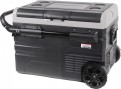 |  |
|---|---|---|
| Vigo V35WR | Brevia 22560 | |
| Outdated Product | Outdated Product | |
| TOP sellers | ||
Smartphone control. Gadget charging via USB. 2 cooling modes — MAX and ECO. Connection of a removable battery (not included). Two compartments with independent temperature settings. Transport wheels. | Two cooling modes: MAX (fast cooling), ECO - cooling with low energy consumption | |
| Type | cooling box | cooling box |
| Principle of operation | compressor | compressor |
| Volume | 35 L | 40 L |
| Number of chambers | 2 | 2 |
| Operation mode | cooling freezing | cooling freezing |
Specs | ||
| Сooling energy consumption | 60 W | |
| Features | USB for charging gadgets smartphone control battery discharge protection interior lighting cup holder removable lid wheels for transportation | USB for charging gadgets smartphone control battery discharge protection cup holder removable lid |
General specs | ||
| Display |  | |
| Supply voltage | 12/24/230 В | 12/24/230 В |
| Energy label | A++ | |
| Size (HxWxD) | 44.1x71.1x46 cm | 51.4x61.8x37.6 cm |
| Weight | 17.8 kg | 12.9 kg |
| Added to E-Catalog | may 2024 | may 2024 |


Compare Vigo V35WR and Brevia 22560
You may be interested in
Glossary
Volume
The volume of the working chamber of the car refrigerator. The larger the volume, the more products can be loaded into the unit at a time. When choosing according to this parameter, it makes sense to select a model with a margin, because it is not recommended to load products too tightly — this adversely affects the quality of the device. On the other hand, note that the volumetric container and dimensions will have the appropriate ones.
Сooling energy consumption
The power consumed by the refrigerator when operating in cooling mode. The greater this power, the more performant the refrigerator is, usually, and the less time it takes to cool the product. On the other hand, note that more power means more power consumption — which can be critical, for example, during long-term operation from a car battery (that is, when the car engine is turned off).
Features
— USB for charging gadgets. A standard USB port that can be used to charge a smartphone or other gadget. Note that this function only works if the refrigerator is connected to the power grid — car refrigerators do not have their own batteries, and without an external power source, no energy will be supplied to the USB port.
— Smartphone control. The ability to control the unit from a smartphone or other gadget, usually through a special application. The gadget itself is connected directly wirelessly, via Wi-Fi or Bluetooth. This function provides a number of conveniences. Firstly, it allows you to control the operation of the refrigerator from a distance. Secondly, the application on the smartphone is often more convenient and visual than the unit's own control panel. Thirdly, the gadget can receive various notifications from the refrigerator: settings, current status, notifications about malfunctions, etc. At the same time, control from a smartphone is not cheap, which is why it is quite rare, mainly in fairly advanced models.
— Built-in fan. The presence of a fan in the working chamber of the refrigerator. Due to this function, improved air circulation inside the chamber is ensured, which contributes to better and more uniform cooling of the loaded products.
— Battery discharge protection. A car refrigerato...r with this function constantly monitors the battery condition when operating from a car battery (with the engine off). If the charge drops to a critical level, the unit “takes action”: it switches off automatically or signals the need to switch off. This allows you to avoid a complete battery discharge and unpleasant situations such as the need to start the engine “by pushing”.
— Interior lighting. The presence of internal lighting in the working chamber of the refrigerator. This makes it easier to use in low-light conditions — even in complete darkness outside, the contents of the chamber can be easily seen.
— Cup holder. Cup holders are typical indentations in the lid: a cup, bottle, or another container with liquid can be placed in such an indentation without fear of it tipping over.
— Bottle opener. A tool for opening glass bottles with metal caps that do not have threads. It is usually implemented as a built-in metal element on one side of the housing.
— Removable lid. The ability to remove the refrigerator cover from the main container. The meaning and features of this function may be different. So, in some models, the cover is removed only to make it easier to get to the contents and to make it easier to wash/clean the working chamber. In others, it may be possible to choose the side to which the cover will be folded. And some units with this function are equipped with two lids at once: one has a power cord and a cooler, when installed, the device functions as a refrigerator, the second is a simple heat-insulating cover that turns the car refrigerator into a thermos.
— Carrying strap (on the shoulder). Special strap that allows you to carry the device like shoulder bag. In fact, this function is most often equipped with bag models (see "Type"). In any case, such a strap significantly simplifies transportation: it is more convenient to carry a fairly heavy refrigerator on your shoulder, and your hands remain free. There are even models that can be carried like regular backpacks.
— Transportation wheels. The ability to transport car refrigerators like a cart is much more convenient than carrying them in your hands or on your shoulder, especially with large volumes and the corresponding weight of the model.
— Smartphone control. The ability to control the unit from a smartphone or other gadget, usually through a special application. The gadget itself is connected directly wirelessly, via Wi-Fi or Bluetooth. This function provides a number of conveniences. Firstly, it allows you to control the operation of the refrigerator from a distance. Secondly, the application on the smartphone is often more convenient and visual than the unit's own control panel. Thirdly, the gadget can receive various notifications from the refrigerator: settings, current status, notifications about malfunctions, etc. At the same time, control from a smartphone is not cheap, which is why it is quite rare, mainly in fairly advanced models.
— Built-in fan. The presence of a fan in the working chamber of the refrigerator. Due to this function, improved air circulation inside the chamber is ensured, which contributes to better and more uniform cooling of the loaded products.
— Battery discharge protection. A car refrigerato...r with this function constantly monitors the battery condition when operating from a car battery (with the engine off). If the charge drops to a critical level, the unit “takes action”: it switches off automatically or signals the need to switch off. This allows you to avoid a complete battery discharge and unpleasant situations such as the need to start the engine “by pushing”.
— Interior lighting. The presence of internal lighting in the working chamber of the refrigerator. This makes it easier to use in low-light conditions — even in complete darkness outside, the contents of the chamber can be easily seen.
— Cup holder. Cup holders are typical indentations in the lid: a cup, bottle, or another container with liquid can be placed in such an indentation without fear of it tipping over.
— Bottle opener. A tool for opening glass bottles with metal caps that do not have threads. It is usually implemented as a built-in metal element on one side of the housing.
— Removable lid. The ability to remove the refrigerator cover from the main container. The meaning and features of this function may be different. So, in some models, the cover is removed only to make it easier to get to the contents and to make it easier to wash/clean the working chamber. In others, it may be possible to choose the side to which the cover will be folded. And some units with this function are equipped with two lids at once: one has a power cord and a cooler, when installed, the device functions as a refrigerator, the second is a simple heat-insulating cover that turns the car refrigerator into a thermos.
— Carrying strap (on the shoulder). Special strap that allows you to carry the device like shoulder bag. In fact, this function is most often equipped with bag models (see "Type"). In any case, such a strap significantly simplifies transportation: it is more convenient to carry a fairly heavy refrigerator on your shoulder, and your hands remain free. There are even models that can be carried like regular backpacks.
— Transportation wheels. The ability to transport car refrigerators like a cart is much more convenient than carrying them in your hands or on your shoulder, especially with large volumes and the corresponding weight of the model.
Energy label
A parameter that characterizes the efficiency of energy consumption. In modern car refrigerators, there are classes from A + and above; the more “pluses” in the marking, the more economical the device.
Note that the energy class does not describe the actual power consumption, but the efficiency of the device compared to similar models. Therefore, for example, a large built -in A++ class unit may consume more energy than a smaller A+ class armrest refrigerator.
Note that the energy class does not describe the actual power consumption, but the efficiency of the device compared to similar models. Therefore, for example, a large built -in A++ class unit may consume more energy than a smaller A+ class armrest refrigerator.