
Comparison Sthor 72373 vs Promate PowerMatrix-5M
Add to comparison | 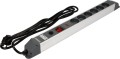 | 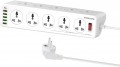 |
|---|---|---|
| Sthor 72373 | Promate PowerMatrix-5M | |
| Outdated Product | Outdated Product | |
| User reviews | ||
| TOP sellers | ||
Total power of USB ports 32 W | ||
| Product type | surge protector | surge protector |
Specs | ||
| Cable length | 3 m | 5 m |
| Max. power | 3500 W | 2500 W |
| Max. load | 16 А | 10 А |
| Max. energy absorption | 578 J | |
| Wire section | 1.5 mm² | 1 mm² |
| Operation indicator |  | |
| Power switch | general | general |
Connection | ||
| Plug type | on camera flashes | on camera flashes |
| Grounding sockets (Type E) | 6 шт | |
| International plug | 10 | |
| USB-A | 5 pcs | |
| USB-C | 1 pcs | |
| Max. charging current | 3 А | |
| Power (with 1 device) | 15 W | |
| Protection | short circuit overload voltage drop voltage surges (varistor) automatic fuse | short circuit overload voltage drop voltage surges (varistor) automatic fuse |
Design features | ||
| Safety socket cover | |  |
| Wall mount | | |
| Outlets location | on both sides of the body | |
| Socket plugs | angled | angled |
| Protection level | IP 20 | |
| Size | 102x68x323 mm | |
| Weight | 1000 g | 980 g |
| Color | ||
| Added to E-Catalog | september 2024 | november 2023 |


Compare Sthor 72373 and Promate PowerMatrix-5M
You may be interested in
My comparisons
Sthor 72373 often compared


Promate PowerMatrix-5M often compared


Glossary
Cable length
The length of the cable used to connect the surge protector to the network.
The longer the cable, the farther from the outlet you can install the device. On the other hand, a long cable can be inconvenient over short distances. Models on a coil are deprived of this drawback (see "Type"), this moment is compensated by the actual presence of the coil, but they differ in large dimensions and heavy weight. So when choosing, it is far from always worth chasing the maximum length of the wire.
The longer the cable, the farther from the outlet you can install the device. On the other hand, a long cable can be inconvenient over short distances. Models on a coil are deprived of this drawback (see "Type"), this moment is compensated by the actual presence of the coil, but they differ in large dimensions and heavy weight. So when choosing, it is far from always worth chasing the maximum length of the wire.
Max. power
The highest power consumption of the connected devices that the surge protector can tolerate without consequences (to be more precise, with which it can work indefinitely without overloads, overheating, etc.).
This limitation is due to the fact that the higher the power at the same voltage, the higher the current passing through the equipment (in this case, through the surge protector); and off-design currents can lead to breakdowns and even accidents. And although in order to avoid these consequences, modern filters often provide various types of protection (see above), however, the operation of protection is still an emergency situation that is best avoided. Therefore, it is worth choosing a model according to this parameter in such a way that the maximum filter power is at least not lower than the total power consumption of the load. And it is best to have a margin of 20 – 30% — this will give additional guarantees in case of various deviations in the operation of the connected equipment.
Separately, it is worth highlighting the situations when the filter is planned to be used for the so-called reactive load — electrical appliances that widely use circuits on capacitors and/or inductors, for example, power tools or refrigeration units. The total power consumption of such devices (written in volt-amperes) can be much higher than the active power (which is indicated in watts). The recommended line filter power in such cases is calculated using special...formulas that can be found in the relevant sources.
This limitation is due to the fact that the higher the power at the same voltage, the higher the current passing through the equipment (in this case, through the surge protector); and off-design currents can lead to breakdowns and even accidents. And although in order to avoid these consequences, modern filters often provide various types of protection (see above), however, the operation of protection is still an emergency situation that is best avoided. Therefore, it is worth choosing a model according to this parameter in such a way that the maximum filter power is at least not lower than the total power consumption of the load. And it is best to have a margin of 20 – 30% — this will give additional guarantees in case of various deviations in the operation of the connected equipment.
Separately, it is worth highlighting the situations when the filter is planned to be used for the so-called reactive load — electrical appliances that widely use circuits on capacitors and/or inductors, for example, power tools or refrigeration units. The total power consumption of such devices (written in volt-amperes) can be much higher than the active power (which is indicated in watts). The recommended line filter power in such cases is calculated using special...formulas that can be found in the relevant sources.
Max. load
The maximum current that the surge protector can pass through itself for an unlimited time without the risk of overheating, breakdowns and other troubles.
This parameter is directly related to the maximum power of the filter (see above): power is the current multiplied by the voltage. Thus, for example, for a standard 230 V model with a maximum power of 2200 W, the maximum load will be 10 A. Note that the characteristics of modern filters may not correspond to such calculations — for example, the same 10 A can be claimed for a 2500 W model . However, this is not something extraordinary: the difference in figures may be due to active and reactive power (see "Maximum power"), the characteristics of single-phase filters (without 400 V sockets, see above) can be given both for 230 V, so for 230 V and even 240 V, figures may be rounded for readability, etc.
Anyway, the practical value of the maximum load is the same as the maximum power: it should not be less than the current supplied to the connected electrical appliances (otherwise the protection may trip, or even break). And they use this parameter, along with the maximum power, because in some cases it is easier to evaluate the characteristics of the load (and filter requirements) in terms of current consumption, and not in terms of power.
This parameter is directly related to the maximum power of the filter (see above): power is the current multiplied by the voltage. Thus, for example, for a standard 230 V model with a maximum power of 2200 W, the maximum load will be 10 A. Note that the characteristics of modern filters may not correspond to such calculations — for example, the same 10 A can be claimed for a 2500 W model . However, this is not something extraordinary: the difference in figures may be due to active and reactive power (see "Maximum power"), the characteristics of single-phase filters (without 400 V sockets, see above) can be given both for 230 V, so for 230 V and even 240 V, figures may be rounded for readability, etc.
Anyway, the practical value of the maximum load is the same as the maximum power: it should not be less than the current supplied to the connected electrical appliances (otherwise the protection may trip, or even break). And they use this parameter, along with the maximum power, because in some cases it is easier to evaluate the characteristics of the load (and filter requirements) in terms of current consumption, and not in terms of power.
Max. energy absorption
The maximum energy absorption provided by the mains filter, namely, the maximum pulse energy at which the device can safely absorb and dissipate it, completely protecting the connected load. The higher this indicator, the more reliable the filter, the more powerful power surges it can handle. In inexpensive models, the maximum absorption is calculated in tens of joules, in the most advanced models it can exceed 1000 J and even 2000 J.
Wire section
The cross-sectional area of the wire used to connect the filter to the network. The larger the cross-sectional area, the thicker the wire, the more reliable it is and the more current it can pass without overheating. Accordingly, thick wires ( 1.5 mm² and 2.5 mm²) are a must for high power devices. At the same time, modern manufacturers, usually, choose the cross-sectional area in such a way as to guarantee the safe operation of the filter at the claimed maximum power (see above). Therefore, in fact, a model with a thicker cable than other similar devices should be chosen if it is supposed to be used in unstable networks in which power surges often occur. If the cross-sectional area seems too small for you ( 0.75 mm² or 1 mm²) for the claimed power, there are special formulas that allow you to check the validity of such doubts.
Grounding sockets (Type E)
The number of sockets with type E grounding, provided in the design of the mains filter.
French Type E sockets use a two-hole pattern for the supply of electrical current and an integrated earth pin just above the center plane of the socket. Plugs for them are made with a characteristic hole for a grounding contact.
French Type E sockets use a two-hole pattern for the supply of electrical current and an integrated earth pin just above the center plane of the socket. Plugs for them are made with a characteristic hole for a grounding contact.
International plug
The number of universal sockets in the filter, compatible with several types of plugs at once.
Most often, such sockets are made compatible with three types of plugs: a standard “Euro plug” used in Europe and the post-Soviet space, an American Type A plug (two parallel flat contacts) and a Type I plug used in China and Australia (three flat contacts at an angle ). The filter for international plugs is useful for those cases when the household has equipment with different types of plugs — it will allow you to do without additional adapters.
Most often, such sockets are made compatible with three types of plugs: a standard “Euro plug” used in Europe and the post-Soviet space, an American Type A plug (two parallel flat contacts) and a Type I plug used in China and Australia (three flat contacts at an angle ). The filter for international plugs is useful for those cases when the household has equipment with different types of plugs — it will allow you to do without additional adapters.
USB-A
Number of USB-A ports for charging included in the power strip design.
These ports don't serve any other function than powering and charging external devices, such as smartphones or tablets. Having such connectors in a power strip can be especially convenient when a "230-to-USB" adapter is not available, and there are few USB ports on a computer or laptop, making their use for charging a "luxury you can't afford."
These ports don't serve any other function than powering and charging external devices, such as smartphones or tablets. Having such connectors in a power strip can be especially convenient when a "230-to-USB" adapter is not available, and there are few USB ports on a computer or laptop, making their use for charging a "luxury you can't afford."
USB-C
Number of USB-C ports in the power strip design.
These ports serve no other function than powering and charging external devices, such as smartphones or tablets. Having such connectors in a power strip can be especially convenient when a "230-to-USB" adapter is not available, and there are few USB ports on a computer or laptop, making it a "luxury" to use them for charging.
These ports serve no other function than powering and charging external devices, such as smartphones or tablets. Having such connectors in a power strip can be especially convenient when a "230-to-USB" adapter is not available, and there are few USB ports on a computer or laptop, making it a "luxury" to use them for charging.