
Comparison Magio MG-831 vs RZTK BS Style
Add to comparison |  | 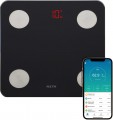 |
|---|---|---|
| Magio MG-831 | RZTK BS Style | |
| Outdated Product | Outdated Product | |
| TOP sellers | ||
Overvantage indicator. Low battery charge indicator. | ||
| Scales type | floor | floor |
| Mechanism | electronic | electronic |
| Minimum measurement weight | 0.1 kg | |
| Max. measurement weight | 150 kg | 180 kg |
| Scale division | 100 g | 100 g |
| Units of measurement | kg | |
Features | ||
| Functions | automatic switch-off smartphone synchronization | automatic switch-off smartphone synchronization |
| Measurements | % adipose tissue visceral fat level % body fluid % muscle mass % bone mass basal metabolic rate (BMR) physical age body mass index calculation | % adipose tissue visceral fat level % body fluid % muscle mass % bone mass basal metabolic rate (BMR) physical age body mass index calculation |
General | ||
| Platform material | glass | glass |
| Hidden display |  | |
| Power source | 3xAAA | 3xAAA |
| Dimensions | 280x280 mm | 302x302x25 mm |
| Color | ||
| Added to E-Catalog | december 2024 | september 2021 |


Compare Magio MG-831 and RZTK BS Style
You may be interested in
My comparisons
Magio MG-831 often compared


RZTK BS Style often compared


Glossary
Minimum measurement weight
The minimum weight limit at which the scale's readings must align with the specified margin of error is referred to as the minimum load parameter. While theoretically the scale can display measurements below this threshold, the reliability of results can't be guaranteed due to the extremely low load on the sensors in the device's design. The minimum load requirement is primarily determined by the type and intended use of the scales. For instance, kitchen models typically have a range of a few grams, floor scales start at a couple of kilograms, and commodity warehouse scales might begin at 10-15 kg.
Max. measurement weight
The largest weight that is allowed to be placed on the platform of this scale model. If this parameter is exceeded, the scales, at best, will not be able to show the correct data, at worst, they will completely fail. Obviously, the maximum weight is directly related to the purpose, but even kitchen scales can weigh both up to 5 kg and up to 20 kg.
Actually, floor scales have the largest maximum measurement weight, in such models it can reach 200 kg or even more. And the most delicate are jewelry models (refer to "Type"). Also note that in mechanical devices (refer to "Mechanism") the scale is usually graduated to the maximum weight.
Now on the market there are scales with such a maximum weight: up to 1 kg, up to 5 kg, up to 10 kg, up to 50 kg, up to 150 kg, up to 200 kg.
Actually, floor scales have the largest maximum measurement weight, in such models it can reach 200 kg or even more. And the most delicate are jewelry models (refer to "Type"). Also note that in mechanical devices (refer to "Mechanism") the scale is usually graduated to the maximum weight.
Now on the market there are scales with such a maximum weight: up to 1 kg, up to 5 kg, up to 10 kg, up to 50 kg, up to 150 kg, up to 200 kg.
Units of measurement
Weights are able to keep records in various units of measurement, while accounting can be done both by mass and by volume. Among the most common units of measurement, we highlight the following.
— Grams (g) — a unit of weight that belongs to the metric system. Grams are used in desktop kitchen scales.
— Kilograms (kg) — a unit of weight that belongs to the metric system. Kilograms are used in floor weighing equipment.
— Pounds (lb:oz) is a common unit of weight used in some countries in Europe, as well as in the United States. 1 pound can be equated to 0.45 kilograms.
— Milliliters (ml) — a unit of volume that belongs to the metric system. Some models of scales are able to determine the volume of milk and water based on mass.
— Ounces (fl'oz) is a unit of volume used in English-speaking countries. 1 US ounce is equivalent to 30 mL.
— Stones (st) is the British unit of weight. Stones are used to take into account the mass of the human body, so this measurement system is found in floor household and specialized diagnostic scales. 1 stone can be equated to 6.35 kilograms.
— Grams (g) — a unit of weight that belongs to the metric system. Grams are used in desktop kitchen scales.
— Kilograms (kg) — a unit of weight that belongs to the metric system. Kilograms are used in floor weighing equipment.
— Pounds (lb:oz) is a common unit of weight used in some countries in Europe, as well as in the United States. 1 pound can be equated to 0.45 kilograms.
— Milliliters (ml) — a unit of volume that belongs to the metric system. Some models of scales are able to determine the volume of milk and water based on mass.
— Ounces (fl'oz) is a unit of volume used in English-speaking countries. 1 US ounce is equivalent to 30 mL.
— Stones (st) is the British unit of weight. Stones are used to take into account the mass of the human body, so this measurement system is found in floor household and specialized diagnostic scales. 1 stone can be equated to 6.35 kilograms.