
Comparison Soundcore Space One Pro vs Soundcore Space Q45
Add to comparison |  | 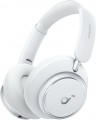 |
|---|---|---|
| Soundcore Space One Pro | Soundcore Space Q45 | |
| Compare prices 12 | Compare prices 11 | |
| TOP sellers | ||
HearID 2.0 adaptive sound technology. Active noise cancellation. LDAC codec and Hi-Res Audio certification. Control and configuration via a proprietary application. Long battery life. | Adaptive active noise cancellation. LDAC codec and Hi-Res Audio certification. Management and configuration using a proprietary application. Long battery life. | |
Connection and design | ||
| Design | overhead, closed full size Over-Ear foldable swiveling earcups | overhead, closed full size Over-Ear foldable swiveling earcups |
| Connection type | combined | combined |
| Connection | mini-Jack (3.5 mm) Bluetooth v5.3 | mini-Jack (3.5 mm) Bluetooth v5.3 |
| Range | 15 m | 15 m |
| Detachable cable |  | |
Specs | ||
| Hi-Res Audio | | |
| Impedance | 16 Ohm | |
| Frequency range | 20 – 40000 Hz | 20 – 40000 Hz |
| Speaker size | 40 mm | 40 mm |
| Emitter type | dynamic | dynamic |
Microphone specs | ||
| Microphone | built into the case | built into the case |
| Microphone noise canceling | ENC | |
Features | ||
| Mobile app | | |
| Volume control | | |
| Noise cancellation | adaptive ANC | adaptive ANC |
| Transparent mode | | |
| Multipoint | | |
| Codec support | AAC LDAC | AAC LDAC |
| Voice assistant | Apple Siri / Google Assistant | |
Power supply | ||
| Power source | battery | battery |
| Headphone battery capacity | 750 mAh | |
| Charging time | 2 h | |
| Operating time (music) | 40 h | 50 h |
| Operating time (no noise canceling) | 60 h | 65 h |
| Fast charge | 5 minutes for 8 hours of work | 5 minutes for 4 hours of work |
| Charging port | USB-C | USB-C |
General | ||
| Ear cushion material | leatherette | leatherette |
| Weight | 286 g | |
| In box | case | |
| Color | ||
| Added to E-Catalog | october 2024 | january 2023 |



Compare Soundcore Space One Pro and Space Q45
Headphones Soundcore Space One Pro and Soundcore Space Q45 have similar designs and features, but there are key differences. The Space One Pro offers active noise cancellation (ANC) and a long battery life of up to 60 hours with noise cancellation turned off, while the Q45 provides 65 hours without ANC and 50 hours with it. The frequency range of the Q45 is wider (20 – 40000 Hz compared to 20 – 20000 Hz for the Pro). Both devices support the LDAC codec and have the option of connecting via 3.5 mm, but the Space One Pro has more advanced sound customization through the Soundcore app. Meanwhile, the Space Q45 offers more convenient control with buttons on the ear cups and comes with a hard case.
Price comparison
You may be interested in
My comparisons
Soundcore Space One Pro often compared


Soundcore Space Q45 often compared


Glossary
Impedance
Impedance refers to the headphone's nominal resistance to AC current, such as an audio signal.
Other things being equal, a higher impedance reduces distortion, but requires a more powerful amplifier — otherwise the headphones simply will not be able to produce sufficient volume. Thus, the choice of resistance depends primarily on which signal source you plan to connect the "ears". So, for a portable gadget (smartphone, pocket player), an indicator of 16 ohms or less is considered optimal, 17 – 32 ohms is not bad. Higher values — 33 – 64 ohms and 65 – 96 ohms — will require quite powerful amplifiers, like those used in computers and televisions. And models with a resistance of 96 – 250 ohms and above are designed mainly for Hi-End audio equipment and professional use; for such cases, detailed recommendations for selection can be found in special sources.
Other things being equal, a higher impedance reduces distortion, but requires a more powerful amplifier — otherwise the headphones simply will not be able to produce sufficient volume. Thus, the choice of resistance depends primarily on which signal source you plan to connect the "ears". So, for a portable gadget (smartphone, pocket player), an indicator of 16 ohms or less is considered optimal, 17 – 32 ohms is not bad. Higher values — 33 – 64 ohms and 65 – 96 ohms — will require quite powerful amplifiers, like those used in computers and televisions. And models with a resistance of 96 – 250 ohms and above are designed mainly for Hi-End audio equipment and professional use; for such cases, detailed recommendations for selection can be found in special sources.
Microphone noise canceling
The presence of a noise reduction system in its own headphone microphone.
In accordance with the name, such a system is designed to eliminate extraneous noise - primarily during conversations. It is usually based on an electronic filter that passes the sound of a human voice and cuts off background sounds such as city noise, the rumble of wind in the microphone grille, etc. As a result, even in noisy environments, thanks to the noise reduction of the microphone, speech is clear and intelligible; True, the system inevitably introduces distortions into the final sound, but they are not critical in this case.
— ENC. ENC (Environment Noise Cancellation) technology significantly reduces ambient noise with directional microphones. It is used both in gaming devices so that gamers can easily communicate in voice chat, and in TWS earphone models so that you can comfortably talk on the phone in a noisy environment.
— cVc. Microphone noise reduction cVc (Clear Voice Capture) is an advanced technology that is found mainly in expensive headphone models. cVc algorithms effectively suppress echo and noise from the environment. Sound processing using this technology is carried out at several levels at once - the algorithm determines the reference signal-to-noise level, automatically adjusts speech to the desired volume level, applies adaptive equalizers to process the entire voice, as well as specialized filters to remove...low-frequency bubbling, sibilants and hissing.
In accordance with the name, such a system is designed to eliminate extraneous noise - primarily during conversations. It is usually based on an electronic filter that passes the sound of a human voice and cuts off background sounds such as city noise, the rumble of wind in the microphone grille, etc. As a result, even in noisy environments, thanks to the noise reduction of the microphone, speech is clear and intelligible; True, the system inevitably introduces distortions into the final sound, but they are not critical in this case.
— ENC. ENC (Environment Noise Cancellation) technology significantly reduces ambient noise with directional microphones. It is used both in gaming devices so that gamers can easily communicate in voice chat, and in TWS earphone models so that you can comfortably talk on the phone in a noisy environment.
— cVc. Microphone noise reduction cVc (Clear Voice Capture) is an advanced technology that is found mainly in expensive headphone models. cVc algorithms effectively suppress echo and noise from the environment. Sound processing using this technology is carried out at several levels at once - the algorithm determines the reference signal-to-noise level, automatically adjusts speech to the desired volume level, applies adaptive equalizers to process the entire voice, as well as specialized filters to remove...low-frequency bubbling, sibilants and hissing.
Voice assistant
Headphones with voice assistant support the user interaction with the device to a new level. The call of the assistant. is carried out by pressing one of the control buttons on the headphones or by a specific voice command (for example, «Ok, Google» for the Google Assistant virtual apprentice). The assistant pauses playback, instantly changes the volume of the music, can notify the user of new alerts, helps to answer messages without the help of hands, and commands are given to the paired smartphone via voice control from the headphones.
Headphone battery capacity
The capacity of the battery installed in the headphones of the corresponding design (see "Power").
Theoretically, a higher capacity allows to achieve greater battery life, but in fact, the operating time also depends on the power consumption of the headphones — and it can be very different, depending on the characteristics and design features. So this parameter is secondary, and when choosing it is worth paying attention not so much to the battery capacity, but to the directly claimed operating time (see below).
Theoretically, a higher capacity allows to achieve greater battery life, but in fact, the operating time also depends on the power consumption of the headphones — and it can be very different, depending on the characteristics and design features. So this parameter is secondary, and when choosing it is worth paying attention not so much to the battery capacity, but to the directly claimed operating time (see below).
Charging time
The time required to fully charge the battery in properly powered headphones (see above).
In this case, we mean the battery charging time from 0 to 100% when using a standard charger (or a third-party charger with identical characteristics). Accordingly, in fact, this indicator may differ from the claimed one, depending on the specifics of the situation. However, in general, it is quite possible to evaluate different models and compare them with each other: headphones with a shorter claimed charging time will in fact charge faster (ceteris paribus).
Also note that an increase in battery capacity (and headphone battery life) inevitably implies an increase in charging time. To compensate for this moment, special fast charging technologies can be used — however, they affect the cost and require the use of specialized charger.
In this case, we mean the battery charging time from 0 to 100% when using a standard charger (or a third-party charger with identical characteristics). Accordingly, in fact, this indicator may differ from the claimed one, depending on the specifics of the situation. However, in general, it is quite possible to evaluate different models and compare them with each other: headphones with a shorter claimed charging time will in fact charge faster (ceteris paribus).
Also note that an increase in battery capacity (and headphone battery life) inevitably implies an increase in charging time. To compensate for this moment, special fast charging technologies can be used — however, they affect the cost and require the use of specialized charger.
Operating time (music)
The declared operating time of headphones with autonomous power supply (see above) when listening to music on a single battery charge or a set of batteries.
As a rule, the characteristics indicate a certain average operating time in music listening mode, for standard conditions; in practice, it will depend on the intensity of use, volume level and other operating parameters, and in models with replaceable batteries - also on the quality of specific batteries. However, based on the stated time, you can fairly reliably assess the autonomy of the selected headphones and compare them with other models. As for specific values, relatively “short-lived” devices have a battery life of up to 8 hours, a figure of 8 – 12 hours can be called quite good, 12 – 20 hours – very good, and in the most “long-lasting” headphones the operating time can exceed 20 hours.
As a rule, the characteristics indicate a certain average operating time in music listening mode, for standard conditions; in practice, it will depend on the intensity of use, volume level and other operating parameters, and in models with replaceable batteries - also on the quality of specific batteries. However, based on the stated time, you can fairly reliably assess the autonomy of the selected headphones and compare them with other models. As for specific values, relatively “short-lived” devices have a battery life of up to 8 hours, a figure of 8 – 12 hours can be called quite good, 12 – 20 hours – very good, and in the most “long-lasting” headphones the operating time can exceed 20 hours.
Operating time (no noise canceling)
How long does the active noise canceling headphones (see above) last on a single battery charge (or a set of batteries) when noise canceling is not used.
This function is quite “gluttonous” in terms of battery consumption, up to half of the total energy consumed by the headphones can go to its work. Thus, models with noise reduction can indicate both overall battery life (see "Operating time"), and battery life with the noise reduction turned off.
This function is quite “gluttonous” in terms of battery consumption, up to half of the total energy consumed by the headphones can go to its work. Thus, models with noise reduction can indicate both overall battery life (see "Operating time"), and battery life with the noise reduction turned off.
Fast charge
The function reduces the charging time of the headphones compared to the duration of the standard procedure. For this, increased voltage and / or current strength is used, as well as a special "smart" process control. The capabilities and features of fast charging may vary depending on the specific implementation of the technology. Most often, accelerated charging implies the possibility of literally 5-10 minutes. extend the battery life of the headphones in the accompanying charging case by at least one hour of additional playback.
Weight
The total weight of the headphones; for true wireless models (see "Cable Type"), the weight of each individual earbud is listed.
This parameter is directly related to the design (see above) and some features of the functionality. Thus, the mentioned true wireless devices are very light, their weight does not exceed 25 g. More traditional in-ears and in-ears can be noticeably heavier, up to 50g for in-ears and up to 100g for most in-ears. Overhead models, for the most part, are quite massive: among them there are many models weighing 200 – 250 g, 250 – 300 g and even more than 300 g. It should be noted that a significant weight for false ears is often not a disadvantage, but an advantage: it allows them to stay on the head more securely, creates an impression of solidity and reliability, and most often does not create significant inconvenience.
This parameter is directly related to the design (see above) and some features of the functionality. Thus, the mentioned true wireless devices are very light, their weight does not exceed 25 g. More traditional in-ears and in-ears can be noticeably heavier, up to 50g for in-ears and up to 100g for most in-ears. Overhead models, for the most part, are quite massive: among them there are many models weighing 200 – 250 g, 250 – 300 g and even more than 300 g. It should be noted that a significant weight for false ears is often not a disadvantage, but an advantage: it allows them to stay on the head more securely, creates an impression of solidity and reliability, and most often does not create significant inconvenience.