
Comparison Pioneer GM-A3702 vs Pioneer GM-A3602
Add to comparison | 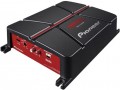 | 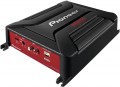 |
|---|---|---|
| Pioneer GM-A3702 | Pioneer GM-A3602 | |
from $111.51 | from $79.80 up to $90.82 | |
| User reviews | ||
| TOP sellers | ||
| Class | A/B | A/B |
| Number of channels | 2 | 2 |
Specs | ||
| Channel power (@2-ohms) | 95 W | 90 W |
| Channel power (@4-ohms) | 60 W | 60 W |
| Bridged connection (at 4 ohms) | 1 x 190 W | 180 W |
| Max. power | 500 W | 400 W |
| Frequency range | 10 – 70000 Hz | 10 – 70000 Hz |
| Signal-to-noise ratio | 95 dB | 95 dB |
| Functions | low pass filter (LPF) | low pass filter (LPF) |
General | ||
| Fuse rating | 25 А | 25 А |
| Dimensions | 246x180x60 mm | 238x180x60 mm |
| Weight | 1.4 kg | |
| Added to E-Catalog | october 2016 | february 2014 |


Compare Pioneer GM-A3702 and GM-A3602
You may be interested in
My comparisons
Pioneer GM-A3702 often compared


Pioneer GM-A3602 often compared

Glossary
Channel power (@2-ohms)
Rated power output by the amplifier per channel when a load (speakers) is connected to it with a nominal impedance of 2 ohms. For details, see "Nom. channel power (at 1 Ohm)”.
Bridged connection (at 4 ohms)
Rated power delivered by the amplifier to a load connected in a bridge circuit. For more information about the rated power, see "Nom. channel power (at 1 Ohm)”.
With a bridged connection, the speaker is connected not to one channel, but to two at the same time — the “positive” connector of one channel and the “negative” connector of the other are used. If the amplifier has a similar format of operation, then such a pair of channels operates in antiphase, due to which the power is summed up. This allows you to connect speakers to the amplifier, the power of which is twice the nominal power of the device: for example, at 150 watts per channel, 300 watts of acoustics can be bridged. If there are 4 or more channels, it becomes possible to use several speakers according to the "bridge" scheme. This is usually directly indicated in the specifications — for example, the entry "2x300 W" in the "Bridge connection" item means the ability to work with two speakers, each with 300 W.
The requirements for load resistance when connecting with a bridge are the same as for conventional; see "Maximum Resistance" for details.
With a bridged connection, the speaker is connected not to one channel, but to two at the same time — the “positive” connector of one channel and the “negative” connector of the other are used. If the amplifier has a similar format of operation, then such a pair of channels operates in antiphase, due to which the power is summed up. This allows you to connect speakers to the amplifier, the power of which is twice the nominal power of the device: for example, at 150 watts per channel, 300 watts of acoustics can be bridged. If there are 4 or more channels, it becomes possible to use several speakers according to the "bridge" scheme. This is usually directly indicated in the specifications — for example, the entry "2x300 W" in the "Bridge connection" item means the ability to work with two speakers, each with 300 W.
The requirements for load resistance when connecting with a bridge are the same as for conventional; see "Maximum Resistance" for details.
Max. power
The highest output power provided by the amplifier. It is worth noting that this indicator is not standardized, and different manufacturers may mean different values \u200b\u200bfor it — for example, the highest power of short-term, in a fraction of a second, peaks (power surges), the highest power that the amplifier can transfer for several seconds, or even the power at which the device will fail. Therefore, it makes no sense to compare different models with each other in terms of maximum power. But when choosing acoustics for an amplifier (or vice versa), this parameter can be very useful: it is desirable that the maximum power of the speaker be at least twice as high as that of the amplifier. This will reduce the risk that a power surge will damage the speakers.