
Comparison Ninja Double Stack XL 2-Level Air Fryer SL451 vs Ninja Double Stack XL Air Fryer SL400
Add to comparison | 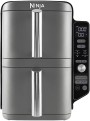 | 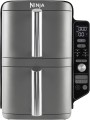 |
|---|---|---|
| Ninja Double Stack XL 2-Level Air Fryer SL451 | Ninja Double Stack XL Air Fryer SL400 | |
| Compare prices 3 | from $359.61 | |
| TOP sellers | ||
Two separate compartments with independent temperature control. Large total capacity of 9.5 L (2.8 kg). Drying mode. Thermo-probe included. Heavy weight 12.2 kg. | The SL400 model has a Max Crisp program, the SL401 model has an Air Broil program. | |
| Type | air fryer-multi-oven | air fryer-multi-oven |
| Power | 2470 W | 2470 W |
| Number of programs | 6 | 6 |
| Modes | frying baking dehydration reheating | frying baking dehydration reheating |
Specs | ||
| A heating element | 2 electric (TEN) | 2 electric (TEN) |
| cooking t | 40 – 240 °С | 40 – 240 °С |
| Basket capacity | 2.8 kg | 2.8 kg |
| Volume | 9.5 L | 9.5 L |
| Features | 2 separate compartments non-stick coating | 2 separate compartments non-stick coating |
General | ||
| Control | push-button | control knob + touch controls |
| Cable length | 0.8 m | 0.8 m |
| Material | plastic | plastic |
| Dimensions (HxWxD) | 385x280x470 mm | 385x280x470 mm |
| Weight | 12.2 kg | 10.3 kg |
| Color | ||
| Added to E-Catalog | january 2025 | october 2024 |





Compare Ninja Double Stack XL 2-Level Air Fryer SL451 and Double Stack XL Air Fryer SL400
Both multi-ovens, Ninja SL451EU and Ninja SL400EU, have 6 programs and operate in modes of frying, baking, drying, and reheating. Their capacity is 9.5 L, and the cooking temperature ranges from 40 to 240 °C. However, the SL451EU is slightly heavier, weighing 12.2 kg, while the SL400EU weighs 10.3 kg. Both devices feature a non-stick coating and a power consumption of 2470 W. There is a difference in basket capacity: the SL400EU can accommodate up to 2.8 kg (with 1.4 kg in each basket), whereas the SL451EU does not provide this information.
You may be interested in
Ninja Double Stack XL 2-Level Air Fryer SL451 often compared


Ninja Double Stack XL Air Fryer SL400 often compared


Glossary
Control
— Rotary switch. Control carried out by mechanical elements directly connected to the corresponding components of the device. The traditional, most popular option provides two rotary knobs: a thermostat and an off timer with a clock mechanism (see “Functions”). The main advantages of this type of control are simplicity and low cost. At the same time, the capabilities of the “mechanics”, although modest, are quite sufficient to control all key functions. Among the clear disadvantages compared to electronic control, it is worth noting less accuracy.
- Push-button. Push-button control is based on electronic circuits. Such systems are more accurate than mechanical ones; more capabilities and modes are provided. On the other hand, such control is more complex and more expensive than mechanical control.
- Touch. A type of electronic control with touch switches. Compared to push-button models, it provides a high level of comfort in operation, and looks more modern and aesthetically pleasing. Touch control is found mainly in top models of juicers.
— Rotary switch with sensor. Another type of electronic control, where the main control is a rotary switch, which is complemented by touch buttons. The switch itself simplifies the selection of modes, temperature, timer time, and the sens...ors are secondary. However, the control panel itself looks stylish and is not inferior in design to models with touch controls only.
- Push-button. Push-button control is based on electronic circuits. Such systems are more accurate than mechanical ones; more capabilities and modes are provided. On the other hand, such control is more complex and more expensive than mechanical control.
- Touch. A type of electronic control with touch switches. Compared to push-button models, it provides a high level of comfort in operation, and looks more modern and aesthetically pleasing. Touch control is found mainly in top models of juicers.
— Rotary switch with sensor. Another type of electronic control, where the main control is a rotary switch, which is complemented by touch buttons. The switch itself simplifies the selection of modes, temperature, timer time, and the sens...ors are secondary. However, the control panel itself looks stylish and is not inferior in design to models with touch controls only.