
Comparison Hoco CS27A Supply vs XO L128
Add to comparison | 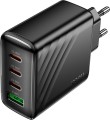 | 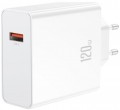 |
|---|---|---|
| Hoco CS27A Supply | XO L128 | |
| Outdated Product | Outdated Product | |
| User reviews | ||
| TOP sellers | ||
| Type | mains charger | mains charger |
| USB-A ports | 1 pcs | 1 pcs |
| USB-C ports | 3 pcs | |
| Max. power (USB) | 67 W | 120 W |
| Fast charge | Quick Charge 3.0 Power Delivery 3.0 | Quick Charge 3.0 Power Delivery 3.0 |
| Cable included | USB C - USB C | USB - USB C |
| Cable length | 1 m | 1 m |
| Material | plastic | plastic |
| Dimensions | 59x54x28 mm | |
| Color | ||
| Added to E-Catalog | january 2025 | april 2024 |


Compare Hoco CS27A Supply and XO L128
You may be interested in
XO L128 often compared

Glossary
USB-C ports
The number of USB-C ports provided in the design of the charger.
USB-C is a relatively new type of connector; it is slightly larger than microUSB and features a reversible design that allows you to insert the plug either way. Despite its compact size, these charging ports can offer quite advanced capabilities — particularly high power delivery and various quick charging technologies. On the other hand, in gadget chargers, this type of port is noticeably less common than full-sized USB (USB-A) ports and comes in smaller quantities — one, rarely two, and as a rarity three USB-C ports. This is because detachable cables typically rely on standard USB ports, which are easier to use with removable cables, and installing such ports in a charger (even a compact one) is not difficult. Therefore, in practice, it only makes sense to specifically look for a device with USB-C if you already have a compatible cable (or a gadget with a suitable plug).
USB-C is a relatively new type of connector; it is slightly larger than microUSB and features a reversible design that allows you to insert the plug either way. Despite its compact size, these charging ports can offer quite advanced capabilities — particularly high power delivery and various quick charging technologies. On the other hand, in gadget chargers, this type of port is noticeably less common than full-sized USB (USB-A) ports and comes in smaller quantities — one, rarely two, and as a rarity three USB-C ports. This is because detachable cables typically rely on standard USB ports, which are easier to use with removable cables, and installing such ports in a charger (even a compact one) is not difficult. Therefore, in practice, it only makes sense to specifically look for a device with USB-C if you already have a compatible cable (or a gadget with a suitable plug).
Max. power (USB)
The maximum energy level that the charger can deliver to a specific port. This parameter determines the charging speed of the gadget and the ability to power high-demand devices, such as laptops.
It's important to note that when using multiple ports simultaneously, the total power of the unit is often distributed among them, reducing the speed for each individual port. For example, a 65W adapter can deliver full power to a single laptop, but when a second smartphone is connected, it will share the resources, limiting the main port to, say, 45W. To achieve the stated maximum, it's necessary to use a quality cable, and the device being charged must support the corresponding charging power.
It's important to note that when using multiple ports simultaneously, the total power of the unit is often distributed among them, reducing the speed for each individual port. For example, a 65W adapter can deliver full power to a single laptop, but when a second smartphone is connected, it will share the resources, limiting the main port to, say, 45W. To achieve the stated maximum, it's necessary to use a quality cable, and the device being charged must support the corresponding charging power.
Cable included
The presence of a cable in the delivery kit of the charger, or any other specific type of included cable.
The presence of a cable is indicated mainly for wireless devices (see “Type”) — in such cases, we are talking about the power cable of the charger itself. For wired models, the type of connectors on the stock wire (s) for charging gadgets is usually specified. At the same time, the USB port is used by default to connect to the charger itself, so this plug may not be mentioned in the description of the wire. On the other hand, there may be such connectors:
— USB-C. A miniature version of the USB connector, gradually replacing microUSB in modern portable devices. It has a convenient reversible plug design, and can also provide some advanced power options not available with microUSB. Also note that USB-C can be used in a cable not only to connect to a gadget, but also to connect to the charger itself (along with traditional USB); so on the market you can find corresponding cables like "USB-C — microUSB", "USB-C — Lightning", etc.
— microUSB. Universal connector, extremely popular in portable gadgets of various types; only relatively recently has it begun to give way to the more advanced USB-C (which differs from it in its one-sided design and lower power supply).
— Lightning. Universal connector, used e...xclusively in portable Apple devices. Like USB-C, it has a two-way layout, but a slightly different design.
The presence of a cable is indicated mainly for wireless devices (see “Type”) — in such cases, we are talking about the power cable of the charger itself. For wired models, the type of connectors on the stock wire (s) for charging gadgets is usually specified. At the same time, the USB port is used by default to connect to the charger itself, so this plug may not be mentioned in the description of the wire. On the other hand, there may be such connectors:
— USB-C. A miniature version of the USB connector, gradually replacing microUSB in modern portable devices. It has a convenient reversible plug design, and can also provide some advanced power options not available with microUSB. Also note that USB-C can be used in a cable not only to connect to a gadget, but also to connect to the charger itself (along with traditional USB); so on the market you can find corresponding cables like "USB-C — microUSB", "USB-C — Lightning", etc.
— microUSB. Universal connector, extremely popular in portable gadgets of various types; only relatively recently has it begun to give way to the more advanced USB-C (which differs from it in its one-sided design and lower power supply).
— Lightning. Universal connector, used e...xclusively in portable Apple devices. Like USB-C, it has a two-way layout, but a slightly different design.