
Comparison Pioneer TS-G1730F vs Pioneer TS-E1396
Add to comparison | 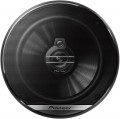 |  |
|---|---|---|
| Pioneer TS-G1730F | Pioneer TS-E1396 | |
from $42.63 | from $38.00 | |
| User reviews | ||
| TOP sellers | ||
| Application area | car | car |
| Type | coaxial | coaxial |
| Size | 6.5" (16.5 cm) | 5.25" (13 cm) |
| Number of bands | 3 | 3 |
Specs | ||
| Rated power | 40 W | 40 W |
| Max. power | 300 W | 160 W |
| Frequency range | 36 – 18000 Hz | 40—32000 Hz |
| Impedance | 4 Ohm | 4 Ohm |
| Sensitivity | 90 dB | 90 dB |
Size | ||
| Tweeter size | 10 mm | 10 mm |
| Midrange speaker diameter | 25 mm | |
| Woofer size | 165 mm | 130 mm |
| Mounting depth | 50 mm | |
| Added to E-Catalog | november 2017 | may 2013 |


Compare Pioneer TS-G1730F and TS-E1396
You may be interested in
My comparisons
Pioneer TS-G1730F often compared


Glossary
Size
The size of the speakers of the acoustic system; in speakers with different driver sizes (component and coaxial, see "Type"), the size is determined by the diameter of the largest (woofer) driver. The size of the speaker determines primarily its ability to work with low frequencies. It is believed that acoustics up to 4 "is practically not suitable for low frequencies (regardless of the frequency range), 5-6" refers to the average level, and speakers of 6" or more even allow you to do without a subwoofer. Also, the size affects the installation options. So , some cars may provide seats for acoustics of a certain size — this limits the choice.And for large acoustics, there may not always be a place in cars with cramped interiors.
Max. power
The maximum power of a short-term (up to several seconds) incoming signal that the speaker can withstand without physical damage. Just like the nominal power, it matters for the selection of acoustics for an amplifier (or vice versa): it is believed that the maximum power of the speakers should be at least 2 times higher than the maximum power of the signal source.
Frequency range
The total audio frequency range reproduced by all speaker speakers.
Obviously, this range should not be too narrow, so that the acoustics do not cut off the lower and/or upper frequency limits of the reproduced sound. At the same time, the human ear perceives sound within 16 Hz - 22 kHz, and it simply does not make sense to provide speakers with a wider frequency range. We also recall that in mid-frequency acoustics and tweeters, reproducible frequencies are limited due to specialization (for more details, see "Type"). And the overall sound quality will depend not only on this indicator, but also on a number of other features.
Obviously, this range should not be too narrow, so that the acoustics do not cut off the lower and/or upper frequency limits of the reproduced sound. At the same time, the human ear perceives sound within 16 Hz - 22 kHz, and it simply does not make sense to provide speakers with a wider frequency range. We also recall that in mid-frequency acoustics and tweeters, reproducible frequencies are limited due to specialization (for more details, see "Type"). And the overall sound quality will depend not only on this indicator, but also on a number of other features.
Midrange speaker diameter
The diameter of the midrange speaker(s) provided in the speaker. Midrange in this case may also mean a combined woofer/midrange speaker or an emitter of broadband acoustics (see "Type").
The size of the midrange speaker is often a key parameter that determines the overall dimensions of the acoustics and, accordingly, the requirements for its installation location. Exceptions can only be found among models with separate woofers (see below). But from the point of view of acoustics, a larger size allows you to achieve higher power and richer sound, including on bass.
The size of the midrange speaker is often a key parameter that determines the overall dimensions of the acoustics and, accordingly, the requirements for its installation location. Exceptions can only be found among models with separate woofers (see below). But from the point of view of acoustics, a larger size allows you to achieve higher power and richer sound, including on bass.
Woofer size
Size of the low-frequency speaker(s) provided in the speaker system.
This size is specified only for models with separate bass speakers. In such acoustics, it is the LF emitter that is the largest (this is due to the physical characteristics of the bass range). Accordingly, the space occupied by the entire system is determined mainly by the diameter of the LF speaker. And since the power and richness of the bass also directly depends on the size of the emitter, then when choosing, you have to proceed from a compromise between the capabilities of the acoustics and the available space in the car.
This size is specified only for models with separate bass speakers. In such acoustics, it is the LF emitter that is the largest (this is due to the physical characteristics of the bass range). Accordingly, the space occupied by the entire system is determined mainly by the diameter of the LF speaker. And since the power and richness of the bass also directly depends on the size of the emitter, then when choosing, you have to proceed from a compromise between the capabilities of the acoustics and the available space in the car.
Mounting depth
The mounting depth of car audio is, in fact, the size of the speaker in depth. Note that for component sets (see "Type") this parameter is given for the largest speaker, and for case models it is generally irrelevant.
The mounting depth, along with the diameter of the speaker (see above), determines the amount of space needed to mount the speaker — in this case, how deep a niche would be required for normal mounting. At the same time, the larger the speaker, the larger, usually, the installation depth. And with similar diameters of equal size, a more powerful model is likely to be more “deep”.
The smallest amount of space — up to 15 mm deep — is required by some tweeters. A depth of 16 – 30mm is normal for tweeters and very shallow for general range speakers, most of these models have a depth of 30mm or more. At the same time, full-range speakers are usually "recessed" by less than 60 mm, component systems — by less than 90 mm, and more depth may be required only for some coaxial and mid-range models and, oddly enough, tweeters.
The mounting depth, along with the diameter of the speaker (see above), determines the amount of space needed to mount the speaker — in this case, how deep a niche would be required for normal mounting. At the same time, the larger the speaker, the larger, usually, the installation depth. And with similar diameters of equal size, a more powerful model is likely to be more “deep”.
The smallest amount of space — up to 15 mm deep — is required by some tweeters. A depth of 16 – 30mm is normal for tweeters and very shallow for general range speakers, most of these models have a depth of 30mm or more. At the same time, full-range speakers are usually "recessed" by less than 60 mm, component systems — by less than 90 mm, and more depth may be required only for some coaxial and mid-range models and, oddly enough, tweeters.