
Comparison ANENG Q1 vs Richmeters RM409B
Add to comparison | 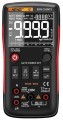 |  |
|---|---|---|
| ANENG Q1 | Richmeters RM409B | |
from $31.99 | Outdated Product | |
| TOP sellers | ||
| Product type | multimeter | multimeter |
| Type | digital | digital |
Measurement types | ||
| Measurements | voltage current resistance capacity temperature frequency duty cycle | voltage current resistance capacity temperature frequency duty cycle |
Specs | ||
| Current type | AC / DC | AC / DC |
| Voltage type | AC / DC | AC / DC |
| DC voltage minimum | 10 mV | 10 mV |
| DC voltage max. | 1000 В | 1000 В |
| Measurement accuracy (V⁻) | 0.5 % | |
| AC voltage minimum | 10 mV | 10 mV |
| AC voltage max. | 750 В | 750 В |
| DC max. | 10 А | 10 А |
| AC max. | 10 А | 10 А |
| Impedance minimum | 100 Ω | 100 Ω |
| Impedance max. | 100 MΩ | 100 MΩ |
| Display count | 9999 | 9999 |
| Display value | 4 | 4 |
Features | ||
| Functions | diode test continuity test mode NCV (non-contact voltage) True RMS autoranging auto power off | diode test continuity test mode NCV (non-contact voltage) True RMS autoranging auto power off |
| In box | test probes case (bag) | test probes case (bag) |
General | ||
| Display backlight |  | |
| Stand | | |
| Power source | battery | battery |
| Battery type | 2xAA | 2xAA |
| Dimensions | 145x72x33 mm | 146x74x34 mm |
| Weight | 171 g | 125 g |
| Added to E-Catalog | july 2023 | september 2022 |


Compare ANENG Q1 and Richmeters RM409B
You may be interested in
My comparisons
ANENG Q1 often compared


Richmeters RM409B often compared

Glossary
Measurement accuracy (V⁻)
Measurement accuracy provided by the instrument.
Measurement accuracy for multimeters is usually indicated by the smallest error (in percent) that the device is able to provide when measuring direct current. The smaller the number in this paragraph, the higher the accuracy, respectively. At the same time, we emphasize that it is the smallest error (the highest accuracy) that is usually achieved only in a certain measurement range; in other ranges, the accuracy may be lower. For example, if in the range "1 — 10 V" the device gives a maximum deviation of 0.5%, and in the range "10 — 50 V" — 1%, then 0.5% will be indicated in the characteristics. Nevertheless, according to this indicator, it is quite possible to evaluate and compare modern multimeters. So, a device with a lower claimed error, usually, and in general will be more accurate than a model with a similar performance with a larger error.
Data on measurement accuracy in other ranges and modes can be given in the detailed characteristics of the device. However, in fact, this information is required not so often — only for certain specific tasks, where it is fundamentally necessary to know the possible error.
Measurement accuracy for multimeters is usually indicated by the smallest error (in percent) that the device is able to provide when measuring direct current. The smaller the number in this paragraph, the higher the accuracy, respectively. At the same time, we emphasize that it is the smallest error (the highest accuracy) that is usually achieved only in a certain measurement range; in other ranges, the accuracy may be lower. For example, if in the range "1 — 10 V" the device gives a maximum deviation of 0.5%, and in the range "10 — 50 V" — 1%, then 0.5% will be indicated in the characteristics. Nevertheless, according to this indicator, it is quite possible to evaluate and compare modern multimeters. So, a device with a lower claimed error, usually, and in general will be more accurate than a model with a similar performance with a larger error.
Data on measurement accuracy in other ranges and modes can be given in the detailed characteristics of the device. However, in fact, this information is required not so often — only for certain specific tasks, where it is fundamentally necessary to know the possible error.