
Comparison Yamaha MODX7+ vs Yamaha MODX7
Add to comparison | 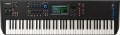 | 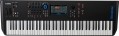 |
|---|---|---|
| Yamaha MODX7+ | Yamaha MODX7 | |
from $1,799.99 | from $1,599.99 | |
| TOP sellers | ||
| Type | synthesizer (rompler) | synthesizer (rompler) |
Keys | ||
| Number of keys | 76 | 76 |
| Size | full size | full size |
| Mechanics | active | active |
| Rigidity | semi-weighted | semi-weighted |
Specs | ||
| Polyphony | 128 voices | 128 voices |
| Built-in timbres | 2227 шт | 2000 шт |
| Tempo change | 5 – 300 | 5 – 300 |
| Metronome |  | |
| Sequencer (recording) | | |
| Mixer | | |
| Built-in compositions | | |
Effects and control | ||
| Timbres layering | | |
| Keyboard split | | |
| Octave shift | | |
| Arpeggiator | | |
| Reverberation | | |
| Transposition | | |
| Pitch controller | | |
| Modulation controller | | |
| Fine tuning | | |
Connectors | ||
| Inputs | Jack (6.35 mm) MIDI in USB to device (type A) | Jack (6.35 mm) MIDI in USB to device (type A) |
| Connectable pedals | 4 шт | 4 шт |
| Outputs | USB to host (type B) MIDI out headphones | USB to host (type B) MIDI out headphones |
| Linear outputs | 2 | 2 |
In box | ||
| In box | PSU | PSU |
General | ||
| Display | colour | colour |
| Touch screen | | |
| Power consumption | 16 W | 16 W |
| Dimensions (WxHxD) | 1144x134x331 mm | 1144x134x331 mm |
| Weight | 7.4 kg | 7.4 kg |
| Color | ||
| Added to E-Catalog | march 2023 | june 2019 |


Compare Yamaha MODX7+ and MODX7
Comparing Yamaha MODX7+ and Yamaha MODX7, it can be noted that both synthesizers have 76 full-size keys with active mechanics and semi-weighted stiffness. However, the MODX7+ offers 2,227 built-in tones compared to 2,000 for the MODX7, which may be important for musicians looking for more sound variety. Both devices have the same polyphony of 128 voices and support keyboard split, arpeggiator, and reverb. Otherwise, their features and capabilities are similar, including a color display and touch screen.
You may be interested in
My comparisons
Glossary
Built-in timbres
The number of built-in sounds provided in the synthesizer.
The number of timbres is often described as the number of instruments that a given model can imitate. However, this is not entirely true — rather, this parameter can be called "the number of instruments and sound effects." For example, the same instrument — an electric guitar — with different "gadgets" (distortion, overdrive) will sound differently, and in the synthesizer each such gadget will be considered a separate timbre. The “drums” timbre usually combines different types of drums and other percussion instruments — in other words, it allows you to portray both the “bass drum” and the cymbals without switching settings, just by pressing the desired keys. And some timbres may not have analogues among real instruments at all.
The more built-in timbres, the more extensive the possibilities of the synthesizer, the more diverse the sounds that can be extracted from it. At the same time, in high-end models like workstations (see "Type"), this number can reach 1000 or even more.
The number of timbres is often described as the number of instruments that a given model can imitate. However, this is not entirely true — rather, this parameter can be called "the number of instruments and sound effects." For example, the same instrument — an electric guitar — with different "gadgets" (distortion, overdrive) will sound differently, and in the synthesizer each such gadget will be considered a separate timbre. The “drums” timbre usually combines different types of drums and other percussion instruments — in other words, it allows you to portray both the “bass drum” and the cymbals without switching settings, just by pressing the desired keys. And some timbres may not have analogues among real instruments at all.
The more built-in timbres, the more extensive the possibilities of the synthesizer, the more diverse the sounds that can be extracted from it. At the same time, in high-end models like workstations (see "Type"), this number can reach 1000 or even more.