
Comparison Haisser 40167 vs Haisser 40168
Add to comparison | 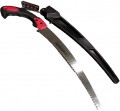 | 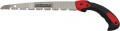 |
|---|---|---|
| Haisser 40167 | Haisser 40168 | |
| Outdated Product | Outdated Product | |
| User reviews | ||
| TOP sellers | ||
| Type | garden | garden |
| Suitable for | wood | wood |
Specs | ||
| Blade length | 330 mm | 270 mm |
| Number of teeth per inch (TPI) | 8 | 8 |
| Hardened teeth |  | |
| Tooth sharpening | trihedral | trihedral |
| Rakers |  | |
General | ||
| Handle material | plastic / rubber | plastic / rubber |
| Case included | | |
| Added to E-Catalog | march 2023 | march 2023 |


Compare Haisser 40167 and 40168
You may be interested in
My comparisons
Glossary
Blade length
The total length of the hacksaw blade.
The value of this parameter is directly related to the saw type (see above). The general rule for choosing is as follows: the blade should be twice as long as the thickness of the largest workpiece that is planned to be sawn. This will provide an optimal range of motion to avoid unnecessary fatigue, and the tool, on the other hand, will not be too bulky. However, a long blade tends to spring back, so when working with hardwoods or other difficult-to-cut materials, shorter saws can also be taken. And in models with interchangeable blades (beam and jigsaw, some mini-saws), length data will be required to search for spare blades.
In general, for simple household tasks for sawing wood, a length of 280 – 300 mm is considered optimal. For a private house with a garden, simple construction work, you should pay attention to larger models — up to half a metre. And the largest two-handed saws can have a length of 1000 mm and even more. More detailed recommendations on the optimal blade length for certain tasks can be found in special sources.
The value of this parameter is directly related to the saw type (see above). The general rule for choosing is as follows: the blade should be twice as long as the thickness of the largest workpiece that is planned to be sawn. This will provide an optimal range of motion to avoid unnecessary fatigue, and the tool, on the other hand, will not be too bulky. However, a long blade tends to spring back, so when working with hardwoods or other difficult-to-cut materials, shorter saws can also be taken. And in models with interchangeable blades (beam and jigsaw, some mini-saws), length data will be required to search for spare blades.
In general, for simple household tasks for sawing wood, a length of 280 – 300 mm is considered optimal. For a private house with a garden, simple construction work, you should pay attention to larger models — up to half a metre. And the largest two-handed saws can have a length of 1000 mm and even more. More detailed recommendations on the optimal blade length for certain tasks can be found in special sources.
Rakers
The presence of shearing teeth in the standard hacksaw blade (or at least one of the complete replacement blades).
Such teeth have a "two-horned" shape, with two tips pointing forward and backward; they are evenly distributed over the saw blade (for example, every 4 teeth for the fifth). The meaning of this function is to improve the efficiency of sawdust removal from the kerf; it is especially useful in damp wood, in which ordinary sheets tend to stick.
Such teeth have a "two-horned" shape, with two tips pointing forward and backward; they are evenly distributed over the saw blade (for example, every 4 teeth for the fifth). The meaning of this function is to improve the efficiency of sawdust removal from the kerf; it is especially useful in damp wood, in which ordinary sheets tend to stick.
Case included
The presence of a cover in the scope of delivery of a hacksaw.
The cover will be useful for storing and transporting the tool: it closes the saw almost entirely (there is usually only a handle outside), protecting the blade and frame (if any) from dirt, moisture and contact with foreign objects. The latter allows you to safely carry the saw in the same bag with other things. Regular covers, usually, are much more convenient than improvised devices (like a rag in which the canvas is wrapped), and are generally inexpensive.
The cover will be useful for storing and transporting the tool: it closes the saw almost entirely (there is usually only a handle outside), protecting the blade and frame (if any) from dirt, moisture and contact with foreign objects. The latter allows you to safely carry the saw in the same bag with other things. Regular covers, usually, are much more convenient than improvised devices (like a rag in which the canvas is wrapped), and are generally inexpensive.