
Comparison Liberton LFD-5524 vs Liberton LFD-5523
Add to comparison | 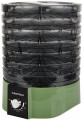 | 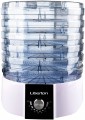 |
|---|---|---|
| Liberton LFD-5524 | Liberton LFD-5523 | |
| Expecting restock | Outdated Product | |
| TOP sellers | ||
| Type | vertical fruit dryer | vertical fruit dryer |
| Drying levels | 7 pcs | 7 pcs |
| Tray size | Ø320 mm | |
| Tray height | 50 mm | 50 mm |
| Total capacity | 21 L | 21 L |
| Power consumption | 520 W | 520 W |
Specs | ||
| Thermostat |  | |
| Pastila tray | 2 pcs | |
| Temperature range | 35 – 70 °C | 40 – 70 °C |
| Location of the fan (heater) | bottom | bottom |
| Control | control knob | control knob |
| Tray material | plastic | plastic |
| Dimensions | 335x320x310 mm | 335x320x310 mm |
| Weight | 3.2 kg | 3.2 kg |
| Added to E-Catalog | august 2021 | may 2021 |


Compare Liberton LFD-5524 and LFD-5523
You may be interested in
My comparisons
Liberton LFD-5523 often compared


Glossary
Tray size
Horizontal dimensions of one dryer tray.
For round models, this paragraph usually indicates the diameter (for example, “Ø250”), for other cases — the length and width. Anyway, the information about the size allows you to estimate the total area and, accordingly, the capacity of the device. At the same time, note that a larger size affects the dimensions and weight of the structure, and also requires more heating power (ceteris paribus).
For round models, this paragraph usually indicates the diameter (for example, “Ø250”), for other cases — the length and width. Anyway, the information about the size allows you to estimate the total area and, accordingly, the capacity of the device. At the same time, note that a larger size affects the dimensions and weight of the structure, and also requires more heating power (ceteris paribus).
Pastila tray
Availability of a tray for pastille in the dryer supply package.
Unlike regular trays, this device features a solid bottom without holes. This is because the primary raw material for making pastille is fruit puree, which simply wouldn't hold on a classic mesh bottom. Most often, there is one pastille tray included in the supply package, but in some models, the set may include more.
We emphasize that using such accessories for more traditional ingredients (pieces of vegetables, fruits, etc.) is undesirable: in some cases, it reduces the drying efficiency, in others, it may lead to spoilage of the contents.
Unlike regular trays, this device features a solid bottom without holes. This is because the primary raw material for making pastille is fruit puree, which simply wouldn't hold on a classic mesh bottom. Most often, there is one pastille tray included in the supply package, but in some models, the set may include more.
We emphasize that using such accessories for more traditional ingredients (pieces of vegetables, fruits, etc.) is undesirable: in some cases, it reduces the drying efficiency, in others, it may lead to spoilage of the contents.
Temperature range
The temperature range that the dryer can provide in the working chamber.
The simplest models provide only one operating temperature option, usually from 50 °C to 60 °C. More advanced devices equipped with thermostats (see above) and can have a wide range of adjustment — this is very useful, because different temperature regimes are recommended for different products. To assess the general capabilities of a particular dryer, you can use the following table of temperatures recommended for drying:
— 35...40 °C — plant stems, greens;
— 40...45 °C — bread;
— 38...42 °C (in some cases up to 45 °C) — yoghurt;
— 50...55 °C — vegetables;
— 55...60 °C — fruits;
— 65...75 °C — meat, fish.
We emphasize that these are the most general, conditional data. The specific temperature may differ from the recommended one — depending on the thickness of the slices, the specific type of food, the desired result, etc. Detailed recommendations on this matter can be found in special sources.
The simplest models provide only one operating temperature option, usually from 50 °C to 60 °C. More advanced devices equipped with thermostats (see above) and can have a wide range of adjustment — this is very useful, because different temperature regimes are recommended for different products. To assess the general capabilities of a particular dryer, you can use the following table of temperatures recommended for drying:
— 35...40 °C — plant stems, greens;
— 40...45 °C — bread;
— 38...42 °C (in some cases up to 45 °C) — yoghurt;
— 50...55 °C — vegetables;
— 55...60 °C — fruits;
— 65...75 °C — meat, fish.
We emphasize that these are the most general, conditional data. The specific temperature may differ from the recommended one — depending on the thickness of the slices, the specific type of food, the desired result, etc. Detailed recommendations on this matter can be found in special sources.