
Comparison Chieftec Core BBS-600S vs Aerocool Value Plus VX Plus 600W
Add to comparison | 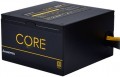 | 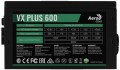 |
|---|---|---|
| Chieftec Core BBS-600S | Aerocool Value Plus VX Plus 600W | |
| Compare prices 1 | from $157.00 | |
| User reviews | ||
| TOP sellers | ||
One of the most affordable 80+ Gold PSUs on the market. Minimum ripple. No voltage drop. Low noise level. | ||
| Power | 600 W | 600 W |
| Form factor | ATX | ATX |
Specs | ||
| PFC | active | passive |
| Efficiency | 85 % | 82 % |
| Cooling system | active | active |
| Fan size | 120 mm | 120 mm |
| Fan bearing | sliding | sliding |
| Certification | 80+ Gold | without 80+ |
| ATX12V version | 2.3 | 2.3 |
Power connectors | ||
| MB/CPU power supply | 24+8 (4+4) pin | 24+8 (4+4) pin |
| SATA | 6 | 4 |
| MOLEX | 3 | 3 |
| PCIe 8pin (6+2) | 2 | 2 |
| Floppy |  | |
| Cable system | non-modular | non-modular |
| Braided wires | |  |
Cable length | ||
| MB | 650 mm | 500 mm |
| CPU | 650 mm | 550 mm |
| SATA | 500 mm | 300 mm |
| MOLEX | 500 mm | 450 mm |
| PCIe | 500 mm | 400 mm |
Max. power | ||
| +3.3V | 20 А | 20 А |
| +5V | 20 А | 17 А |
| +12V1 | 49 А | 46 А |
| -12V | 0.3 А | 0.3 А |
| +5Vsb | 2.5 А | 2.5 А |
| +12V | 558 W | 552 W |
| +3.3V +5V | 110 W | 120 W |
| -12V | 3.5 W | 3.6 W |
| +5Vsb | 12.5 W | 12.5 W |
General | ||
| Over voltage protection (OVP) | | |
| Over power protection (OPP) | | |
| Short circuit protection (SCP) | | |
| Manufacturer's warranty | 2 years | 2 years |
| Dimensions (HxWxD) | 87x150x140 mm | |
| Weight | 1.67 kg | |
| Added to E-Catalog | april 2019 | august 2018 |



Compare Chieftec Core and Aerocool Value Plus Chieftec BBS-600S и Aerocool VX Plus 600W?
Price comparison
You may be interested in
My comparisons
Chieftec Core often compared


Aerocool Value Plus often compared


Glossary
PFC
The type of power factor correction (PFC) provided in the power supply.
The power consumed by the PSU is divided into active and reactive; the first goes to perform useful work, the second does not produce such work and is dissipated in the form of heat. The power factor is the ratio of active power to the total power consumed; the closer it is to one, the more efficient the PSU.
PFC correction is applied to improve the power factor. It can be done passively or actively. The first option provides the presence of a coil (choke), which partly compensates for the operation of the reactive components of the PSU; such a correction is simple and inexpensive to implement, but not very effective. The active method, in turn, provides the presence of a specialized controller. It is more expensive, but the power factor in such PSUs can reach 0.95 or more; in addition, the device is more resistant to voltage drops.
In general, for use in a home or small office, passive correction is more than enough; active PSUs should be specifically looked for mainly in cases where we are talking about numerous computers connected to a powerful UPS.
The power consumed by the PSU is divided into active and reactive; the first goes to perform useful work, the second does not produce such work and is dissipated in the form of heat. The power factor is the ratio of active power to the total power consumed; the closer it is to one, the more efficient the PSU.
PFC correction is applied to improve the power factor. It can be done passively or actively. The first option provides the presence of a coil (choke), which partly compensates for the operation of the reactive components of the PSU; such a correction is simple and inexpensive to implement, but not very effective. The active method, in turn, provides the presence of a specialized controller. It is more expensive, but the power factor in such PSUs can reach 0.95 or more; in addition, the device is more resistant to voltage drops.
In general, for use in a home or small office, passive correction is more than enough; active PSUs should be specifically looked for mainly in cases where we are talking about numerous computers connected to a powerful UPS.
Efficiency
Efficiency, in this case — the ratio of the power of the power supply (see "Power") to its power consumption. The higher the efficiency, the more efficient the power supply, the less energy it consumes from the network at the same output power, and the cheaper it is to operate. Efficiency may differ depending on the load; the characteristics can indicate both the minimum efficiency and its value at an average load (50%).
It should be noted that compliance with one or another level of 80PLUS efficiency directly depends on this indicator (for more details, see "Certificate").
It should be noted that compliance with one or another level of 80PLUS efficiency directly depends on this indicator (for more details, see "Certificate").
Certification
The presence or absence of an 80+ certificate for the power supply. This certificate indicates high energy efficiency: to obtain it, the efficiency (see above) must be at least 80%, and in different modes (20%, 50% and 100% of the maximum load). There are several degrees of 80+:
— 80+. The original version of the certificate, assuming an efficiency of at least 82% (at least 85% for 50% load).
— 80+ White. The second name of the original 80+ certificate (see above).
— 80+ Bronze — efficiency not less than 85% (for half load — 88%).
— 80+ Silver — respectively 87% (90% for half load).
— 80+ Gold — 89% (92% for half load)
— 80+ Platinum — 90% (94% for half load).
— 80+ Titanium — 94% (96% for half load).
The power factor (see "PFC Type") must be at least 0.9 for the lower levels and at least 0.95 for the Platinum level. Also note that for redundant power used in server systems, the efficiency requirements are somewhat lower.
— 80+. The original version of the certificate, assuming an efficiency of at least 82% (at least 85% for 50% load).
— 80+ White. The second name of the original 80+ certificate (see above).
— 80+ Bronze — efficiency not less than 85% (for half load — 88%).
— 80+ Silver — respectively 87% (90% for half load).
— 80+ Gold — 89% (92% for half load)
— 80+ Platinum — 90% (94% for half load).
— 80+ Titanium — 94% (96% for half load).
The power factor (see "PFC Type") must be at least 0.9 for the lower levels and at least 0.95 for the Platinum level. Also note that for redundant power used in server systems, the efficiency requirements are somewhat lower.
SATA
The number of SATA power connectors provided in the PSU.
Nowadays, SATA is the standard interface for connecting internal hard drives, and it is also found in other types of drives (SSD, SSHD, etc.). Such an interface consists of a data connector connected to the motherboard, and a power connector connected to the PSU. Accordingly, in this paragraph we are talking about the number of SATA power plugs provided in the PSU. This number corresponds to the number of SATA drives that can be simultaneously powered from this model.
Nowadays, SATA is the standard interface for connecting internal hard drives, and it is also found in other types of drives (SSD, SSHD, etc.). Such an interface consists of a data connector connected to the motherboard, and a power connector connected to the PSU. Accordingly, in this paragraph we are talking about the number of SATA power plugs provided in the PSU. This number corresponds to the number of SATA drives that can be simultaneously powered from this model.
Braided wires
The presence of a braid in the complete wires of the system unit — for all or at least for some.
This feature has a positive effect on reliability, making the wire as resistant as possible to bending, abrasion, strong pressure and other similar influences; it also provides additional protection against accidental contact with sharp objects (for example, when repairing a PC). The disadvantages of braided wires, in addition to increased cost, are also increased thickness and greater rigidity than similar cables in conventional insulation. This can create some difficulties in organizing space inside the system unit.
This feature has a positive effect on reliability, making the wire as resistant as possible to bending, abrasion, strong pressure and other similar influences; it also provides additional protection against accidental contact with sharp objects (for example, when repairing a PC). The disadvantages of braided wires, in addition to increased cost, are also increased thickness and greater rigidity than similar cables in conventional insulation. This can create some difficulties in organizing space inside the system unit.
+5V
The maximum current that the PSU is capable of issuing + 5V to the power line. For more information about power lines in general, see "+3.3V". Also note here that + 5V power, in addition to connectors for motherboards (for 20 and 24 pins), is also found in Molex and SATA plugs, as well as some other specific types of connectors.
+12V1
The maximum current the PSU can deliver on the first +12V power line.
For more information on power lines in general, see the "+3.3V" section. Here, it is worth mentioning that 12V is the most popular voltage among computer power connectors. It is used in almost all such connectors (with few exceptions), and some plugs (for example, additional PCI-E power with 6 or 8 connectors) use only 12-volt lines — specifically in the +12V format. The division of +12V power into several separate lines is done for safety reasons — to reduce the current going through each individual wire and thus prevent excessive load and overheating of the wiring. However, some manufacturers do not specify the maximum current for individual +12V lines and provide only the overall value in the specifications; in such cases, this number is indicated in this section.
For more information on power lines in general, see the "+3.3V" section. Here, it is worth mentioning that 12V is the most popular voltage among computer power connectors. It is used in almost all such connectors (with few exceptions), and some plugs (for example, additional PCI-E power with 6 or 8 connectors) use only 12-volt lines — specifically in the +12V format. The division of +12V power into several separate lines is done for safety reasons — to reduce the current going through each individual wire and thus prevent excessive load and overheating of the wiring. However, some manufacturers do not specify the maximum current for individual +12V lines and provide only the overall value in the specifications; in such cases, this number is indicated in this section.
+12V
The maximum power that the PSU can deliver to the +12V power rail.
For more details on power rails in general, see "Maximum current and power." Here, it should be noted that 12V is the most popular voltage among computer power connectors. It is used in nearly all such connectors (with few exceptions), and some plugs (such as the additional PCI-E power for 6 or 8 connectors) use only 12-volt rails, specifically in the +12V format. Therefore, this indicator is one of the most important characteristics of any PSU.
It is worth noting that many PSUs have multiple separate +12V power rails. In such cases, the total power is indicated here, which is usually divided equally among the rails.
For more details on power rails in general, see "Maximum current and power." Here, it should be noted that 12V is the most popular voltage among computer power connectors. It is used in nearly all such connectors (with few exceptions), and some plugs (such as the additional PCI-E power for 6 or 8 connectors) use only 12-volt rails, specifically in the +12V format. Therefore, this indicator is one of the most important characteristics of any PSU.
It is worth noting that many PSUs have multiple separate +12V power rails. In such cases, the total power is indicated here, which is usually divided equally among the rails.
+3.3V +5V
The maximum power that the PSU is capable of delivering on the + 3.3V and + 5V power lines.
See "Maximum current and power" for details on power lines in general. Here we note that the power lines + 3.3V and + 5V are used both in the general connector for the motherboard (for 20 or 24 pins), and in specialized plugs — in particular, the SATA power connector (both) and Molex (only +5V, in addition to +12V). The power of these lines is a rather specific parameter, rarely required in fact; it is usually the same for both voltages, so it is indicated in the general clause.
See "Maximum current and power" for details on power lines in general. Here we note that the power lines + 3.3V and + 5V are used both in the general connector for the motherboard (for 20 or 24 pins), and in specialized plugs — in particular, the SATA power connector (both) and Molex (only +5V, in addition to +12V). The power of these lines is a rather specific parameter, rarely required in fact; it is usually the same for both voltages, so it is indicated in the general clause.